 part 1. |
Biunial and triunial
magic lanterns double mahogany and brass lanterns |
|
A biunial lantern is a form of double lantern in which the two systems are placed one over the other. They were manufactured by many companies during the last thirty years of the nineteenth century. Genuine biunials are quite rare nowadays. They are much sought after by collectors and by every self-respecting modern lanternist who wants the use of sophisticated effects in his shows. The lanterns were produced so that the picture from one slide could dissolve while another appeared. For that purpose various dissolving techniques were developed and employed. (See also: Dissolving views) The arrangement one unit on top of the other only became possible with the adoption of limelight. In those days the control of the illuminant was a tricky business. The light had to be turned up to its full height in one lantern before that in the other began to diminish. This difficulty was overcome by the use of dissolving taps, the commonest form of this gadget being the 'Star dissolver'. 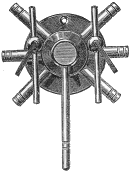 Star six-way dissolver, 1888. |
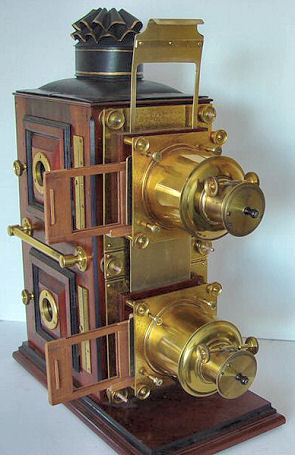 |
Typical British style lantern (unsigned) from the
penultimate turn of the century. The mahogany body is fitted with four
heavy panelled doors The interior is metal lined,
each with a porthole style brass framed ruby glass window. There are
hinged, brass vertical ventilation slots beside the doors, to let out excess
heat, and the double fluted chimney has black paintwork and gilding. The heavy brass frontage is equipped with 6" lenses using a rack and pinion system to focus. Dimensions: height 25" (63.5 cm), length 20 1/2" (52 cm) (lenses pushed in) or 24" (61 cm) (fully extended). Base 19" x 10" (48 x 25,5 cm). |
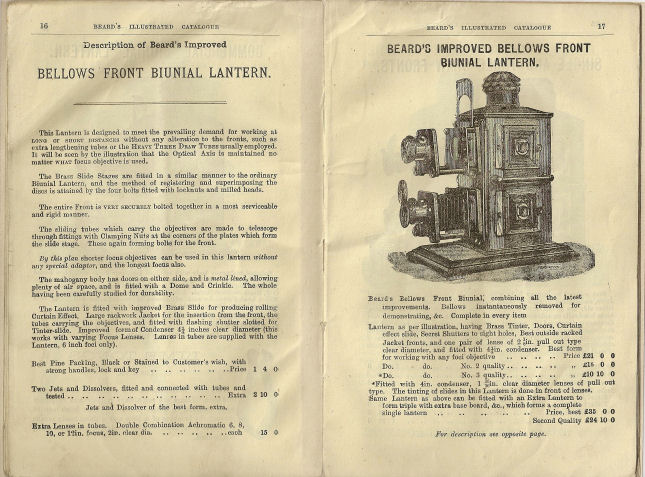 Early 1900s Beard's illustrated catalogue. Besides the optical system with bellows there is a strong resemblance to the biunial above. |
||
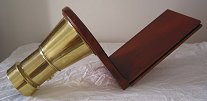 |
Very nice biunial magic lantern, perhaps made by one John F. Hand (difficult to read the name). Black velvet curtain at the back, hanging from a bended brass rod. The brass lenses from Darlot, Paris, are mounted on an extending wooden lens holder. Size 26 x 26 x 12 inches (66 x 66 x 30.5 cm). |
|
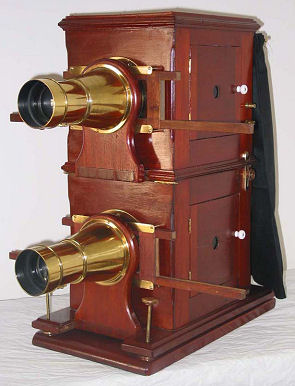
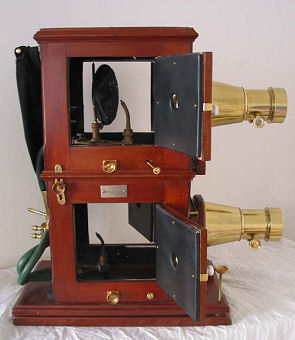
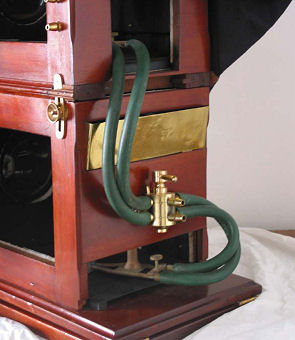 |
||
|
A magnificent mahogany and brass biunial Magic Lantern fitted with two limelights and
a 'Star' gas dissolver. The body has four panelled doors with ebony moulding, dark blue viewing glasses with brass surrounds, brass hinges and brass knobs. At each side is a solid brass carrying handle. The brass lenses have a rack and pinion focussing and are equipped with covers. The lens panel is marked 'Optimus' and has a brass rack and pinion operated dissolver, finished with a mahogany handle at the top. This lantern was made in the late 19th century and has a plaque with the name of the dealer 'R. Asquith, Leeds' at the front of the base board. The polish is matt. |
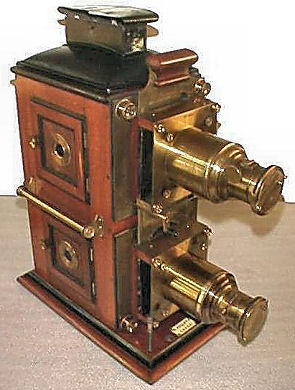 |
|
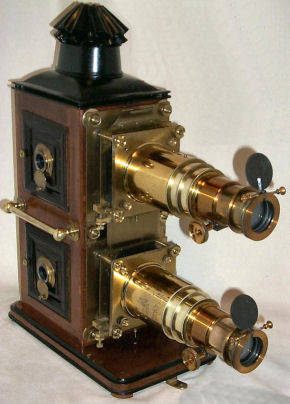
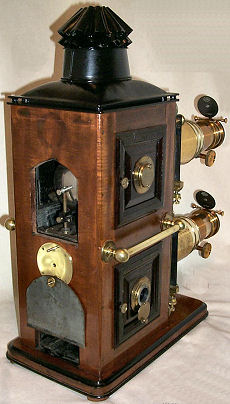
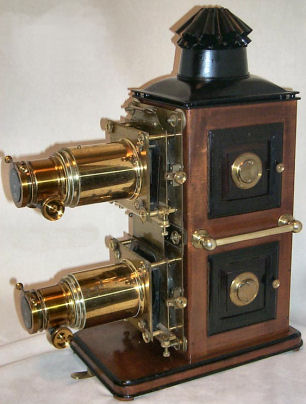
This is an exceptionally fine
brass and mahogany biunial, made by J. Wrench, London, circa 1890. It has
the Wrench's  Trademark on the brass lens carrier, and also
on both of the two identical 8.5" projection lenses. This very sturdy
and heavily constructed instrument rests on a baseboard measuring about 16" by
9.5" (41 x 24 cm), and is about 25.5" (65 cm) in total height
(about 19" (48 cm) without its chimney). Included on the sides are two solid brass carrying handles, the width of the biunial
being about 11" at this point. The total length of the biunial can be from about 21.5" to
29" (54.5 to 74 cm), depending upon the extension
of the lenses.
Trademark on the brass lens carrier, and also
on both of the two identical 8.5" projection lenses. This very sturdy
and heavily constructed instrument rests on a baseboard measuring about 16" by
9.5" (41 x 24 cm), and is about 25.5" (65 cm) in total height
(about 19" (48 cm) without its chimney). Included on the sides are two solid brass carrying handles, the width of the biunial
being about 11" at this point. The total length of the biunial can be from about 21.5" to
29" (54.5 to 74 cm), depending upon the extension
of the lenses.This biunial features four beautiful doors which open to the illumination compartments and have a brass-bound circular blue glass window with a pivoting brass cap. The internal catches are operated by fluted brass knobs. And inside, the doors are protected from the heat of the light source by raised metal panels. |
||
 |
||
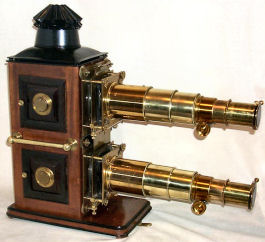 |
The lantern is fitted with two 8.5"
J. Wrench projection lenses, that each include three draw tubes as well as a rack
and pinion focus mechanism. The lens assemblies each measure about 8.5"
(21.5 cm) retracted (photo right above), and can reach about
17" (43 cm) when fully extended (photo left). The lens assemblies mount to a massive back plate, which is mounted to the wooden
body by a series of large fluted nuts. There are spring mounted, adjustable mechanisms on the back plate to receive
lantern slide holders, and there is a long vertical brass mask, which fits into a slot just behind the slide position,
and can block light coming either from one or from the other unit. |
|
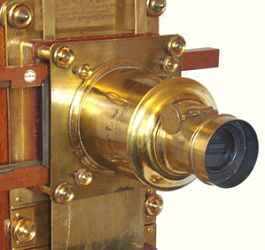 |
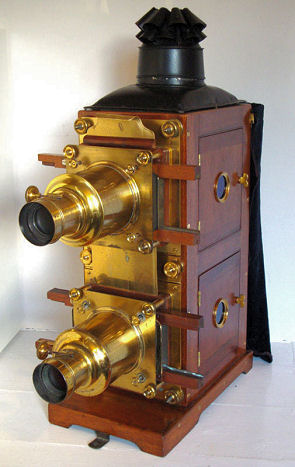
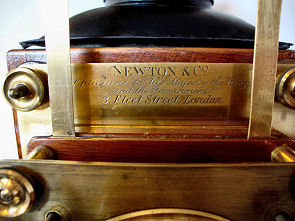 Newton & Co. A small plate on the side above the top door reads 'Newton & Co. Opticians to the Queen. 3 Fleet Street. London'. There is a something deviating inscription engraved in the brass plate above the top lens 'Newton & Co. Opticians to His Majesty the King'. Base measures 8.5" x 14.5" (c. 22 x 37 cm). Overall total height is 27.5" (70 cm). |
 |
| As you may have guessed, there were triple lanterns, or triunials, too. |
Right: Malden Trinopticon 1870s.
Depicted on a very old photograph (6 1/2 by 4 1/4 inches). |
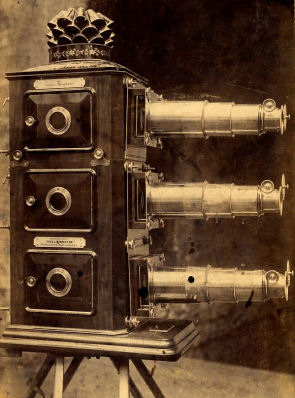 |
The Malden Trinopticon was one of the first
triunials, manufactured by James Henry Steward and also by Thomas.J. Middleton.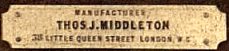 Middleton, the maker of the lantern on the photograph as a plate at the side indicates, was settled in London. Professor Benjamin Malden was an English lantern designer whose name and reputation were used by several manufacturers. |
||
 |
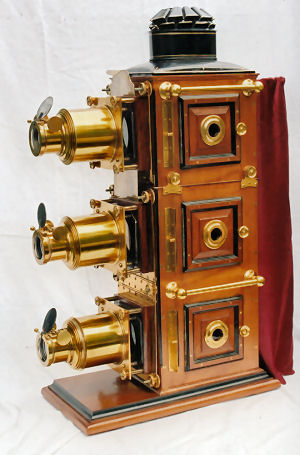 |
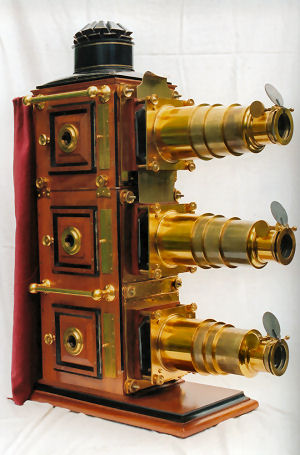
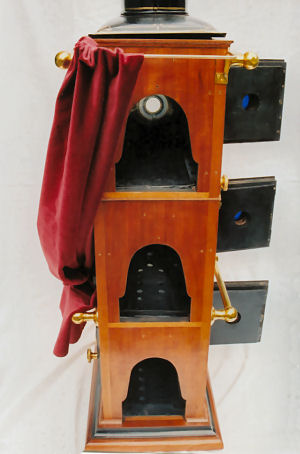
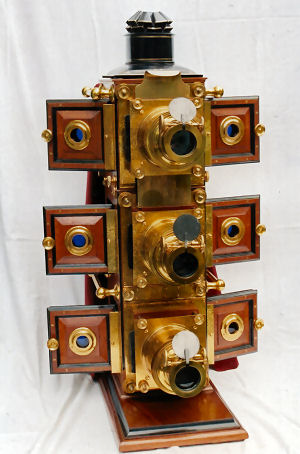
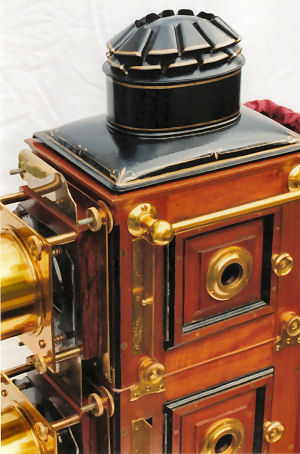
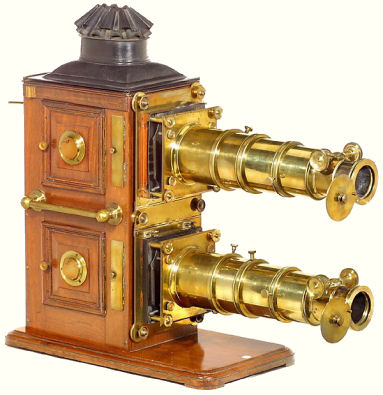
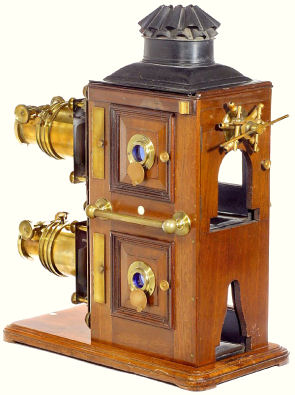
Superb Mahogany and Brass Triunial Magic Lantern with 7" lenses and a brass dissolver curtain. The lantern is divisible in two main sections; the top part can be removed by unscrewing four retaining nuts, to allow the operator to use the bottom section as a biunial lantern. Each lens has three telescopic sections within the outer tube and has a rack and pinion focusing on the front elements. Each one of the six doors is provided with a cobalt blue window surrounded with heavy brass portholes. The lacquered brass work at the front of the lantern is decorated with traditional 19th century style filigree detail. The interior of the lantern is lined with black metal with ventilation holes between each section. There is a red velvet curtain at the rear. |
| Height - 35 inches (89 cm), length (closed) - 20 inches (51 cm), width (including handles) - 12 inches (30.5 cm). | ||
 |
 |
 |
|
 |
|
|
Very attractive
long-focus biunial magic lantern, c. 1885, unmarked. Very decorative mahogany body with brass fittings.
Open back with brass 'star dissolver', dissolving gas taps for the control of
the illuminant. Measures 48 x 62 x 26 cm. |
||
 |
 |
|
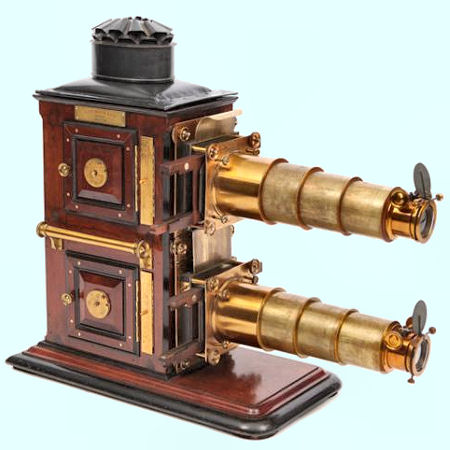
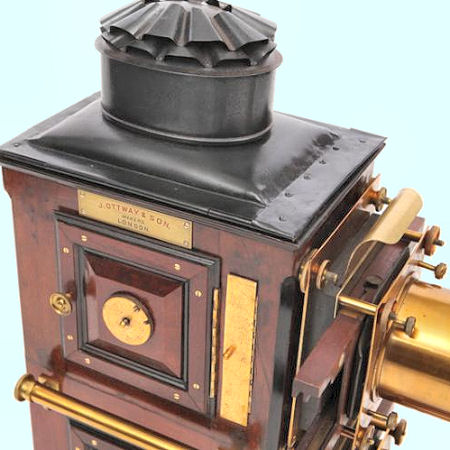
English biunial, c. 1890, signed to plaque at top 'J. Ottoway & Son, Makers, London'. Polished mahogany body with two panelled
doors to each side, black steel plate interior, two condenser lenses, 6"
projection lenses to front with rack and pinion focusing and flaps to
front, brass dissolving curtain behind lenses. Height 63 cm. |
|
|
More biunials........ |
|
 
 |
©1997-2021 'de Luikerwaal' All rights reserved. Last update: 02-07-2021. |


|