 |
 |
The (mostly) colourful labels on the
boxes and cases in which the magic lanterns were sold. (part 2: the others). |
| Many
well known toy manufacturers had their residence in
the German town of Nuremberg (Nürnberg). Among them were the brothers Ignaz
and Adolf Bing, Georg Carette, Max Dannhorn, Johann Falk, Jean Schoenner, Leonard Müller
and of course Ernst Plank. The pleasant, homey scenes which are pictured on their labels, could, unfortunately, never be beheld in reality. Due to the weak light sources in the magic lantern, the performances always had to take place in pitch-darkness. |
|
 |
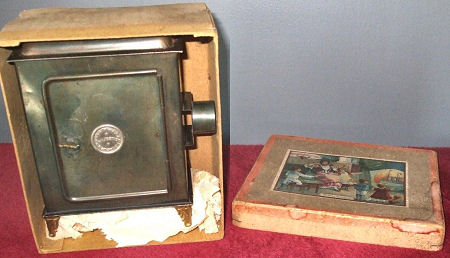 The lantern is 'Made in Germany'. No manufacturer's name or trademark at the label, but the magic lantern in the box has a small round shield with the trade name 'MAJESTIC'. |
 A label on the inside of this attractive box reveals the supplier of the lantern: a certain Adler. The label promises that the lantern is 'Kinderleicht einzustellen', and further 'Mit dieser Laterna Magica kann man bei 2 Meter Entfernung von der Wand bequem ein 80 ctm gross Bild produzieren' (A child can operate this lantern. At a distance of 2 m from the wall the projected image is 80 cm tall). |
|
 |
 |
|
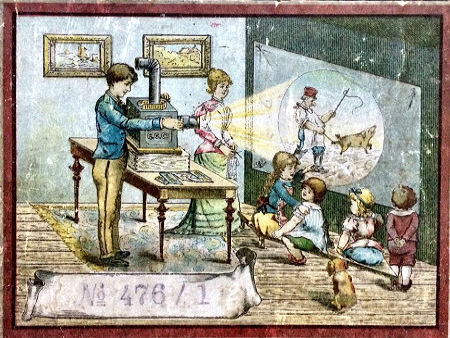
(Above) Probably one of the earliest labels of Georg Carette.
The directions for use stuck inside the wooden box reveal the trade mark G. C. & Co N.
The box measures approx. 9 inches wide by 7 inches deep and it stands 4 inches tall
(23 x 18 x 10 cm). |
 |
|
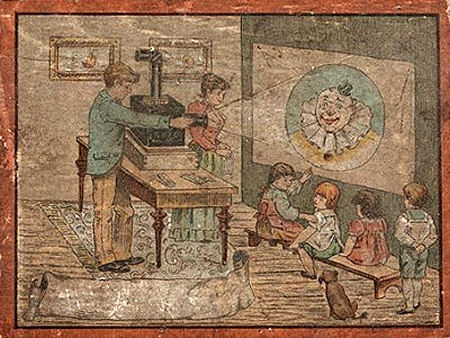
(Right) A slightly different Carette-label
on which the father shows the head of a clown on the screen. This label was
also stuck on the lid of a wooden box. |
|
 |
 |
| Georg
Carette was a French national who founded a company in 1886 in the German
town of Nuremberg. The firm produced, as one of
the first, besides magic lanterns also electric train sets. His lanterns are provided with a
trade mark containing the initials 'G.C.Co.N.' The firm was liquidated in 1908.
One of its most beautiful models was 'der Fabrik' (the Factory) (have a
look at: Very special magic lanterns) Just like the labels of other manufacturers, also Carette's labels were adjusted to the latest coiffures and fashion. Also see: A complete magic lantern set. |
|
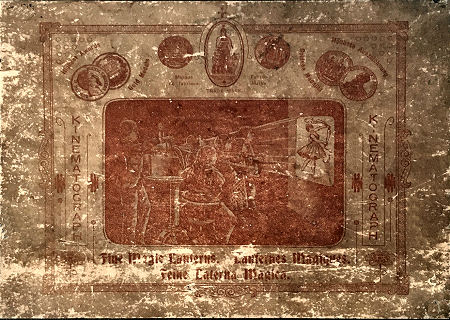 The business of the Bing brothers in Nuremberg was founded in 1860. At first it was described as 'G.B.N.- Bavaria', later on as 'G.B.N.' or 'B.W.' (Bing Werke). After World War I the company only used the indication 'B.W.'. |
  |
|
Bing also received many impressive prizes,
among them two medals at the World Fair in 1893 in Chicago, but other then
Plank and Schoenner (below) they were not always mentioned on the labels. In
1908 however they proudly called themselves 'die grösste Spielwarenfabrik der
Welt' (the greatest toy factory in the world). One of the most beautiful designs was the 'Bosco' from 1899 that could be used to project circular disc shaped slides. |
|
 |
 |
|
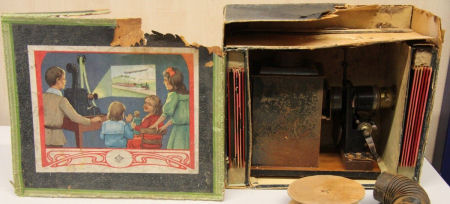
Probably this label of G.B.N. Bavaria is not often used. This label was
found on the heavy damaged card board box of a cinematograph. |
|
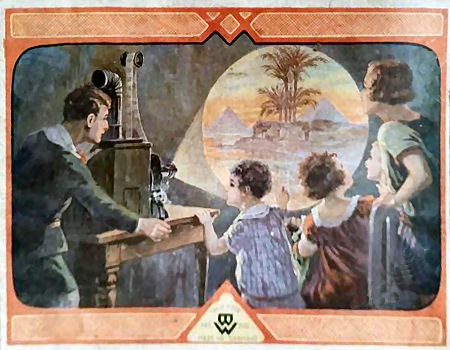 |
 Another Bing label, now with the trademark B.W., which has been used very rarely. The box with this label contained an episcope. |
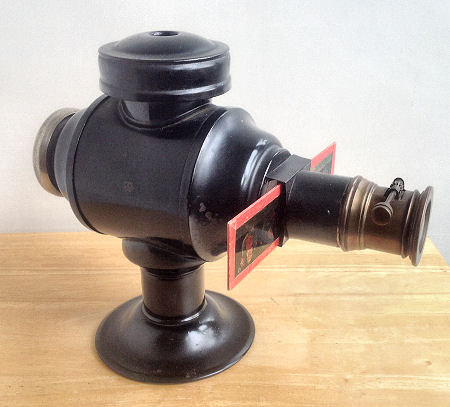 |
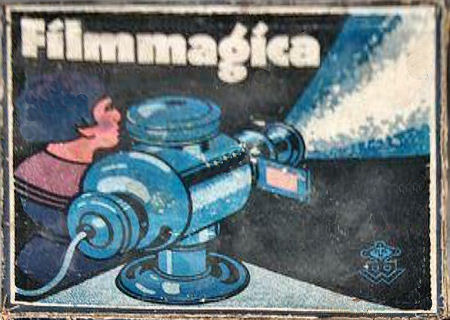 A special label specially made for the cardboard box of a striking magic lantern. The Film Magica made by Bing Werke, Nuremberg. |
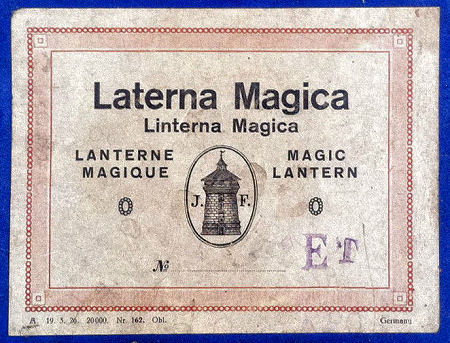
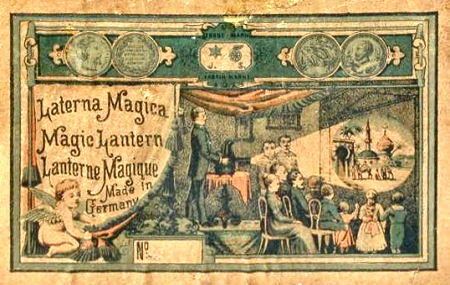 The firm Jean Schoenner was founded in 1875 in (again) Nuremberg. They principally produced mechanical-optical toys. Initially the trade mark was 'S.N.' and later on 'J.S.'. |
 The labels show, here too, some golden medals. |
 |
 |
|
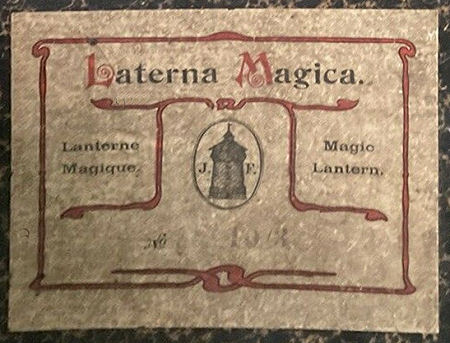
The labels on Johann Falk's boxes were less
illustrative than those of most of his colleague manufacturers. The
trademark shows a tower and the initials J.F. in an oval frame. |
|
 |
Neither
manufacturer nor origin of this cinematograph are known. Probably
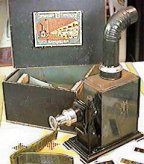
the lantern is from about 1900. (photo top of page). The
lantern is 8 1/2" tall, not counting the rod that holds the film; the base is 8 1/2" x 5".
Six films and a list of films that could be bought additionally are included. |
Because of
the many similarities this label could be from the same (unknown) manufacturer.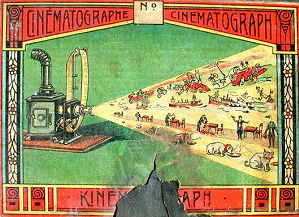 |
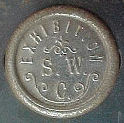
Though there is no trade mark existing on the matching magic lantern there is a strong resemblance to a cinematograph made by S.W.C. (see: Cinematographs part 2). |
 |
|
The
wooden case provided with this label contains a standing cylinder shaped
magic lantern which is able to project the normal rectangular slides as
well as round slides. The trade mark has two griffin style rearing lions
to each side of a top shaped escutcheon with the initials 'M.N.'
underneath. It's likely that the letter 'N' also stands for 'Nuremberg here,
as the lantern was made in Germany. |
 |
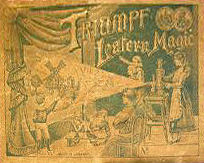
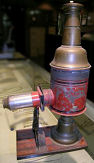
| A label
that looks like the label above at first sight, but has some important
differences. The trade name is spelled as Triumpf, ending with an 'F' and
Laterna Magica is spelled as 'Lantern Magic'. The trade mark is also
different. The young children left mothers lap and the girl uses a magic
lantern that more resembles the lantern in the box. |
 |
 |
This 'Triumph-Latern-Magic' label shows a couple of gnomes operating the magic lantern. A young boy and girl look on with amusement. This label also shows a trade mark with the capitals M.N. on it. The lantern was made in Germany by Michael Nüsslein. |
|
Another 'Triumpf label', this time in beautiful colors
and well spelled. Here too we see the city coat of arms of the German city
of Neuremberg with the initials M.N. The N most likely stands for Nuremberg,
but who or what is that M? The magic lantern strongly resembles a model by Ernst Plank. It is said that E.P. these Triumpf lanterns were made for the American market. |
 |
 |
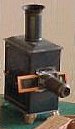 Label on the cover of a cardboard box, containing a magic lantern that
resembles the one the clown uses to show a picture of a proud cock, but is made of black Russian iron (and
is considerable smaller in relation to the clown). Manufacturer unknown.
Label on the cover of a cardboard box, containing a magic lantern that
resembles the one the clown uses to show a picture of a proud cock, but is made of black Russian iron (and
is considerable smaller in relation to the clown). Manufacturer unknown. |
|
This label decorates the box of a multicoloured
Lanterne Carree produced in the 1880's by E.V.L Paris or Edouard Virgile
Lapierre, son of Auguste Lapierre who started the firm. The box is 10 3/4" x 10" x 4" (27.5 cm x 25.5 cm x 10 cm).
|
 |
| More colourful labels...........
|
 
 |
©1997-2023 'de Luikerwaal' All rights reserved. Last update: 17-11-2023. |
  
|