 |
How to raise a Ghost part 1 |
|
From the dawning of history of the magic lantern there was a strong connection with death and everything that has to do with it. The story goes that one of the inventors, Athanasius Kircher, scared the living daylights out of irregular churchgoers by projecting images of the devil and the death on the paper windows of their simple houses. |
Phantoms and ghosts, churchyards and
skeletons were regular returning subjects during magic lantern shows. In October 1833 an illustrious apparition could be seen in Amsterdam, at the 'Oude Schans'. This phenomenon draw a good crowd every evening, until it turned out to be a trick. Probably some students, using a magic lantern, were responsible for the illusion. 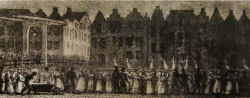 In 1834 Jacob van Oosterwijk Bruyn publiced a smal rhyme that the Amsterdam people sung for a long time: Al op de Oude Schans Daar is de Spokendans En aan de overzij Daar lopen de meisjes vrij. |
 |
|
|
THE GHOST !!
|
Source: The Magic Lantern. How to
buy and how to use it; also How to raise a Ghost, by 'a mere
Phantom'. London, Houlson and Wright 1870.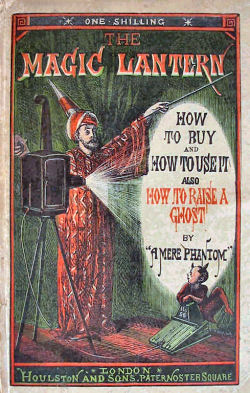
Dutch Translation: De Tooverlantaarn. De Wijze van samenstelling en gebruik, alsmede De Kunst om een Geest op te wekken, door een Spook. Amsterdam, C.L. Brinkman, 1873. 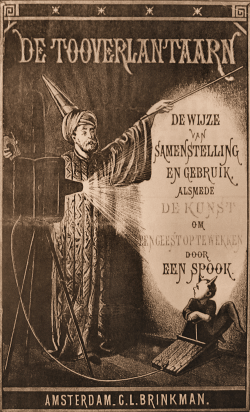
|
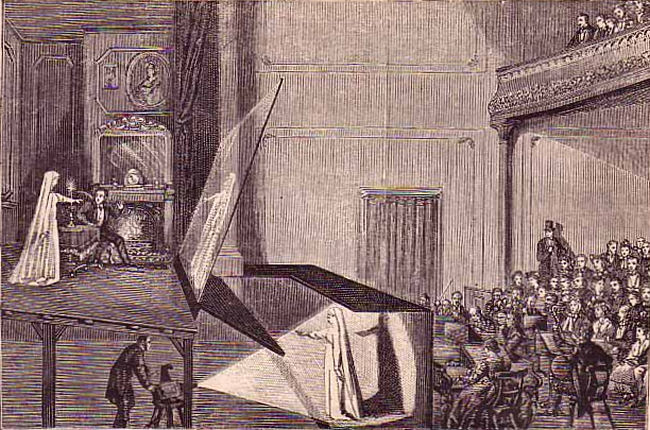
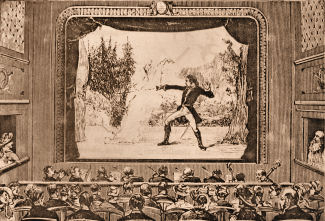 "coming like a, shadow, so departs." The real "woman in
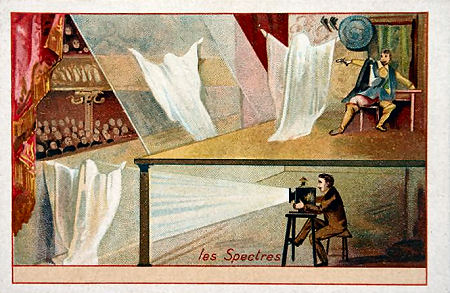
white" stands under the stage, concealed from the spectators by the
usual board near the orchestra; the Magic Lantern, illuminated by the
oxyhydrogen light, directs its beams full upon her figure, the reflection
of which appears as far behind the inclined plate of glass as the real
figure is in front. The living actor on the stage, notwithstanding his
expressive attitude of surprise, really sees nothing, and is simply
staring at a portion of space where he has been previously instructed
"the apparition comes," the spectators alone being so situated
that they "take false shadows for true substances."
"coming like a, shadow, so departs." The real "woman in
white" stands under the stage, concealed from the spectators by the
usual board near the orchestra; the Magic Lantern, illuminated by the
oxyhydrogen light, directs its beams full upon her figure, the reflection
of which appears as far behind the inclined plate of glass as the real
figure is in front. The living actor on the stage, notwithstanding his
expressive attitude of surprise, really sees nothing, and is simply
staring at a portion of space where he has been previously instructed
"the apparition comes," the spectators alone being so situated
that they "take false shadows for true substances."
De
Phantasmagoria van Robertson.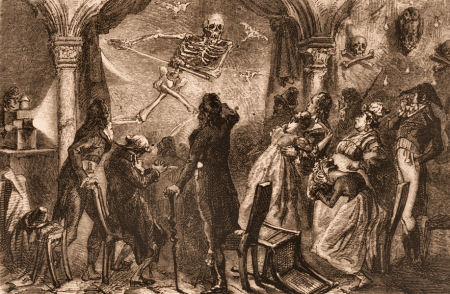 |
Étienne-Gaspard Robert was
fascinated by science from
a young age and studied physics at the Katholieke Universiteit Leuven,
becoming a professor specialising in optics. His work with optics would
later be extremely useful for his theatrical career, but in 1791 Robert
left Belgium and moved to Paris, intending to pursue a career as an
artist. After his move to France, Robert began developing the show that was to make him famous: the phantasmagoria. Robert took the basic technology of the magic lantern and applied his knowledge of optics to it so that the projected images could expand or shrink in size. Robert secured a patent for a magic lantern on wheels – the Fantascope – in 1799. Skilfully painted slides were used for the images of ghouls and phantoms. The use of smoke and mirrors helped to conceal the projectors, and Robert employed a cast of actors and ventriloquists to provide music, movement and voices to add to the spectacle. |
 |
 |
| Les Spectres (the Ghosts). French trade card, depicting the trick of the ghost illusion on stage, and advertising a chicory-product. | |
|
Another way......
|
|
 
|
©1997-2021 'de Luikerwaal' All rights reserved. Last update: 15-05-2021. |


|