 |
Lanternists
of today Annet Duller en Wim Bos. |
|
|
The Goois Museum, Hilversum, the Netherlands, on a Sunday-afternoon. A dark curtain screens the little room from daylight. On the long wooden benches and in some chairs the audience is seated. Boys, girls, but also elderly people. Their parents? Or grandfather and granny? Outside, in the street, a car is hooting. A boy is driving a noisy moped. A plane in the air leaves a white trail. A woman is animatedly talking in the mobile telephone at her ear. In the room of the museum the clock seems to be put back at least one century.
Since 1987 Annet has been busy in
organising Magic Lantern shows.
In the beginning Wim only accompanied her as a driver for transporting the lantern and accessories, but Annet decided that if ‘he had to participate anyway’, he might as well make himself useful during the performance. Very soon Wim was fully involved in the show and initially this caused some friction from time to time. ‘Wim is also constantly busy in a creative way.’ Annet says. ‘Sometimes he had different ideas about the presentation. Two captains on the same ship does not work. So we have made clear arrangements on the division of labour and now everything goes well.’
Five or six times a year Annet and Wim give shows in the Goois Museum. Besides this activity, there are also performances in other museums, homes for the elderly, and as club activities. One time they were asked for a performance at the birthday-party of a centenarian, to please the old man, his children, grand- and great-grandchildren, with nostalgic pictures from long ago. The family found a very original solution for the problem ‘what to give, goodness knows, to a centenarian?’ The shows in the Goois Museum usually have a theme, such as ‘Christmas’ or ‘fairy tales’. But sometimes the programme also includes more serious matters, e.g. death. Monks are seen striding in a long procession acros the screen, on their way to bury one of their brothers. Or a mourning family in the churchyard. All of a sudden the sky lightens, followed by the appearance of their mother in the shape of an angel. ‘Life, love, drama, war, death, birth…… these themes you will find again and again on the images,’ says Annet. ‘About one hundred and fifty years ago, such pictures caused people to faint in the audience. When the eruption of the Vesuvius was shown, the spectators left the room in a hurry, afraid as they were that the stream of lava would come down the screen and bury them. Our audience of today knows quite well that the images are not reality. Furthermore the shows are presented at a much quicker rate. Formerly you had a full evening's entertainment with a few dozens of slides. Of course you can’t do that nowadays. People would fall asleep.’
Annet and Wim co-operate
(co-operated, see below) regularly
with ‘de Luikerwaal’, located in Huizen.
During exhibitions from ‘de Luikerwaal’ they present one or two shows
to the visitors. That combination works perfectly: Such an exhibition is
nice, a magic lantern show is nice, but the combination of those two makes
it very special in its kind. |
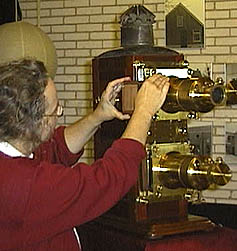 Next
to the magic lantern, an English specimen dating from 1879, with two
objectives, stands Annet. With a quick hand she pushes the lanternslides
alternately into the upper-groove or in the bottom-groove. The double
optics offer the possibility of wonderful dissolving views and other
spectacular effects. We look at a beautiful summery landscape. Gradually
it is becoming autumn, winter, spring, and summer again. With her clear
voice Annet knows how to transmit the emotions belonging to the pictures
shown. Fear, anger, joy and grief. Her enthusiastic performance, those
emotions, these make precisely the difference between a magic lantern show
and a dull evening spent with the neighbours, looking at the boring slides
of their holidays. The pictures may be very nice, if the
performer is not able to convey emotions to his public, people will soon
become bored.
Next
to the magic lantern, an English specimen dating from 1879, with two
objectives, stands Annet. With a quick hand she pushes the lanternslides
alternately into the upper-groove or in the bottom-groove. The double
optics offer the possibility of wonderful dissolving views and other
spectacular effects. We look at a beautiful summery landscape. Gradually
it is becoming autumn, winter, spring, and summer again. With her clear
voice Annet knows how to transmit the emotions belonging to the pictures
shown. Fear, anger, joy and grief. Her enthusiastic performance, those
emotions, these make precisely the difference between a magic lantern show
and a dull evening spent with the neighbours, looking at the boring slides
of their holidays. The pictures may be very nice, if the
performer is not able to convey emotions to his public, people will soon
become bored.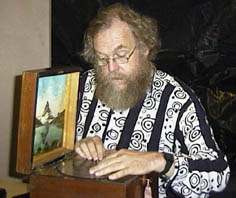 Behind
the lantern Wim has taken a seat. On the small table before him stands a
heterogeneous collection of appliances for the sound effects. Such as a
really antique music box to provide a merry melody when kaleidoscopic
images are shown on the screen. Or a belly organ, to cater for the
corresponding music. In addition bells, whistles, rattles and any other
instrument to serve the purpose. On showing the picture with a burning
house, Wim makes the fire crackle in such a realistic way that you
really feel the heat. The desired effect is achieved by wrinkling a piece of
cellophane. No, he never uses sounds recorded on a tape. All sounds are
‘true’.
Behind
the lantern Wim has taken a seat. On the small table before him stands a
heterogeneous collection of appliances for the sound effects. Such as a
really antique music box to provide a merry melody when kaleidoscopic
images are shown on the screen. Or a belly organ, to cater for the
corresponding music. In addition bells, whistles, rattles and any other
instrument to serve the purpose. On showing the picture with a burning
house, Wim makes the fire crackle in such a realistic way that you
really feel the heat. The desired effect is achieved by wrinkling a piece of
cellophane. No, he never uses sounds recorded on a tape. All sounds are
‘true’. At
that time she ‘did everything with puppets’. She played the leading
characters in famous puppet series on TV, made dresses for puppets and
also designed settings occasionally; in brief: acting was already in her blood. She
collected lanternslides and also had some magic lanterns
at her disposal. When the umpteenth anniversary of the cinema was
celebrated in a local theatre in Hilversum, someone hit upon the idea to
ask Annet to give a show. After hesitating quite some time she
accepted the invitation, not knowing that this would be the first of many
shows to come.
At
that time she ‘did everything with puppets’. She played the leading
characters in famous puppet series on TV, made dresses for puppets and
also designed settings occasionally; in brief: acting was already in her blood. She
collected lanternslides and also had some magic lanterns
at her disposal. When the umpteenth anniversary of the cinema was
celebrated in a local theatre in Hilversum, someone hit upon the idea to
ask Annet to give a show. After hesitating quite some time she
accepted the invitation, not knowing that this would be the first of many
shows to come.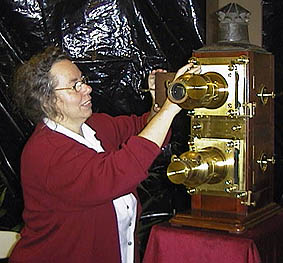 The
lantern they worked with at the outset, was a simple device with only one
objective, and thus restricted possibilities. Therefore, Annet was very
glad when she was able to purchase a double lantern at a relatively low
price. This was the English Tyler from 1879 which she works with
nowadays. However, an explosion of the gaslighting had seriously damaged
the apparatus when it was still in use. With a saintly patience and the
help of many friends she succeeded in restoring the lantern and now she is
rightly proud of having achieved such a good result.
The
lantern they worked with at the outset, was a simple device with only one
objective, and thus restricted possibilities. Therefore, Annet was very
glad when she was able to purchase a double lantern at a relatively low
price. This was the English Tyler from 1879 which she works with
nowadays. However, an explosion of the gaslighting had seriously damaged
the apparatus when it was still in use. With a saintly patience and the
help of many friends she succeeded in restoring the lantern and now she is
rightly proud of having achieved such a good result.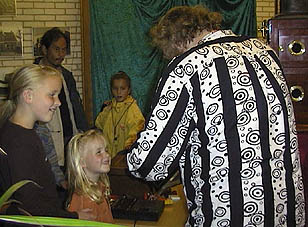 This
means that a hundred percent authentic performance is not possible any
more. Yet Annet and Wim try to approach the former atmosphere as near as
possible, which, needless to say, requires a lot of work. ‘Sometimes it
is very difficult to find out how the shows were given in the old days. It
often occurs,’ Annet explains, ‘that you pick up a series of slides
whilst the relevant story is missing. Then I’m really going after
digging up that story. For that reason, among others, Wim and I regularly
attend meetings of Magic Lantern-lovers in England. We have the pleasant
experience that, when talking to other collectors, they can sometimes help
you with that particular narrative, you have been looking for, for such a
long time. The slides I get are often in a very bad condition. I try to
restore these as much as possible to their original state. This also
involves a lot of research. Fortunately I possess quite a lot of books and
magazines on the subject, which are of great help.’
This
means that a hundred percent authentic performance is not possible any
more. Yet Annet and Wim try to approach the former atmosphere as near as
possible, which, needless to say, requires a lot of work. ‘Sometimes it
is very difficult to find out how the shows were given in the old days. It
often occurs,’ Annet explains, ‘that you pick up a series of slides
whilst the relevant story is missing. Then I’m really going after
digging up that story. For that reason, among others, Wim and I regularly
attend meetings of Magic Lantern-lovers in England. We have the pleasant
experience that, when talking to other collectors, they can sometimes help
you with that particular narrative, you have been looking for, for such a
long time. The slides I get are often in a very bad condition. I try to
restore these as much as possible to their original state. This also
involves a lot of research. Fortunately I possess quite a lot of books and
magazines on the subject, which are of great help.’| The article above filled one of the first pages of my website. It was written in 1997 so it's heavily outdated, but I won't delete it. It was a nice memory of the beginning of my website; now I also see it as a tribute to Annet. Henc. | ||
 |
|
|


 |
©1997-2022
'de Luikerwaal' All rights reserved. Last update: 22-11-2022. |

|