|
All about magic lantern slides |
| PART 1: PART 2: PART 3: |
SINGLE LANTERN-SLIDES
Mounted in wood frames The
very first lantern-slides painted on glass were mounted in solid wood
frames. Sometimes there were several pictures on a slide, but in most
cases a single one only.
Long strips of glass Perhaps the major part of the lantern slides was supplied in the shape of long strips of glass containing more than one picture on a glass. Initially these hand-painted glasses were also mounted in wood frames; as such they were less vulnerable and easy to handle during the projection. Along
with the introduction of the 8,3 x 8,3 cm size the double slide carriers
appeared on the market. The carriers enabled the presentation of wider
types of long glasses too. This made the use of wooden frames redundant.
There was no question of any standardized widths or lengths; every manufacturer was working with his own standards. Example: glasses of 6 cm wide are found with a length of 20, 20.5 or 27.5 cm. In the earliest examples the glass is often uneven and flawed by small air bubbles. Long
strips of glass were supplied with hand painting work, decalcomania and
with photographic pictures. On the long strips you can find three, four,
five or even six pictures next to one another. These images are
practically always circular round; occasionally also of square shape. The
blank spaces between the pictures were filled with black paint.
Those
glasses were mostly issued in series of twelve pieces, on which the
pictures could be presented each separately numbered. Example: glass 1
contained the images 1 till 4, glass 2 the numbers 5 till 8,
|
|
Exchangeable elongated glass slides in a
wood frame. Vervaardigd door Bing (G.B.N.). 1906 Bing Toy Catalogue. |

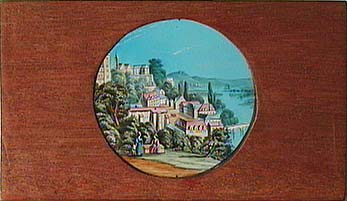 The small glasses with the pictures were set in
recessed holes and held in place by means of a round metal spring. Also
the first slides which were supplied in the so-called 'world-size' of 8,3
x 8,3 cm (3 1/4" square) were often delivered in a wood edge. Many
times the slides had to be carried along back and forth, hence they used
mostly light poplar for the framing. In England, however, mahogany was
applied as well , moreover the Hamburg firm of Andres Krüss made use of
this kind of wood because of its hardness and therefore being suitable for
frequent use. On the wooden panels we often find labels mentioning the
title of an item in different hand writings. This indicates that the
slides were occasionally changing of owner. Besides that, it occurs that
various titles are mentioned on the frames; from time to time it happened
that a glass broke into pieces and in such case it was simply replaced by
a another one in the frame.
The small glasses with the pictures were set in
recessed holes and held in place by means of a round metal spring. Also
the first slides which were supplied in the so-called 'world-size' of 8,3
x 8,3 cm (3 1/4" square) were often delivered in a wood edge. Many
times the slides had to be carried along back and forth, hence they used
mostly light poplar for the framing. In England, however, mahogany was
applied as well , moreover the Hamburg firm of Andres Krüss made use of
this kind of wood because of its hardness and therefore being suitable for
frequent use. On the wooden panels we often find labels mentioning the
title of an item in different hand writings. This indicates that the
slides were occasionally changing of owner. Besides that, it occurs that
various titles are mentioned on the frames; from time to time it happened
that a glass broke into pieces and in such case it was simply replaced by
a another one in the frame.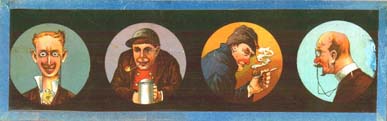 As a consequence they disappeared, to start with the wider glasses, and
later on also the narrower glasses for the small lanterns for use at home.
Instead thereof the strips of glass were rimmed with a strip of glued
paper in many colours and motives. Specific firms worked with distinct
paper to be glued around their glasses. The glasses of Roose from Nurnberg
(Germany) were often glued with pink squared paper, whereas Bing not
seldom used white paper with golden stars. The wider glasses were
frequently protected against damage by a cover glass. The narrow glasses,
varying from 2 cm to 5 cm wide, which were fitted in the cheaper toy-magic
lanterns were generally protected merely by a layer of transparent lacquer.
As a consequence they disappeared, to start with the wider glasses, and
later on also the narrower glasses for the small lanterns for use at home.
Instead thereof the strips of glass were rimmed with a strip of glued
paper in many colours and motives. Specific firms worked with distinct
paper to be glued around their glasses. The glasses of Roose from Nurnberg
(Germany) were often glued with pink squared paper, whereas Bing not
seldom used white paper with golden stars. The wider glasses were
frequently protected against damage by a cover glass. The narrow glasses,
varying from 2 cm to 5 cm wide, which were fitted in the cheaper toy-magic
lanterns were generally protected merely by a layer of transparent lacquer.
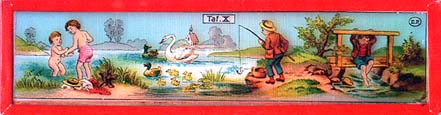 Besides
there are also glasses on which the paintings have not been encircled.
There is almost without exception a direct relation between the figures on
these so-called panorama slides. These show e.g. a Christmas market with
stalls or a parade of musicians. Such slides were slowly passed through
the magic lantern without interruption. With other ones, on which the
pictures have no or hardly any relation with each other, the figures were
shown with intervals of rest, in exactly the same way as with the
encircled images.
Besides
there are also glasses on which the paintings have not been encircled.
There is almost without exception a direct relation between the figures on
these so-called panorama slides. These show e.g. a Christmas market with
stalls or a parade of musicians. Such slides were slowly passed through
the magic lantern without interruption. With other ones, on which the
pictures have no or hardly any relation with each other, the figures were
shown with intervals of rest, in exactly the same way as with the
encircled images.
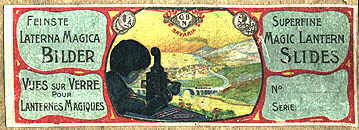 so completing
a series of 48 pictures. In other cases the numbering was done on each
single strip only or the glasses were not numbered at all. Repeatedly the
packing-box of the small magic lanterns for use in the living-room
contained open spaces in which a series of slides was delivered along.
Depending on the possibilities offered by the lantern and its price, a
single chromatrope or slipping slide was included as yet.
so completing
a series of 48 pictures. In other cases the numbering was done on each
single strip only or the glasses were not numbered at all. Repeatedly the
packing-box of the small magic lanterns for use in the living-room
contained open spaces in which a series of slides was delivered along.
Depending on the possibilities offered by the lantern and its price, a
single chromatrope or slipping slide was included as yet.
 |
 |
 |
 |
 |
New comical moving pictures very
practically packed. With one wood frame and 12 exchangeable changing pictures. By this new arrangement it is possible - by using only one wood frame for all moving pictures - to supply larger number of pictures at a comparatively cheap price. |
|
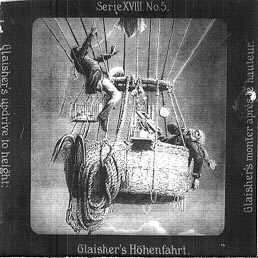
8,3 x 8,3 cm (3 1/4" square) and other sizes. Lantern-slides
of 8,3 x 8,3 cm were mainly used in the bigger lanterns which were often
used in support of 'teaching with visual aids', also otherwise called
'sciopticons';
These
slides were mostly sold in sets of 6, 8, 12 or 24 pieces, but also by the
piece. The well-known series of the English company of Butcher & Sons,
which were issued as 'Primus Junior Lecturers Series' during the period
1870-1906, were put up in boxes containing 8 slides each Those
narrative or educational series were mostly offered with an explanatory
text. This could have been printed on the slides themselves or loosely
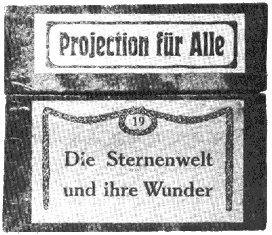
included on a small sheet of paper. The 'Projektion für Alle` series
often came with an additional booklet with the accompanying text.
Unfortunately, it goes without saying that such loose texts have got lost
many times. At the same time there appeared many unbranded slides, without
numbering or text, on the market; during their multiple use they were
pulled out the original packing,
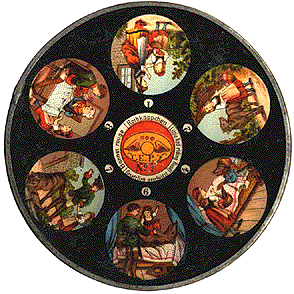
Finally we still want to mention the round slide, being a glass disc on which along the edges a series of images, whether in circles or not, has been put on. This one could only be applied in magic lanterns which had been specially made for this purpose by, among others, the manufacturers Bing and Ernst Plank. Sometimes
we also come across very deviating formats, which appear to be then many a
time cut up long strips of glass. This might be intended to grant a second
life to broken glasses. |
|
|
More about magic lantern
slides.... |
 for the smaller magic lanterns for private purposes the
long strips were applied. Even if this size was called the 'world size',
German manufacturers also produced slides of 8,5 x 8,5 cm. The slides were
sold with as well as without a cover glass. Frequently the retailers
fitted them out with a cover glass, if required by some customer. Hand
painted slides, decalcomanias, glass transparencies and glass photograms
also were launched on this size. (photograms are drawings multiplied by
means of photography.) They were supplied in wooden frames with a metal or
paper edge, or fully 'bare'.
for the smaller magic lanterns for private purposes the
long strips were applied. Even if this size was called the 'world size',
German manufacturers also produced slides of 8,5 x 8,5 cm. The slides were
sold with as well as without a cover glass. Frequently the retailers
fitted them out with a cover glass, if required by some customer. Hand
painted slides, decalcomanias, glass transparencies and glass photograms
also were launched on this size. (photograms are drawings multiplied by
means of photography.) They were supplied in wooden frames with a metal or
paper edge, or fully 'bare'.
 (see the
  which hampers the search for the original
supplier of the slides often seriously. Moreover, many dealers marketed
the slides under a 'brand of their own', whilst identical series sometimes
were issued by different manufacturer.
which hampers the search for the original
supplier of the slides often seriously. Moreover, many dealers marketed
the slides under a 'brand of their own', whilst identical series sometimes
were issued by different manufacturer.


 |
©1997-2024
'de Luikerwaal' All rights reserved. Last update: 21-08-2024. |

 
|