
Part 1. |
 |
 |
Viewing stereo photographs was a popular home entertainment in
the nineteenth century. It may be compared to the function of the television in
our days. The stereoscope was invented in 1838 by Sir Charles Wheatstone, the famous English scientist. He maintained that we perceive depth because each eye sees different images, which are united by the mechanism of the brains. The instruments he made to prove his theory were bulky, because the paired pictures were viewed by means of mirrors. The first improvement was made in 1849 by Sir David Brewster, who not only did away with mirrors, but magnified the pictures with lenses. It was Oliver Wendell Holmes who brought back this box-type stereoscope to a skeleton model that quickly became standard. Because of the relationship with the magic lantern almost every collector of magic lanterns has some stereoscopes in his collection. |
|
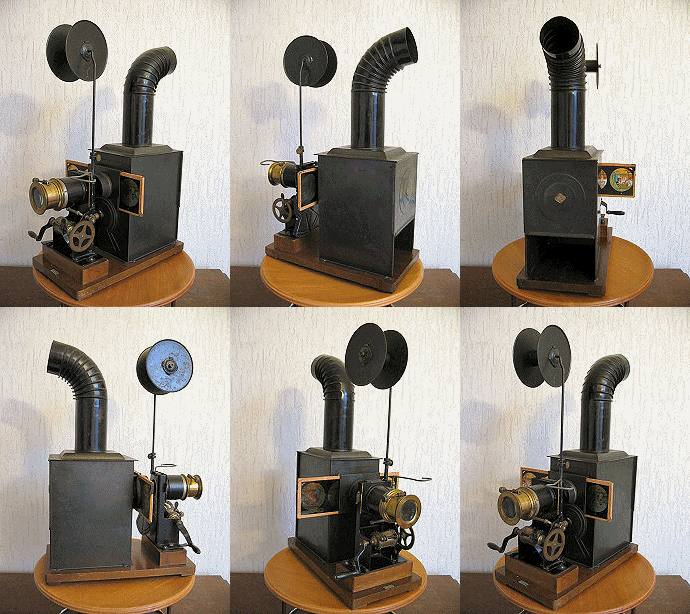
Also the rotating of an object can create an illusion of
depth. (Cinematograph. Manufacturer Gebrüder Bing, Nuremberg, c. 1913. Animated by the webmaster.) |
|
|
Wheatstone stereoscope. The earliest type of stereoscope used a pair of mirrors at 45 degree angles to the user's eyes, each reflecting a picture located off to the side. It demonstrated that when two pictures simulating left-eye and right-eye views of the same object are presented so that each eye sees only the image designed for it, but apparently in the same location, the brain will fuse the two and accept them as a view of one solid three-dimensional object. Wheatstone's stereoscope was introduced in the year before the first practical photographic process became available, so drawings were used. This type of stereoscope has the advantage that the two pictures can be very large if desired. |
 |
 |
 |
 |
 |
|
Brewster Stereoscope.
Though David Brewster did not invent the stereoscope, Brewster's personal contribution was the suggestion to use lenses for uniting the dissimilar pictures, and accordingly the lens based stereoscopes may fairly be said to be his invention. This allowed a reduction in size, creating hand-held devices, which became known as Brewster Stereoscopes. Brewster was unable to find in Britain an instrument maker capable of working with his design, so he took it to France, where the stereoscope was improved by Jules Duboscq who made stereoscopes and stereoscopic daguerreotypes, and a famous picture of Queen Victoria that was displayed at The Great Exhibition. This was the start of a real 3D industry and 250,000 stereoscopes were produced and a great number of stereoviews, stereo cards, stereo pairs or stereographs were sold in a short time. Stereographers were sent throughout the world to capture views for the new medium and feed the demand for 3D.  This Brewster stereoscope is made of maple with bakelite and metal parts & a frosted white glass panel and was made to hold glass stereo slides. This model has a knob on the side which allows the viewer to focus. There is a brass plaque which reads "Unis France Stereoscope Paris.". Stereoscope measures 5" across, 6" including pertruding knob, just under 5" deep including the eye pieces, and just under 3" in height.
|
|
Holmes stereoscope (c. 1861). A hooded eyepiece fitted with two prismatic half-lenses, slotted support for the cards and a handle to support the whole. Because it was cheap, convenient and efficient, this instrument quickly found its way to almost every household. Other viewers were sometimes as large as a piece of furniture and could store and show fifty or more stereograms. A lot of photographic companies produced stereo photocards (stereograms) and stereoscopes. Photographers were sent across the world to record famous sights and events in stereo. "See the world from your parlour!", is just one of the many advertising slogans from that time. |
|
 |
 |
 |
Of course also all kinds of other subjects were represented on the sets of cards, like stories, nature, and of course.... erotic scenes. |
|
 |
||
 |
 Erotic? Lady proudly showing her underpants? In the background a magic lantern. |
|
| Small tin advertising stereo viewer from Monopol-Thee, Rotterdam | ||
 |
Around 1910, many manufacturers of foodstuffs such as tea,
coffee and cocoa released small, collapsible tin stereo viewers. They weren't
expensive, but to get the accompanying pictures you had to drink or eat a lot of coffee, cocoa and the like. The
viewers are so similar that they
probably came from the same factory. Well-known viewers are those of De Jong
Cacao, Tieleman and Dros, Dobbelmann, Imperial (USA) and Kis-Me chewing gum. Dimensions box: 15.5 x 8 cm, dimensions viewer: 11 x 8 cm. |
|
 |
 |
 |
 |
|
Advertisement for Monopol tea. This 1919 commercial film begins by introducing the actors. As they sit at the lunch table, there is some excitement about a small box of tea that one of the men has brought. The maid immediately makes a pot of tea and the drink calms the mood. The film closes with a title card: 'De vrede is hersteld door Monopol-thee' ('Peace is restored by Monopol tea'). (source: Eye Film Museum) |
 |
|
Larger viewers were also made, sometimes as large as a piece of furniture, in which fifty or more stereo photos could be stored and viewed. |
|
|
ICA - Multiplaszt. Viewer for stereo slides size 4.5 x 10.7 cm made by the German manufacturer Ica Akt. Ges. Dresden. The device can accommodate 300 glass stereo slides, divided over twelve aluminium trays in the base cabinet. These trays can each contain 25 plates. The front of the device must be opened for inserting or changing a filled tray. By pressing down a large lever on the side, a different slide is made visible again and again. |
 |
 |
 |
 This 3D photocard is made by Universal View Co., William H. Rau, Publisher. The title is "Papa, I like Pictures." A little girl holds a glass Magic Lantern Slide up to the light to view it. There are piles of the slides on her lap and by her side. |
|
 |
 |
 The Stereo
Realist is a stereo camera that was manufactured by the David White Company
from 1947 to 1971. It was the most popular 35 mm stereo camera ever manufactured
and started the era of popular stereo photography of the mid 20th century. The Stereo
Realist is a stereo camera that was manufactured by the David White Company
from 1947 to 1971. It was the most popular 35 mm stereo camera ever manufactured
and started the era of popular stereo photography of the mid 20th century.In August 2010, Fujifilm announced the W3, a new stereoscopic digital 3D compact point-and-shoot camera with the ability to capture 3D images as well as videos. The non-commercial stereo photo's at this page are made by the webmaster using this camera and the computer program Stereo Photo Maker. |
 Incidentally, it is also quite possible to take stereo photos of motionless objects with a normal camera by taking two photos in succession with a horizontal offset of approximately 6 cm. Handy do-it-yourselfers like the webmaster can make a simple tool for this themselves. |
 |
 |
A commercial version of an attachment for taking stereo
photographs with a single photo camera. Complete with manual and original
cardboard box. German manufacture. The price was 4.30 Mark. |
Anaglyph Other techniques for displaying 3D-images use a single image, which contains all the information to reconstruct the full three-dimensional picture. The most common of these is the Anaglyph, which requires the viewer to wear glasses with red and green or cyan lenses. From the left image the blue and green colours are removed to leave a purely red picture while the right image has the red colour removed. The two images are superimposed into one picture with the characterizing red and cyan or green fringes around objects. The red and cyan lenses in the glasses let the eyes separate the two superimposed images into their individual components which the brain then combines to a 3D-image. |

 |
| Depending on the way of
mounting the depicted object is placed behind, in, or in front of a ghost
window. The magic lantern in the anaglyph above seems to stick out of the
window, into the living room. The lantern on the stereocard below is placed
behind the window. |
|
Stereogram Side-by-side 3D photos |
There are several ways to view 3D
side-by-side photos. The printed photos can be viewed in a parlour-viewer like the Holmes viewer. (Many are still around today.) After some practice most people succeed to do it without a viewer, just by staring beyond the two pictures, seeing a centre 3D image and a left and right peripheral image beside them. |
|
 |
 Download a printable version by clicking the card. 1.5 MB, c. 9 x 18 cm. |
|
More 3 D Stereo. |
||
 
 |
©1997-2024 'de Luikerwaal' All rights reserved. Last update: 22-02-2024. |


|