 |
|
Of all the slides prepared
for the magic lantern, those with mechanical effects prove the most interesting to persons of all ages.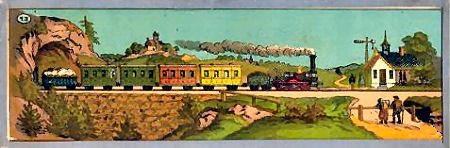 The
first 'moving' slides shown by the itinerant lanternists were probably all of the panoramic kind. This type
of slide, an oblong glass containing a series of images which, passed slowly in front of
the lens, gave a sense of movement, but soon the desire to animate the
projected images led to the invention of many ingenious mechanical slides. The
first 'moving' slides shown by the itinerant lanternists were probably all of the panoramic kind. This type
of slide, an oblong glass containing a series of images which, passed slowly in front of
the lens, gave a sense of movement, but soon the desire to animate the
projected images led to the invention of many ingenious mechanical slides.These slides are provided with slipping plates, pulleys, levers, rackwork and other arrangements, by means of which life and motion are apparently imparted to the objects exhibited. |
|
 MECHANICAL
SLIDES
MECHANICAL
SLIDES
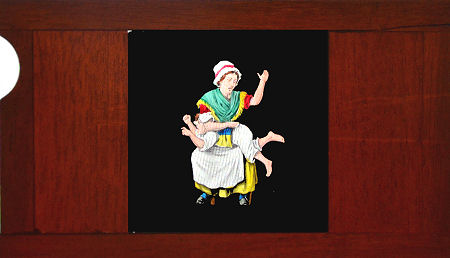
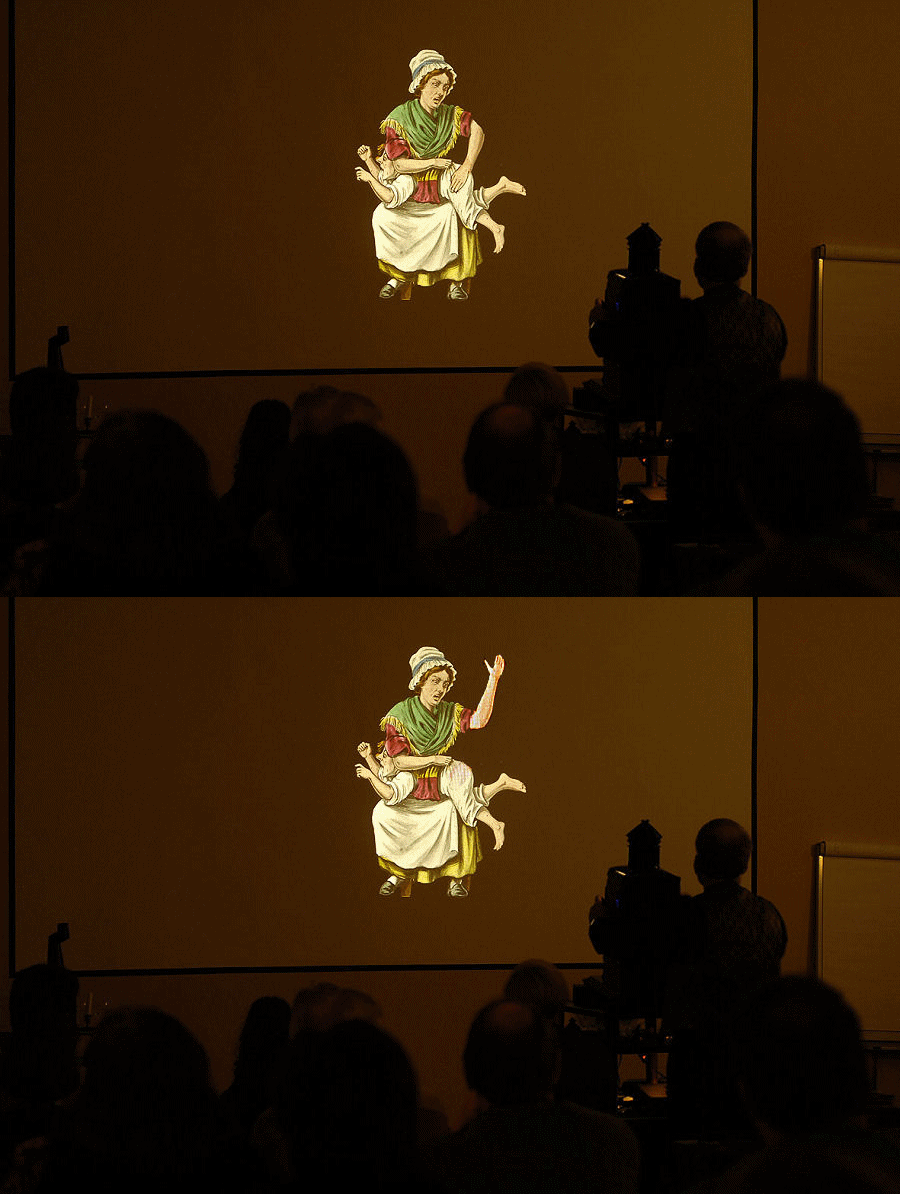 The Dutch lanternist Daan Buddingh at one of his magic lantern shows. Hand painted single slipping slide in a wooden frame showing a mother punishing her naughty tot. |
|
 |
 |
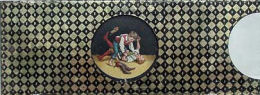 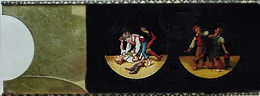 Simple slipping slide showing two man in some sort of a quarrel, fitted in a tin frame that measures about 7 1/4" x 2 5/8. |
SIMPLE SLIPPING SLIDE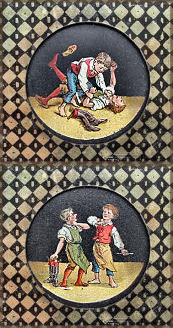 The easiest way to impart 'movement'
to the subject was the use of two pictures, both painted on the same
glass, showing two phases of the story. During the projection the
pictures had to be changed rapidly, the second after the first one, by
pushing or pulling the glass with one quick move, in a lateral direction. The easiest way to impart 'movement'
to the subject was the use of two pictures, both painted on the same
glass, showing two phases of the story. During the projection the
pictures had to be changed rapidly, the second after the first one, by
pushing or pulling the glass with one quick move, in a lateral direction.
Usually the glass was mounted in a wood or metal frame to obtain a smooth movement. |
|
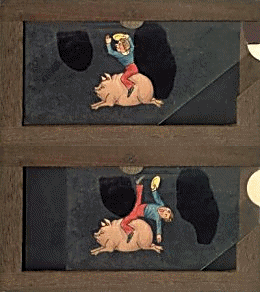
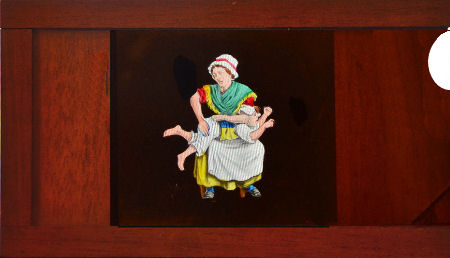
Hand painted magic lantern slide in a
mahogany frame, measuring 18 cm x 10 cm.
|
SINGLE
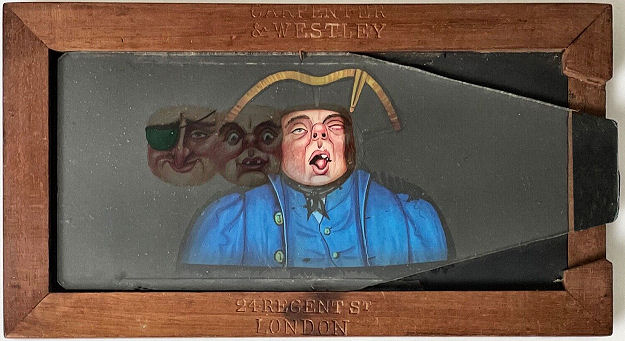
SLIPPING SLIDE Two glasses are mounted in a wood frame. The action is produced by moving one glass, the 'slipping glass', in front of the second glass, which is fixed. The slipping glass is free to move across in a lateral direction and can be pulled partly out of the frame, and pushed in to its former position. The subject may be represented on the fixed glass in two distinct positions. The illusion of movement is effected by alternately masking one and then another part of the picture. |
|
 |
 |
|
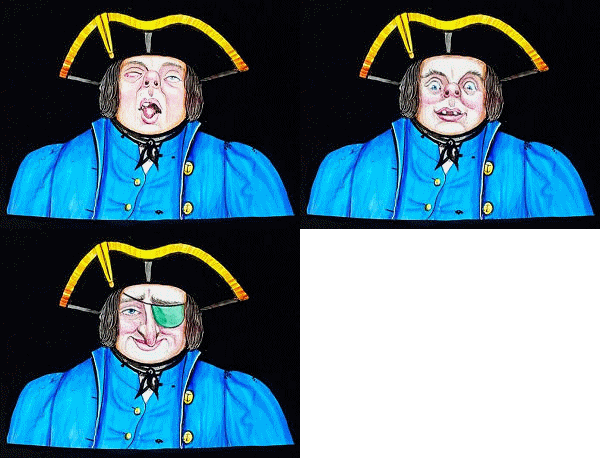
| Typically, these types of slipping slides showed a two-phase movement, as in the slide above. This slipping slide is a bit more extensive and shows the face of the man in three expressions. The dimensions are 17.5 x 9.5 cm and the manufacturer is Carpenter & Westley, London. | ||
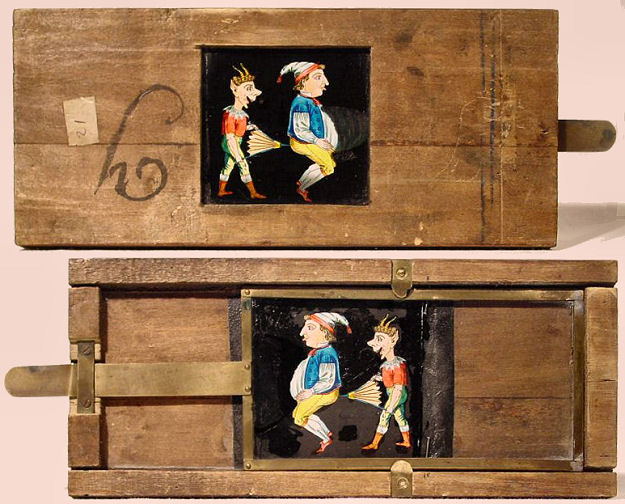
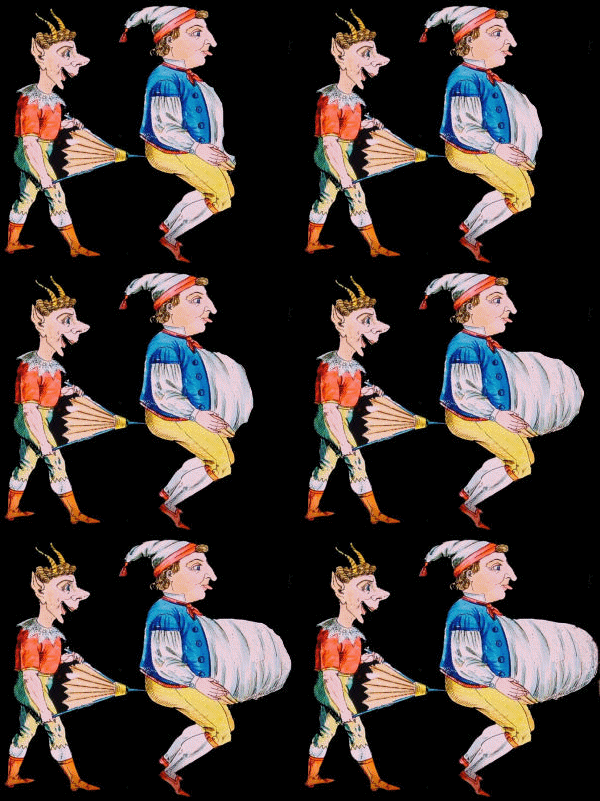 THE DEVIL'S JOKE, an antique magic lantern glass slide from c. 1880. The hand painted glass slide represents a man who is blown up with a bellows by a devil. The lever is brass made. All measure 9.9" x 3.9" (25cm x 10cm. Probable English made. |
 |
 |
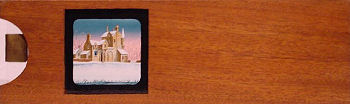 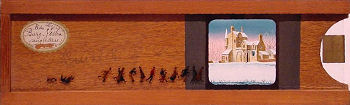 |
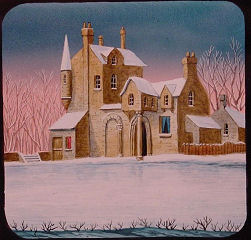
 BURG-YESTRA (ENGLAND). Special single slipping slide. The frame is made of mahogany. The glass slide is hand painted and represents 13 persons and a dog who are passing an English castle (Burg-Yestra) that is depicted on the fixed glass. The label is inscribed in French. All measure 14.2" by 4.3" (36 x 11cm). Probably French made (c. 1880). |
|
|
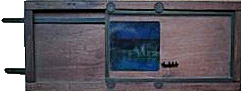
DOUBLE SLIPPING SLIDE
This slide is an extension of the single slipping slide, having two slipping glasses on either side of a fixed glass. |
|
|
 |
 |
|
This
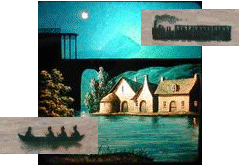
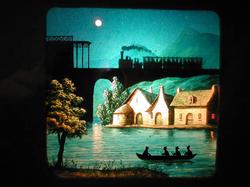
rare Double Panorama magic lantern slide shows a night time landscape with a passing train and a small boat crossing a river. The slide has a glass panorama on either side, one containing the boat, the other provided with the train. By slipping the two glasses across the fixed one it was possible to make the boat bob up and down on the water and let the train cross the bridge. The slide is late nineteenth century and probably made by the great French slide maker Desh. Dim. 31cm x 13cm or about 12 1/4" x 5 1/8". |
||
 |
SINGLE
LEVER SLIDE
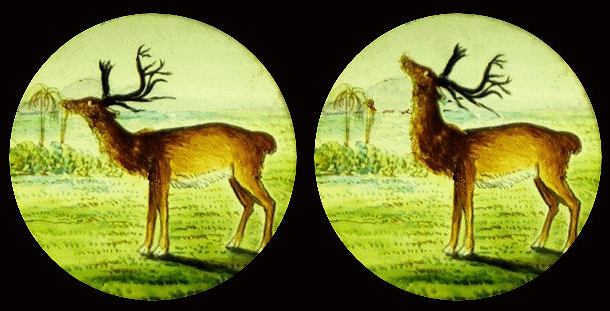
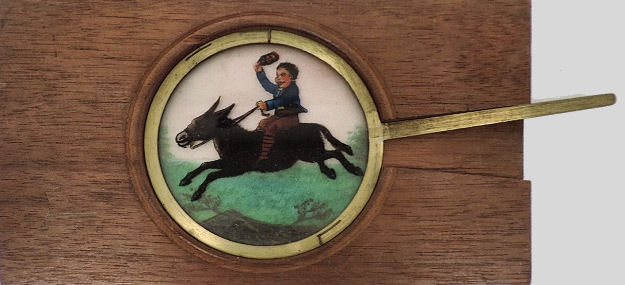
These slides give movement to the subject by the use of two glasses, one of which is a fixture in the frame and the other is free to turn in a circular direction by means of a lever. 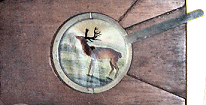 The
fixed disc is mounted in a solid wood frame. The movable disc is enclosed
in a metal collar with a lever attached to it so that it can be partly
turned in front of the other glass. The lever is restricted in its
movement by being confined in a channel cut in the surface of the frame.
The movable glass is held in position by two pins. The
fixed disc is mounted in a solid wood frame. The movable disc is enclosed
in a metal collar with a lever attached to it so that it can be partly
turned in front of the other glass. The lever is restricted in its
movement by being confined in a channel cut in the surface of the frame.
The movable glass is held in position by two pins. |
|
 |
 |
|
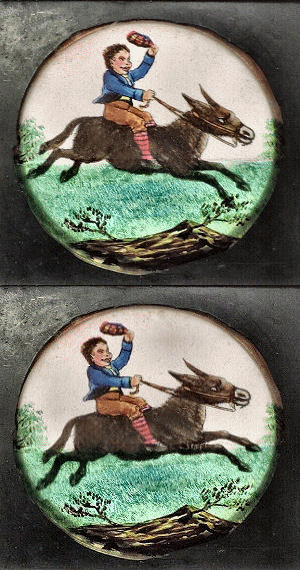
| A rider on horseback. Man and horse are painted on the moving glass and the background is painted on the fixed glass. | ||
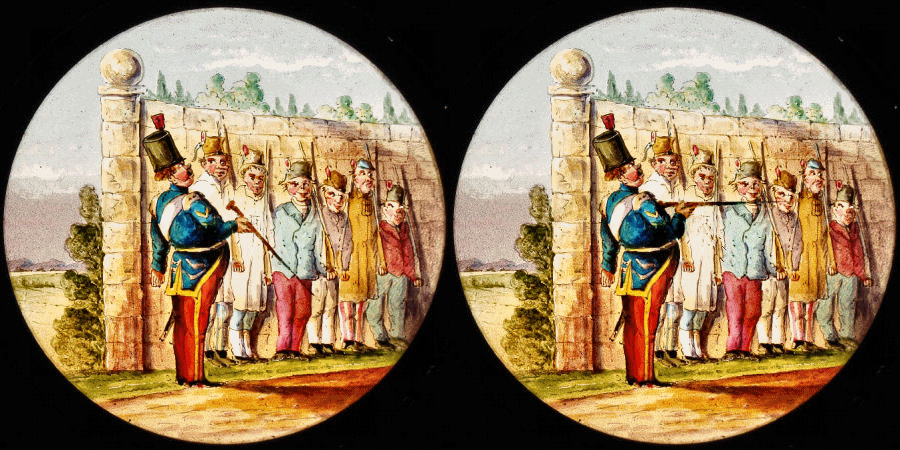
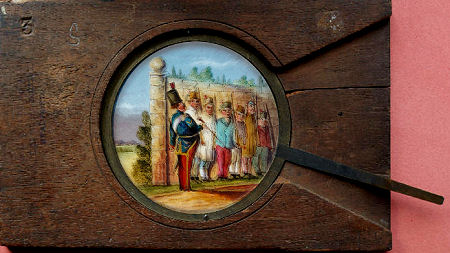 Sergeant before the new recruits. Single lever slide. When the lever is moved, the sergeant swings his stick. The slide measures 7 "x 4.5" (18 x 11.4 cm). |
 |
| DOUBLE
LEVER SLIDE As you may have guessed, there are also double lever slides, having two movable glasses at each side of a fixed glass. |
|
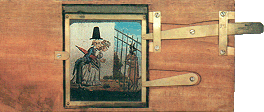 England, about 1890. By pressing the lever one of the glasses is shifted, revealing the horns under the hat (meaning: the wife's being unfaithful to her husband by having an affair with the man behind the gate!). |
PIVOTED-LEVER
SLIDE Two glasses are used to give movement to the subject; one is a fixture in the frame and the other is free to move up and down in a vertical direction by a pivoted lever. |
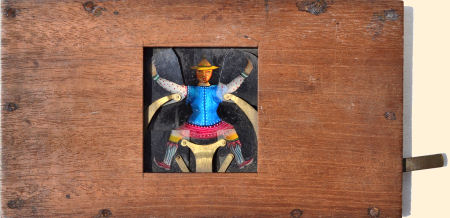 |
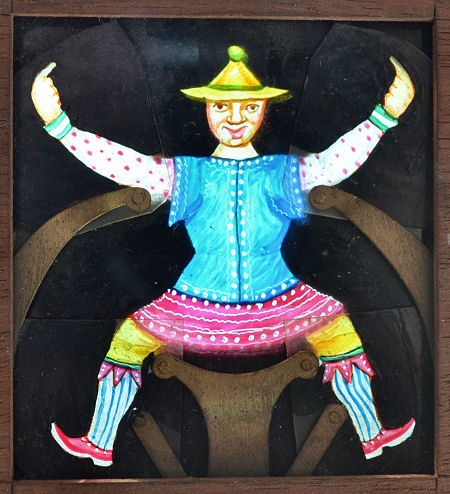
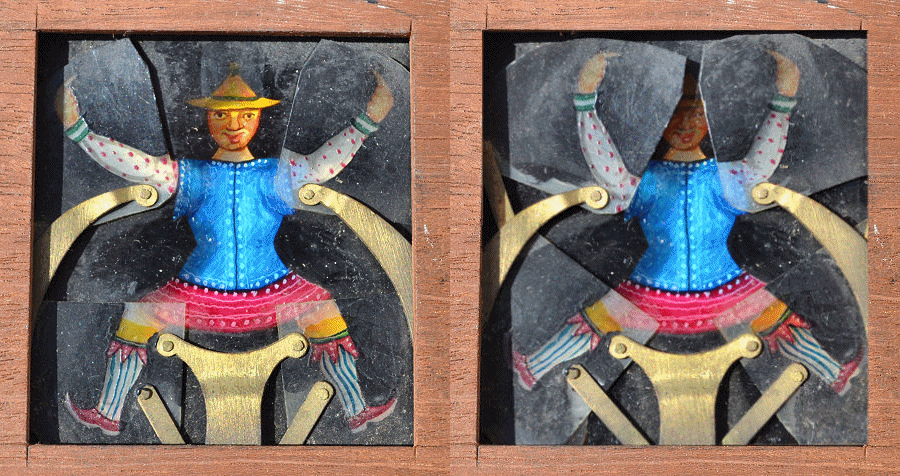
 The mechanism of this lever slide is rather complex, with a lever system simultaneously pivoting four small glass pieces to give the illusion of the Chinese man dancing. The wooden frame measures 17.5 x 9.5 cm. |
 |
 |
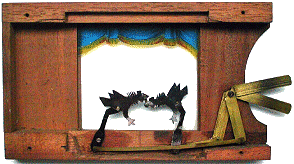
Extremely
rare English mid nineteenth century mechanical Magic Lantern
slide. This slide projects silhouette/shadow of a cock fight. |
SILHOUETTE
SLIDES A very special kind of mechanical slide is the silhouette slide or fantoccini slide, which has the figures cut out of opaque materials, such as paper, copper and tin, mostly combined with a painted background on glass. The front cover is removed so that you can see the mechanism. Each cockerel is linked to a brass rod and is moved by its own lever. They are also joined by the beaks. The movements are impressive and varied. The cockerels are made of thin painted tin. |
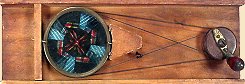
Chromatrope. By crossing one
of the threads the glass discs revolve in opposite directions. |
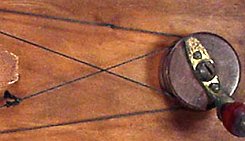
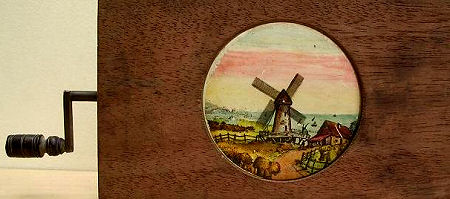
SINGLE PULLEY SLIDE Two glass discs are mounted at one end of a long wooden frame, one fixed and the other free to revolve in front of it. The revolving glass is mounted in a brass collar with a groove around its outer edge, forming a kind of pulley. A pulley wheel at the other end of the frame is turned by a handle. The glass disc is connected to the pulley-wheel by a thread or band, which drives the disc when the handle is turned. Most of the subject is represented on the fixed glass and a part on the revolving glass, so that they form a complete picture together. Often used subjects are windmills with revolving sails and watermills. Also DOUBLE PULLEY SLIDES are known. |
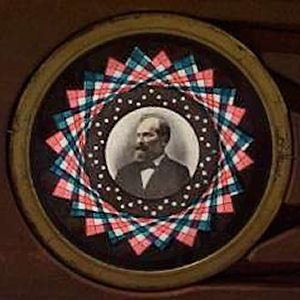 |
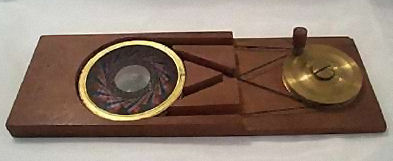 Rotating political magic lantern slide showing a portrait of the American president Garfield combined with a chromatrope. Brass mechanism. Made by T.H. McAllister, Optician, N.Y. Label on side reads, "The Garfield Chromatrope". By turning the handle, the rotating glass slides have a kaleidoscope effect. Measures 11" x 4" x 1/4" (28 x 10 x 6.4 cm). |
|
SINGLE RACKWORK SLIDE
|
|

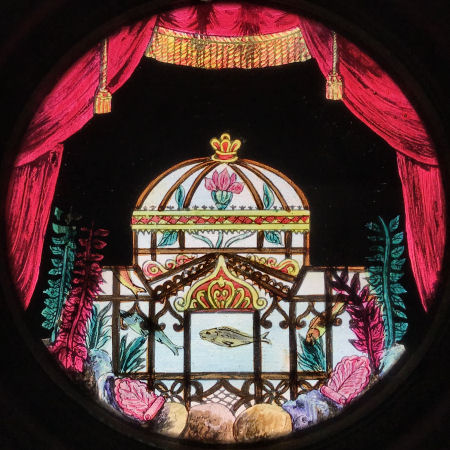
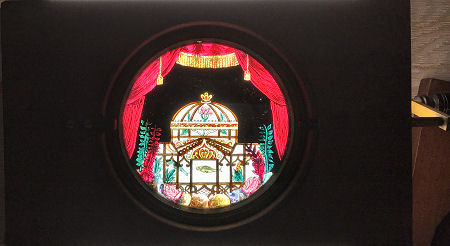
Gé Aarts, owner of the
smallest movie theatre in the Netherlands, shows the single rackwork slide
'the emperors aquarium'. (Sometimes the fishes even swim backwards!) |
 |
 |
|
|
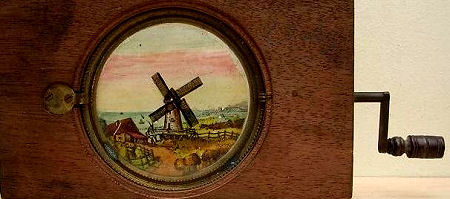 |
|
Single rackwork slide in a
wooden frame. Size frame: 6.75" x 3.75" (17 x 9.5 cm). |
|
DOUBLE RACKWORK SLIDE |
|
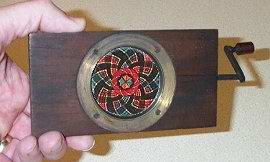
You'll find a 'real working' chromatrope at All about magic lantern slides, part 3. |
CHROMATROPE
It's difficult to give an impression of the dazzling brilliancy of the effects produced on the screen by the chromatrope. It resembles the kaleidoscope, with the addition of constant motion and rapid change. The two discs are painted with an almost endless variety of geometrical and other designs in brilliant colours. Turning the handle causes the discs to revolve in opposite directions, giving amazing effects. Sometimes the chromatropes are furnished with words like 'Welcome', 'Adieu' or 'Goodnight' to be used at the beginning and end of a performance. Even phrases like 'God Save the Queen' and 'Rule Britannia' are used, from which the most dazzling rays of glory are disseminated. |
|
SPECIAL MECHANISMS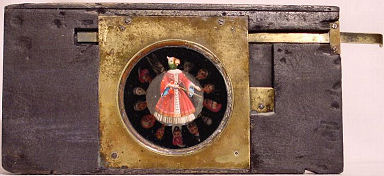
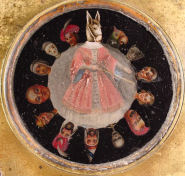
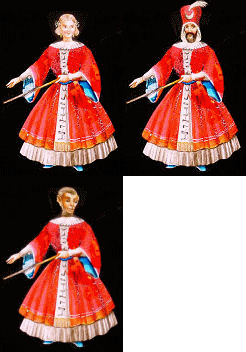 INTERCHANGEABLE HEADS. This superb antique magic lantern slide from 1880 is operated by a very special mechanism. The fixed glass represents a body dressed in a wonderful red and white dress with laces. The moving glass has 14 heads: a beautiful girl, a monster with a red crest, a skull, a magician, a Turkish, a crook, a big head with glasses, an Arab, a Pierrot, a gentleman, an ass, a parrot, a cat, and a monkey. Each time you pull or push the rod, a new head is added to the body. The moving glass slide is set within a brass frame. The rod is also brass made. Its size: 9.7" x 4.9" (24.5cm x 12.5cm). |
||
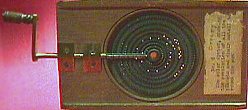
The solar system, showing
the revolution of all the planets and their satellites round the sun. The crank must be turned
24 times to make a complete rotation of the planets around the sun. |
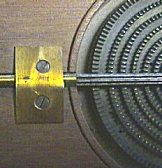 ASTRONOMICAL RACKWORK SLIDE ASTRONOMICAL RACKWORK SLIDE
This rackwork slide was specially designed to demonstrate the movements of the solar system (showing only the eight planets known at that time). |
|
 |
CYCLOIDOTROPE
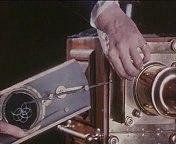
A nice effect was produced by the Cycloidotrope, a kind of spirograph. A black disc of smoked glass revolved within the slide frame, while a stylus on a pivoted arm traced a pattern in the soot against the moving glass. This appeared on the screen as a brilliant white line tracing a regular geometric design with an increasing complexity. The stylus could be reset while the cycloidotrope was rotated, producing interlocking rosettes and similar mechanical geometric figures. (also read: Special Effect Slides) |
|
|
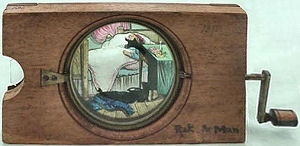
MORE SYSTEMS Of course there are more systems to make the pictures move and also slides that combine two or more features mentioned above, thus producing a most vividly lifelike effect. Example: the well-known slide of the mouse eating man. |
 |
|
 |
INTERCHANGEABLE
MECHANICAL SLIDE
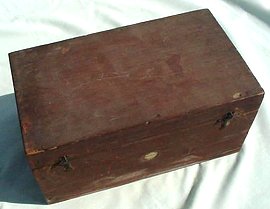
A rare interchangeable mechanical slide sold by BENETFINK, Cheapside, London. c.1880. The pine case is fitted with five hand painted slides of a beehive, acrobat, windmill, fountain and goodnight wish, and twelve hand painted glass discs. If you want to read and see more about this curiosity, and why shouldn't you, click on the lid of the box to open it (exciting, isn't it?), or simply proceed with the next page. |
|
|
|
||


 |
©1997-2024
'de Luikerwaal' All rights reserved. Last update: 23-02-2024. |
 
|