 |
 |
| Chromatropes |
| The amazing, dazzling effects that
are produced by the chromatrope remind us of the kaleidoscope of our childhood. The mostly
cardboard tube contained two plane mirrors, set at an angle of 60° to
one another, and multiple fragments of coloured glass or paper. When
rotated, this simple device produced wonderful
symmetrical patterns that changed continuously. The chromatrope effect
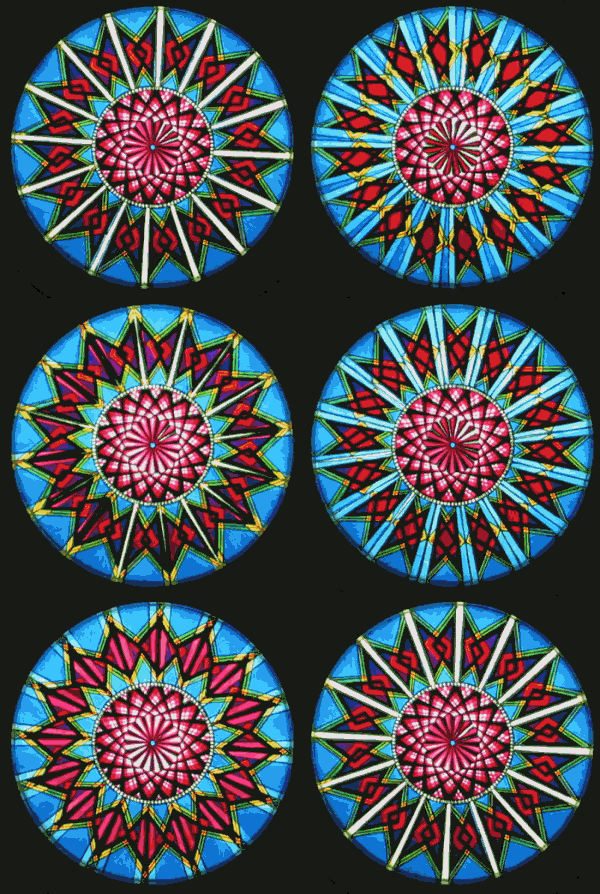
is engaging and sometimes almost hypnotic. The chromatrope uses two discs of glass painted with abstract patterns, which rotate in opposite directions to produce similar images on the screen. The pattern appears to spread out from the centre of the screen, or move in towards the centre, depending on the direction of rotation of the discs. Cheaper forms used only one rotating glass, or used transfers printed by chromolithography. These exist in several sizes, including miniature examples designed for toy lanterns. |
|
 Double pulley slide. |
 |
|
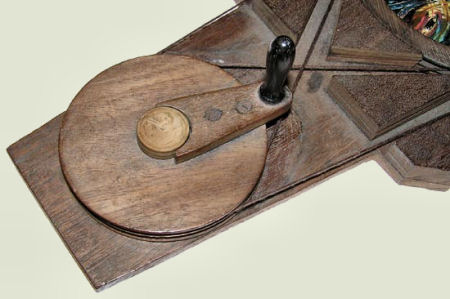
Early form of a chromatrope. Two rotating discs of glass carrying the
colourful patterns are driven by a string linkage from a pulley wheel,
turned by a small handle. The string forms a double loop, crossing over
itself between the wheel and the glass discs so that the glasses rotate
in opposite directions. |
 |
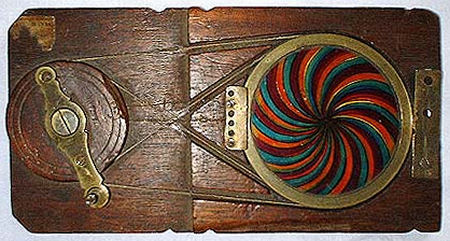 |
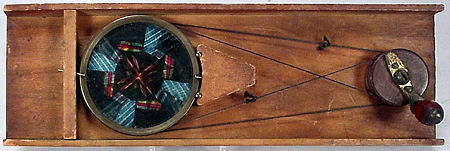
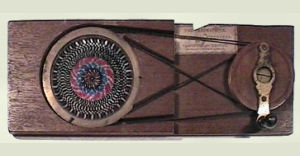
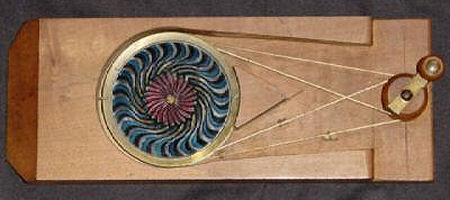 Two double pulley chromatropes, the left one very old, the right one more recent. |
 |
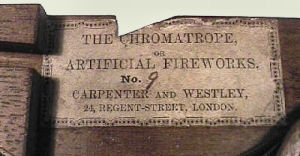 |
ARTIFICIAL FIREWORKS, that is what the chromatropes
sometimes were called, of course because of the spattering
color effects that look like fireworks. Made by Carpenter and Westley 24, Regent Street, London. Size: 252 mm x 95 mm x 13 mm. |
|
Rackwork mechanism. Because the pulley chromatrope was rather fragile and difficult to construct it was superseded in the mid-19th century by a rackwork mechanism. The glass discs were framed in a toothed brass ring. The revolving of the glasses was achieved by means of a ratchet within the frame, placed between the two toothed rings and operated by a handle. Though some lanternists prefer pulley driven chromatropes so far as speed and smoothness of rotation are concerned, a rackwork system is more reliable. In the course of years strings can snap or hang loosely, causing a sudden stop or slipping during the show. |
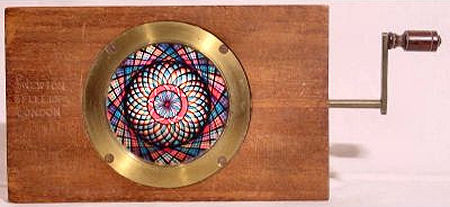 |
| A superb
English rackwork chromatrope from around 1880. The frame is made of mahogany. Glasses are fixed in a brass setting and the handle is made in brass and wood. All measure 6.5 "x 3.9" (16.5 x 10 cm) without the handle. On both sides the name of the maker is engraved: "NEWTON 3 FLEET St LONDON". |
|
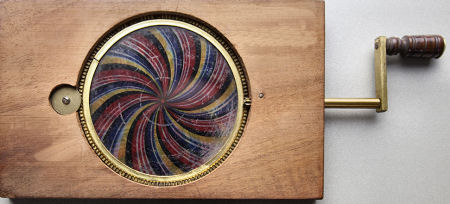 |
In the vast majority of cases, the
gear construction is concealed. Gear and cog wheel are usually covered by a
metal circular plate or a gearbox. On this photo you can see how the gear and the wheel interlock. The cog wheel is a part of the pendulum rod that runs through the wooden frame. |
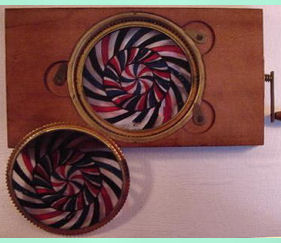
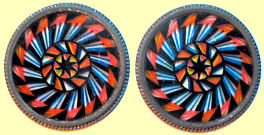 Two disassembled chromatrope discs, mounted in a toothed metal ring. 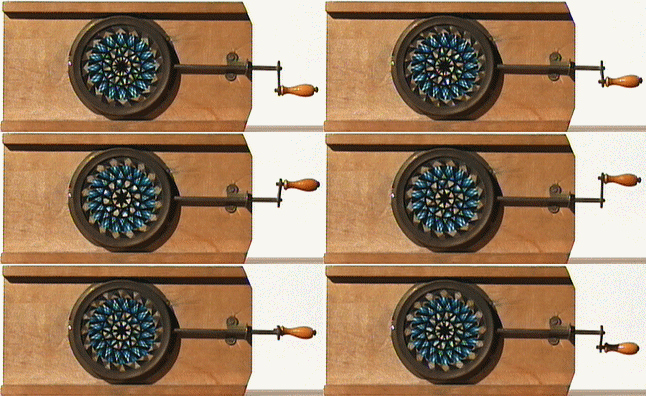 |
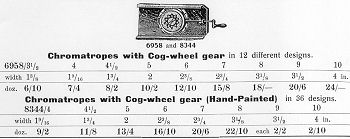 The 1906 Bing Toy Catalogue. The colourful patterns on the glass discs were mostly hand painted. Cheaper forms were transfer-printed by chromolithography. |
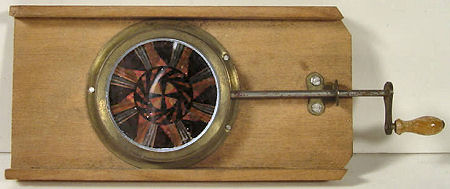
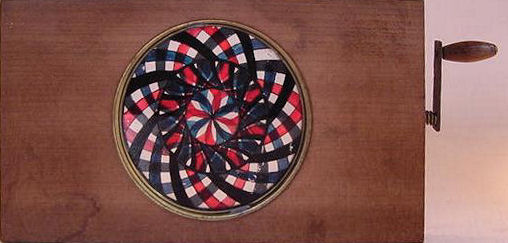
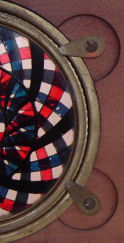
| Simple
rackwork chromatrope from c. 1880. The frame is made of mahogany, size: 4.3" x 2" (11 x 5 cm) without the crank. |
 |
 |
|
| Also interchangeable
chromatrope sets have been produced. They consisted of a rackwork frame
and a number of discs to fit it. So the lanternist was able to assemble
his own combinations and to project a lot of different designs using the
same mechanism. |
|
|
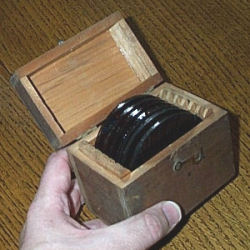
 Wooden box containing six excellent sets of English hand painted chromatrope discs. Each set consists of two identical glasses; each disc is 3 1/8" (8 cm) in diameter. |
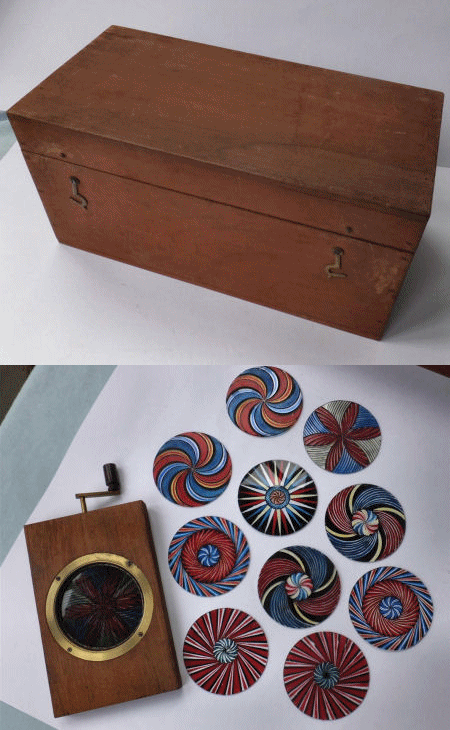 A set of these slides are illustrated in "Cameras and Photographica, Price Guide" by Kyle Husfloen, pg.107-108. |
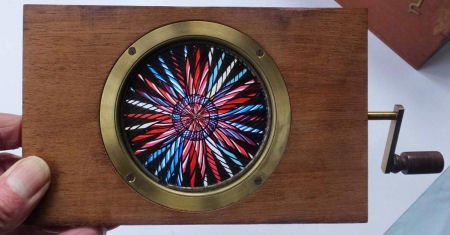 Another boxed set of interchangeable chromatrope slides comprising of 12 separate hand painted glass discs which can be inserted into the slide holder. The discs are held in place by a wire clip. Diameter of slide 3.1/8" (8cm). Slide holder approx 7" x 4.1/2" (17.8 x 11.3cm). |
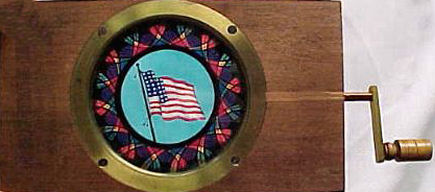 |
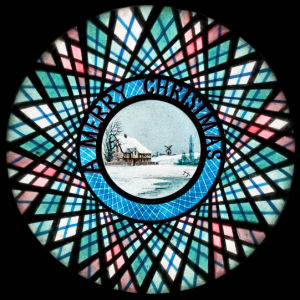
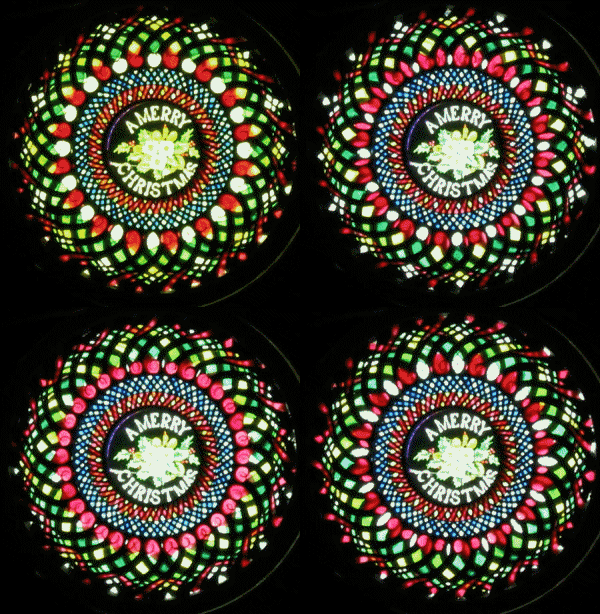
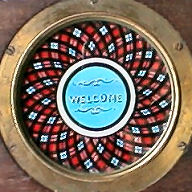 Chromatropes could incorporate static central pictures or texts like the words 'Welcome', 'Good Night' or 'Seasons Greetings', to use as an introduction or closing of the show. |
|
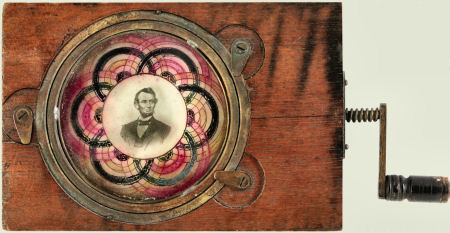
A rare chromatrope comprising of a hand
painted geometrical pattern to be turned against another pane, this
being the visage of Lincoln. Manipulated by an ingenious arrangement of
crank pinion and gear wheels, they are made to revolve in opposite
directions, thus producing a kaleidoscopic effect. |
 |
Also movable objects could be depicted in the
centre however, like a working windmill.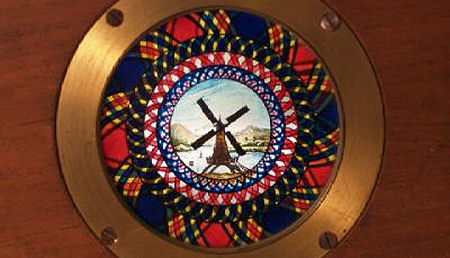 |
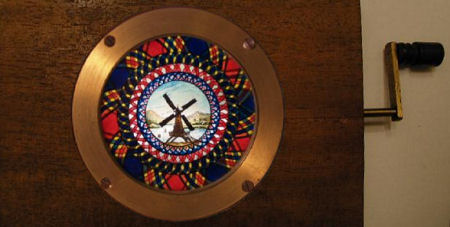 When the crank is turned a detailed kaleidoscopic pattern is created in sparkling colours. As the apparent pattern turns in one direction the vanes of the windmill rotate in the opposite direction. The windmill is set in the foreground of a miniature painting with a lake, hills and sky, with boats on the lake and tiny figures on the steps of the mill. All this a little over one inch in diameter. |
|
A special variation was de 'masked chromatrope',
listed in a Newton & Co. Catalogue of c. 1900, which had additional
grooves to permit insertion of a removable glass behind the rotating
disc system. The mask glasses where painted in black to leave a
transparent shape or pattern, so that the chromatrope appeared as 'fill
in' colouring through the mask design. A popular subject was a
butterfly, with the chromatrope providing changing coloured patterns for
the wings. |
|
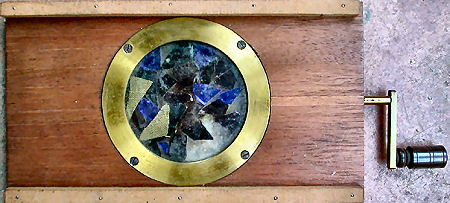 |
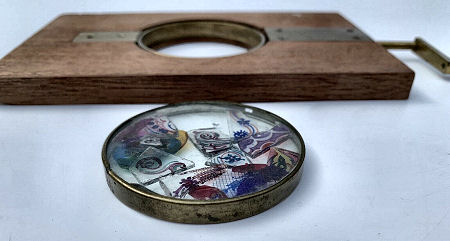
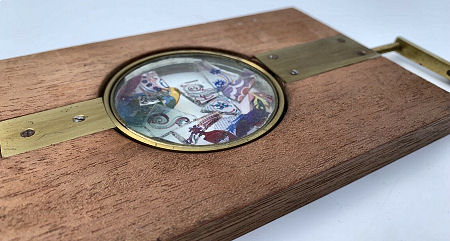
Unusual 19th century French single rackwork slide.
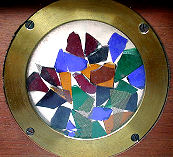 Small pieces of glass and brass gauze sandwiched between glass giving a kaleidoscope effect when the handle is turned. Size about 7" x 4" (18 x 10 cm). |
The working and the effect are the same as
those of a
children's toy kaleidoscope.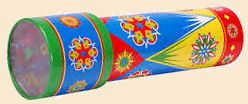 Two or more mirrors are placed at an angle to one another, (usually 60°) inside a tube, in this case inside the lens tube of a magic lantern. |
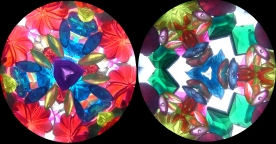 Projecting now gives an effect comparable to that of a normal kaleidoscope. |
 |
 |
|
Another Kaleidoscope Slide with removable brass
bound cell that contains loose painted glass inserts. Approximately 18 cms x 11 cms. |
|
 |
||
|
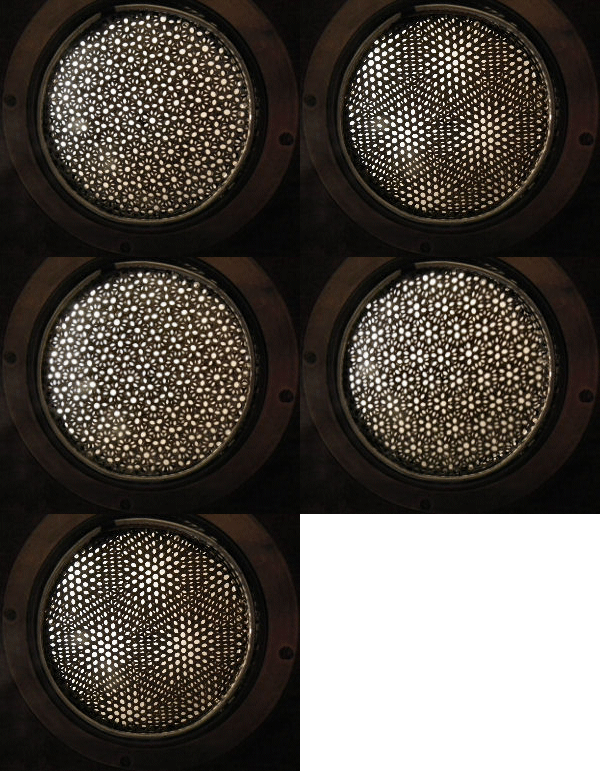
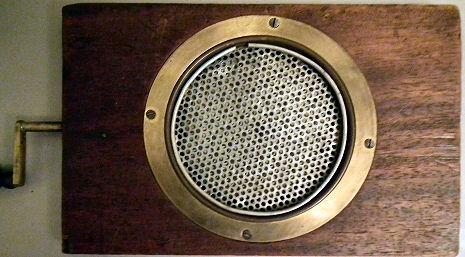
Special chromatrope that depicts a strobe like
effect. Operated by means of a crank handle. Sizes: c. 17.5 x 11.5 cms. |
||
 |
 |
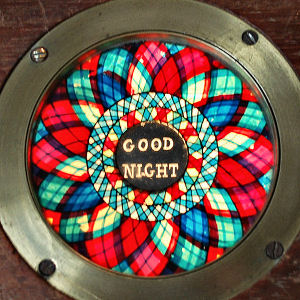 |
| Three chromatropes of which the text, and possibly a small image in the centre, remains, while the rest of the image behaves like a normal chromatrope. | ||
 
 |
©1997-2021 'de Luikerwaal' All rights reserved. Last update: 12-05-2021. |

|