 |
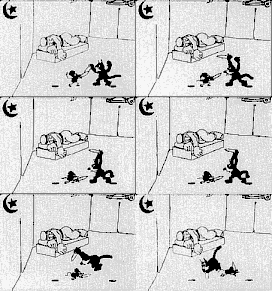 |
Cinematographs 1 movies on the magic lantern  |
Manufacturers of magic lanterns reacted to the emerging rivalry of the
motion picture at the beginning of the last century by making
supplementary devices that could be mounted on the base board, together
with the magic lantern. They were sold as 'a mechanism by which it is possible
to change each magic lantern into a cinematograph'. Later the projectors
were fabricated as a combined normal magic lantern and a film projector
 at once. Often those apparatus had their own trade name, we bring them
together under the collective noun 'cinematograph'. at once. Often those apparatus had their own trade name, we bring them
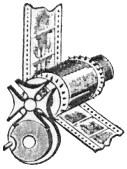
together under the collective noun 'cinematograph'.Cinematographs always had the ability to show loops, film strips from which the begin and end were glued together. For this purpose the upper reel was mounted high above the apparatus on an extending bar. Mostly also longer films could be showed. Often an receiving reel was absent; after passing the film channel the film landed simply on the table or the floor. The intermittent film transport was brought about by a rotating buckled rod that repeatedly struck the film down, or later by means of a 'Maltese cross' (see picture). |
||
 |
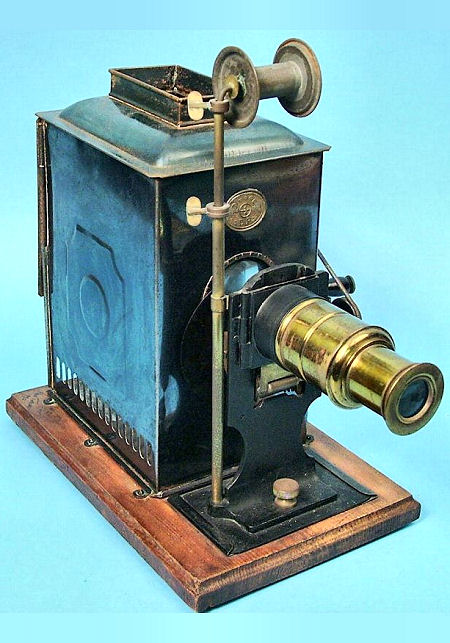
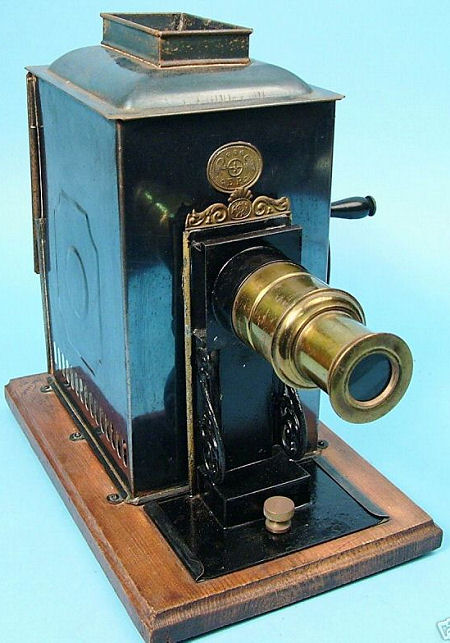
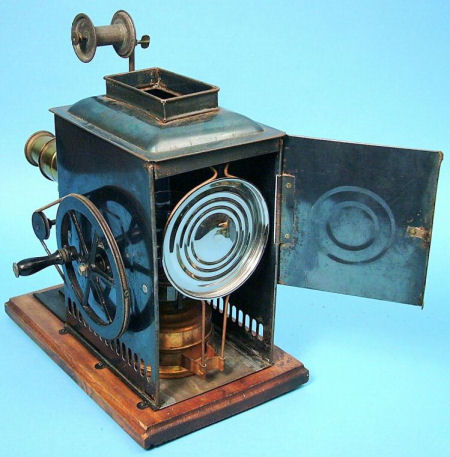
Cinematograph made by Ernst Plank c. 1905 This cinematograph is a good example of a combined slide/cinematograph magic lantern. It is complete except the chimney, which can be considered as a part of the source of light. |
|
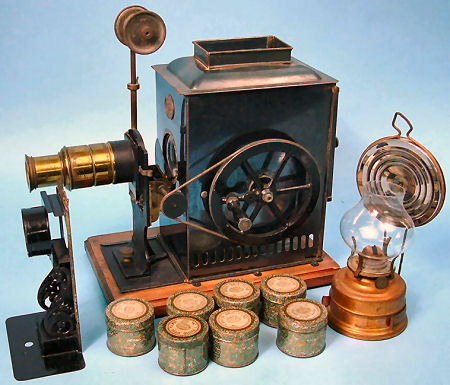 The Russian iron lamp house stands on a massive oak baseboard and has the makers trade plate with the well known winged wheel and the initials E.P. at the front. |
 |
|
|
The optical part consists of a condenser lens in the
body, and a brass objective assembly that can be placed in one of the two
interchangeable pedestals. The lantern measures c. 36 x 20 x 36 cm. |
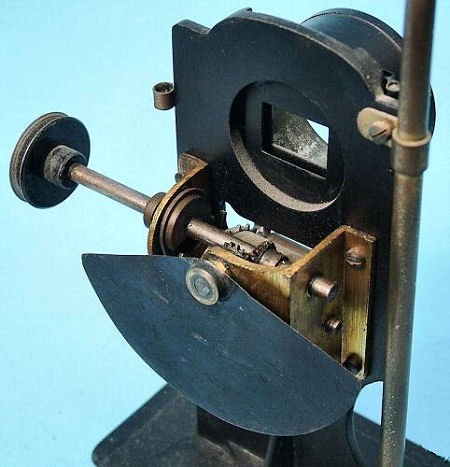
When used as a cinematograph a big handwheel to one side drives the film transport and shutter via a belt, pulley, shaft, wormwheel, and pinion. | |
 |
 |
|
|
Most models have a combined pedestal for projecting
slides as well as film strips. With this model the front pedestal with the
film transport mechanism can be removed and replaced by a simple pedestal,
enabling it to operate as a 'normal' magic lantern for showing oblong glass
lantern slides. |
||
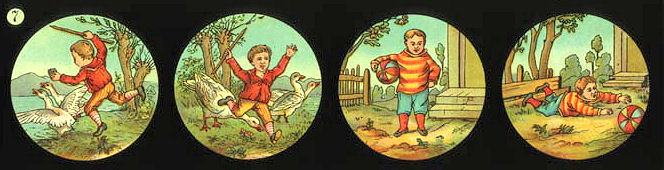 Magic lantern slide |
||
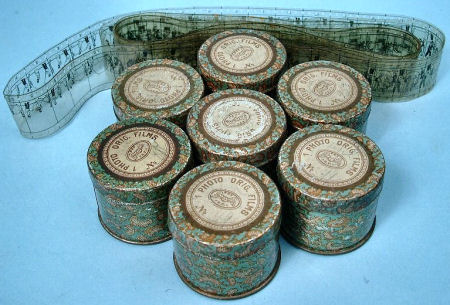 Belonging to this cinematograph are some small cans containing short films on a variety of topics. The beginning and the end of the films are glued together, thus forming an endless loop. The rear door opens to reveal the oil lamp with reflector. Of course this simple lamp could easily be replaced by another type. |
 |
|
 |
Nog een
goed voorbeeld: Another good example:
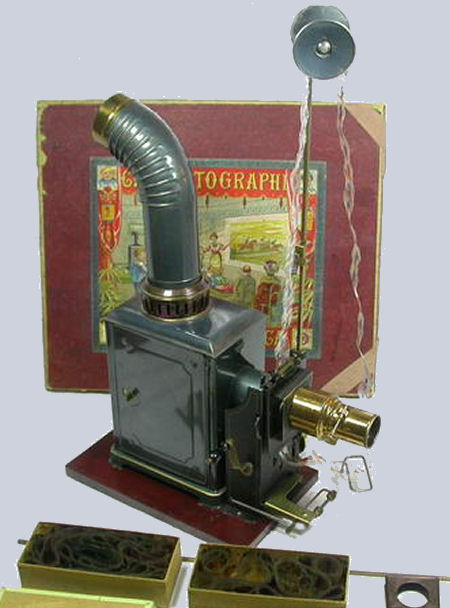
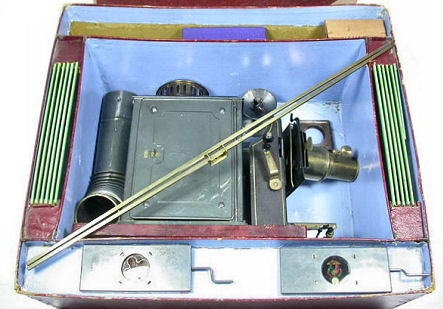
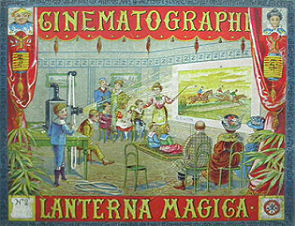
Cinematograph Georg Carette & Co, Nuremberg,
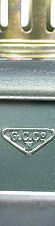
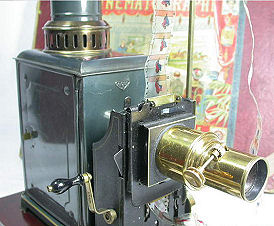
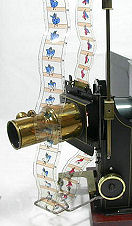
c. 1900. This cinematograph has a combined fixed front part for projecting slides as well as filmstrips, which is mounted on the wooden baseboard and forms an indissoluble part of the lantern. |
|
 |
||
 |
||
|
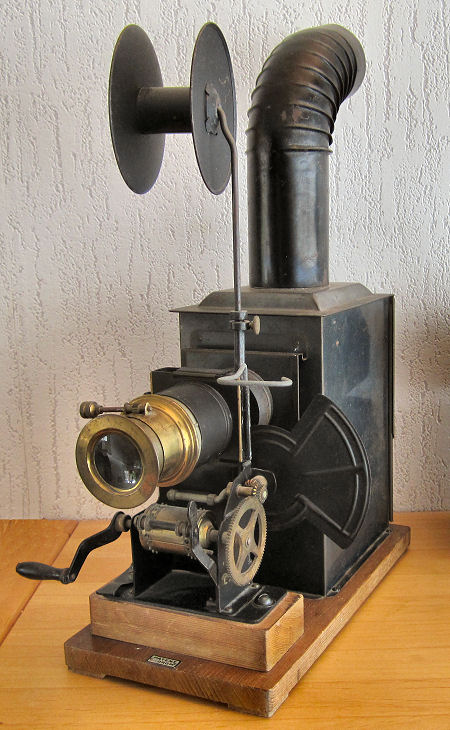
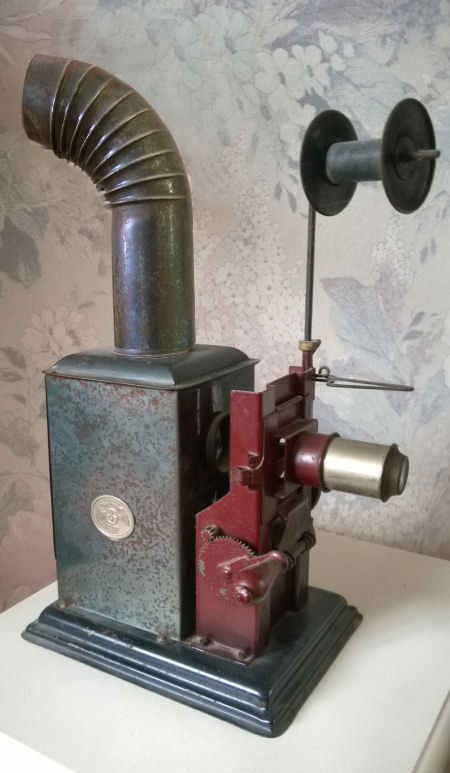
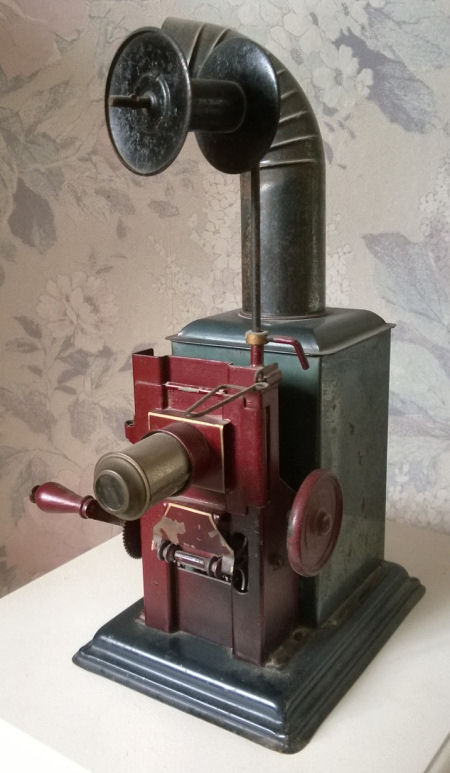
Gebrüder Bing. Great magic lantern and cinematograph, made by Gebrüder Bing, Nürenberg, Germany. On the back the 'G.B.N. Bavaria' trade mark, on the wooden base a little plate with the text 'PATENT DIV DRGM'. Film transport is achieved by a rotating, buckled rod that hits the film continually near the sprocket, causing an intermittent movement of the film. In cooperation with the synchronic rotating shutter a flowing movement of the image is obtained. Dimensions: Ground plate: 11 x 6 inches (28.5 x 15 cm); lantern 9 inch (23.3 cm) high without and 17 inch (44 cm) including the chimney. 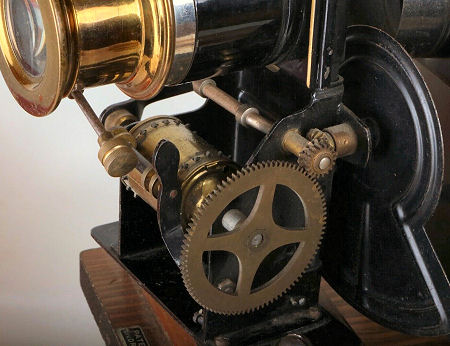 |
 |
||
 |
 |
||
|
Beautiful cinematograph made by Ernst Plank (E.P.),
Germany. |
|||
|
 |
||
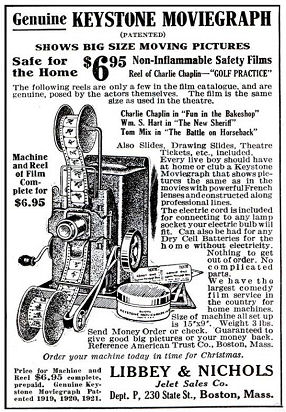
| Keystone
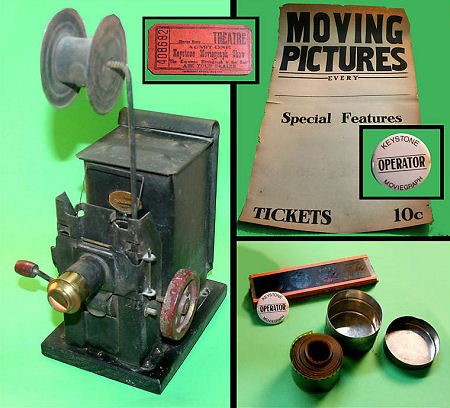
Moviegraph c. 1920. Pat. date may 4, 1920. The lantern stands 13 1/2" (34 cm) high and is 10" (25,5 cm) long. Light source is a standard light bulb in ceramic socket. Also included are some original posters, announcing a BIG MOVIE SHOW, some tickets and last but not least the KEYSTONE OPERATOR button.
|
|||
 |
 |
||
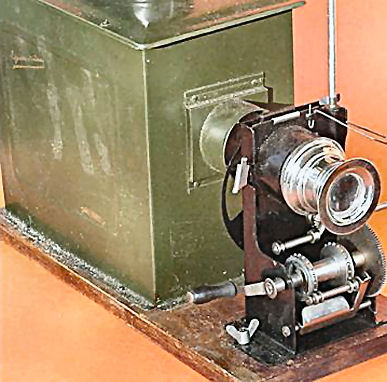
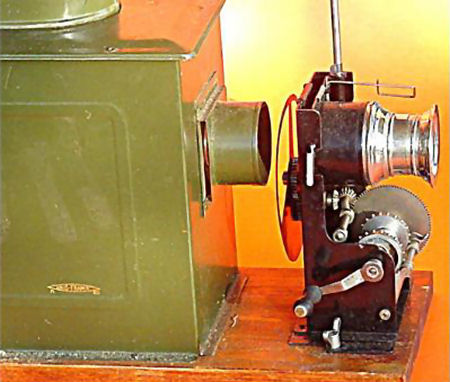
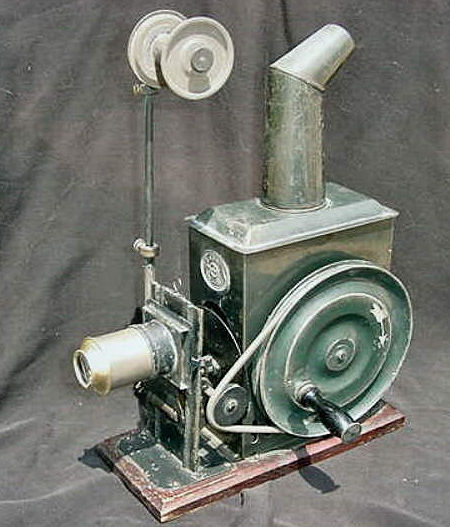
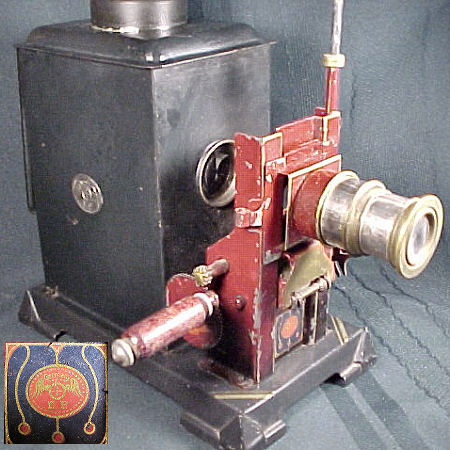
Lapierre Cinéma Model n°6 EL.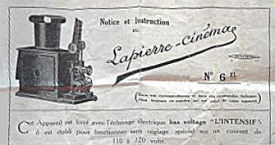 Lapierre Cinéma Model n°6 EL.
French movie projector and magic lantern of the 1920's with original marked box. Fitted for use on electricity with a voltage of 110 or 220 V. On one of the sides of the lantern the name of the manufacturer is printed, and also the logo of UNIS-FRANCE (see photo). UNIS-FRANCE was an organisation in which a large number of French companies was united. It was established probably during or shortly after the First World War in Paris, and existed up to the 1930s. UNIS is short for 'Union Nationale Inter Syndicale'. Aim was the promotion of French products, while it was a kind of quality brand too. It can be considered as a counterbalance for the mention 'Made in Germany'. On this lantern the indication UNIS-FRANCE is placed in a sharp oval near which also some numbers are printed, but also other versions of the logo are known. |
|||
|
 |
||
 |
 |
||
|
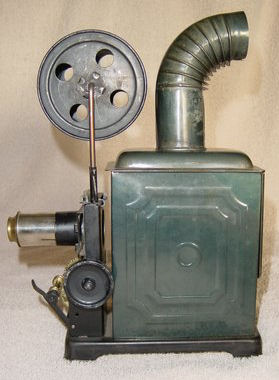
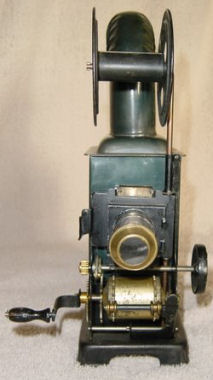
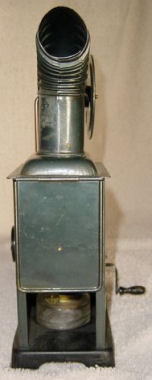
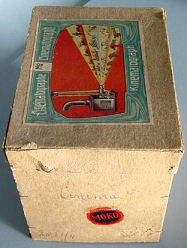
Cinematograph supplied by Moses Kohnstam.
Besides the lantern this set includes some admission tickets for children and adults for a Stereoptican show. This early tin Magic Lantern measures approx. 9 1/4" wide by 11" high (23.5 x 28 cm). Beautiful coloured label on the cardboard box. (more labels) On one side a pencil written text reads: Cinema 2821/4. The MOKO label is the trade mark of the German lantern dealer Moses Kohnstam in Fürth who was a distributor for several Nuremberg manufacturers. |
 |
||
|
|
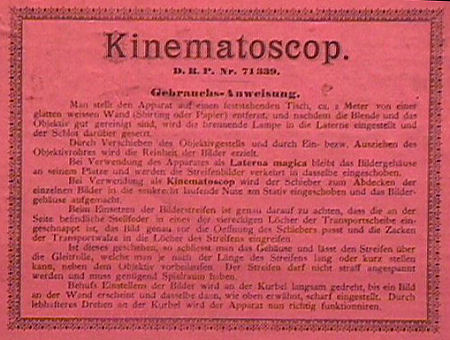
Kinematoscop |
||
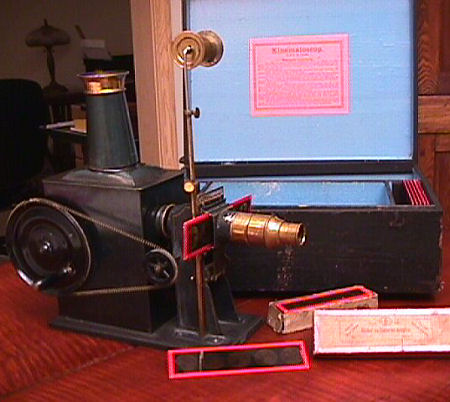
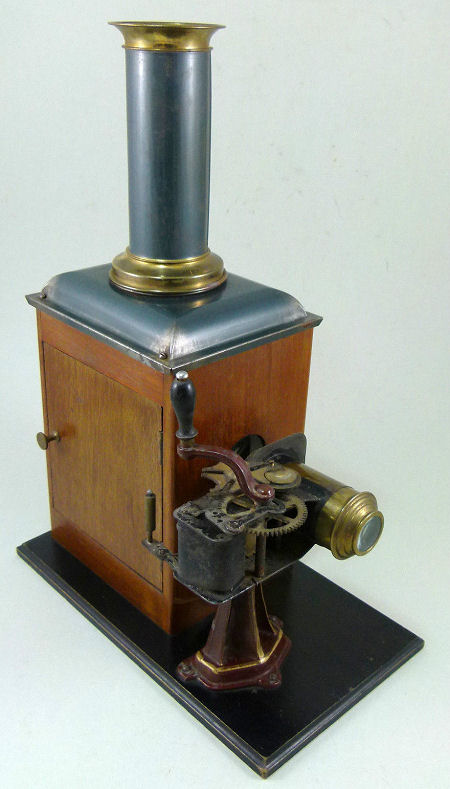
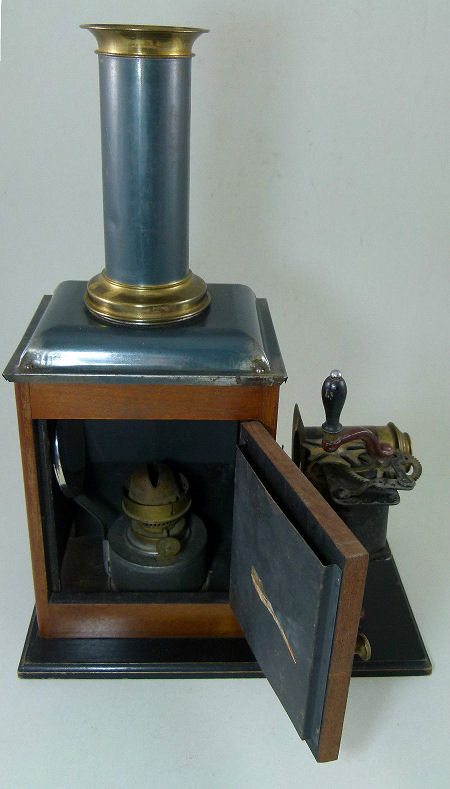
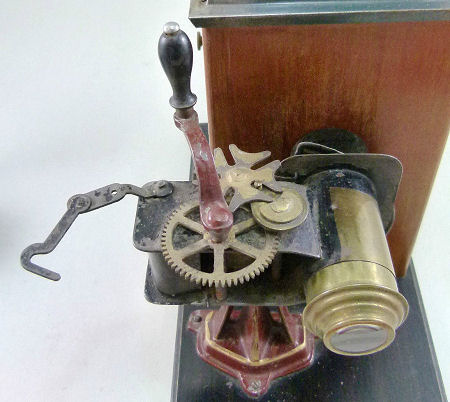
| Very special Carette cinematograph with a wooden body and a very unusual horizontal Maltese cross movement and film run. By means of the matching adapters the cinematograph is also suitable as a normal magic lantern for showing rectangular magic lantern slides. Made by Georg Carette & Co. Nürnberg, Germany, c. 1900. | |||
 |
 |
||
 |
 |
||
 |
Brown wooden lamp house with domed roof made of blued iron sheet. The side
door and the opposite side are lined inside with sheet metal. Moulded bearer
for lens and film mechanics. Two adapters for magic lantern slides with
round and square cut-out. Base plate 25 cm x 14 cm, total height approx. 35
cm including chimney. This lantern was also produced with a metal lamp house. |
||
 |
|||
|
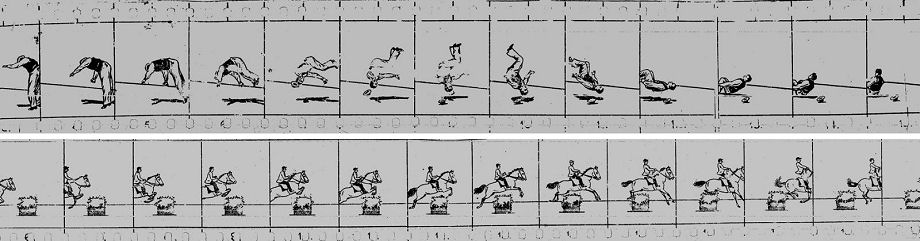
Of course this
special cinematograph needed special film strips on which the pictures were placed horizontally. |
|||
 |
 |
 |
|
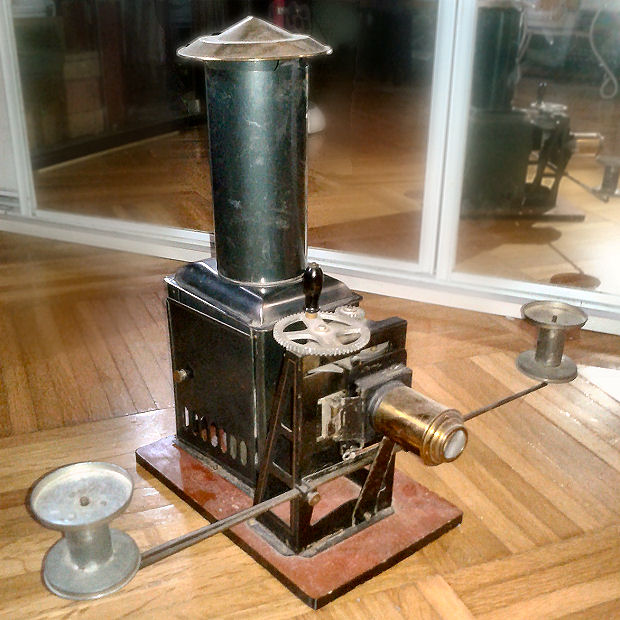
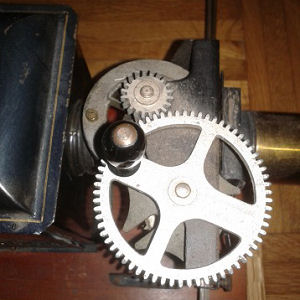
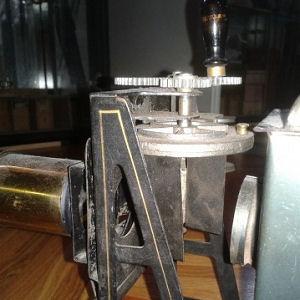
| Another very special and rare cinematograph with a very unusual horizontal film run of probably German origin. | |
More cinematographs on the next pages.... |
|
 
 |
©1997-2021 'de Luikerwaal' All rights reserved. Last update: 17-05-2021. |


|