 |
Magic Lanterns, manufactured by Ernst Plank part 1 |
|
The Ernst Plank
Company was seated in the Hochfederstrasse 40 in the German
toy town of Nuremberg. In 1866 it was enrolled in the Commercial Register of
Nuremberg as 'Ernst Plank, Fabrik Optischer und Mechanischer Waren'. Besides
magic lanterns the firm also made all kinds of tin toy steamboats and
train sets. Ernst Plank was the second largest in Nuremberg, after the 'Gebrüder
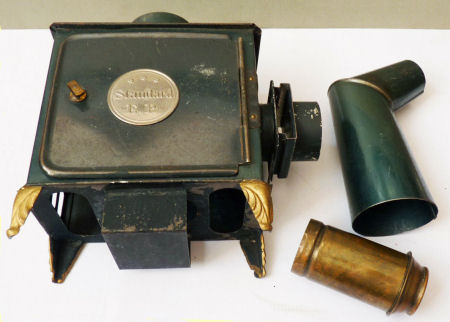
Bing'. Almost all the lanterns from Plank are supplied with its trade mark, bearing the initials 'E.P.'. Sometimes this mark was simply pressed in the tin, mostly a roundel was fixed to the lantern by means of two small clips. 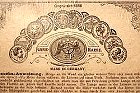
Also the label on the boxes always show his well known mark with the winged wheel. By this Plank's lanterns are always easy to recognize. The company survived the First World War, but magic lantern production gradually ceased in the 1920s. In 1930 the factory was sold to Hans and Fritz Schaller, who specialized in home movie equipments. After World War II their company was known as Noris Projektion GmbH.
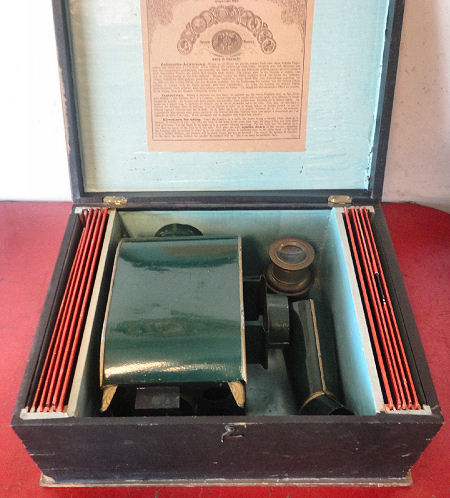
Usually the magic lanterns were sold in solid cardboard boxes or in wooden cases, which were able to contain one or two sets of slides and some other accessories as well. Most of the time the directions for use were glued on the inside of the lid; a colourful label often adorned the top of the box. Many of these labels are a real work of art. |
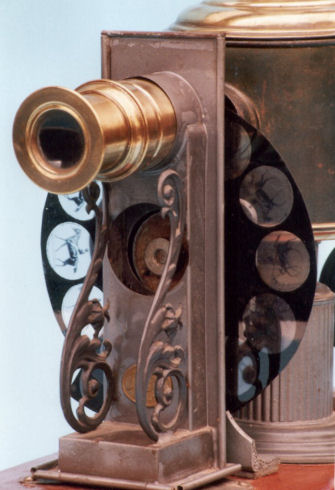
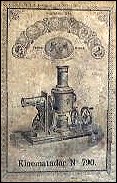
'Kinematador N°790', 1897. | |
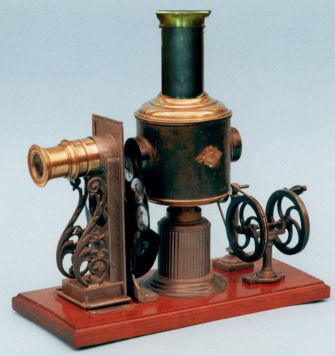  |
Though this type of lantern also has been produced as a 'normal' magic lantern
(see below),
this superb projector is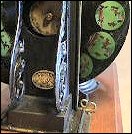 supplied with a mechanism
with a handle, flywheel and rotating shutter, that offers the option to show moving
pictures. By turning the crank, one makes rotate a disc of twelve slightly different
circular images, thus obtaining the effect of movement. The system is supplied with a mechanism
with a handle, flywheel and rotating shutter, that offers the option to show moving
pictures. By turning the crank, one makes rotate a disc of twelve slightly different
circular images, thus obtaining the effect of movement. The system is
 adaptable for the use of normal glass
slides too. Light system with oil lamp. adaptable for the use of normal glass
slides too. Light system with oil lamp.The original wooden box is labelled and numerated '1/12', made in Germany. Dimensions: box: 14 x 10 x 8 inches (35.5 x 25.5 x 20 cm); lantern: 13 x 5.2 inches (33 x 13 cm), height 12.1 inches (31 cm). 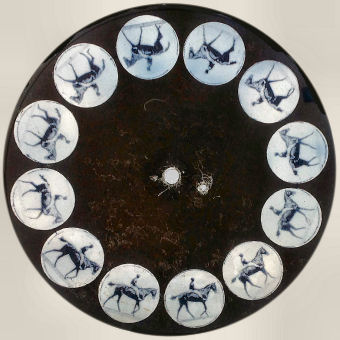 |
|
| Triumph. | ||
 |
||
 |
||
  |
 |
 |
| Ernst Plank circa 1885 | |
 |
 |
 |
 |
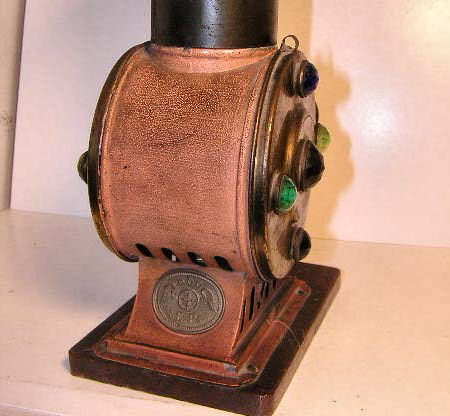 |
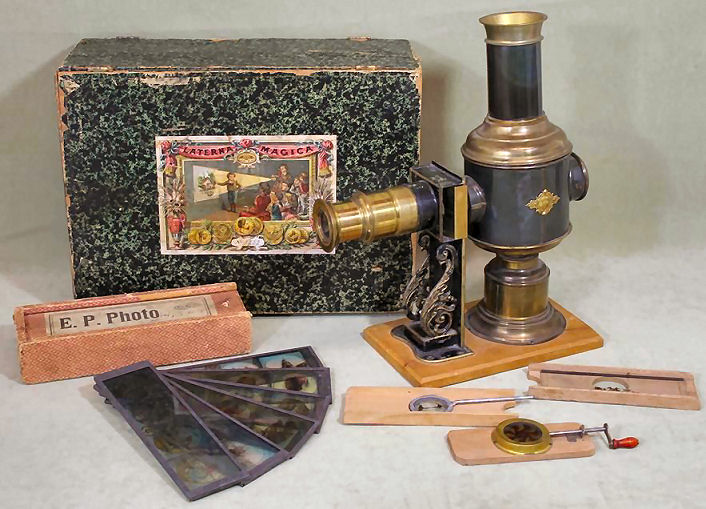
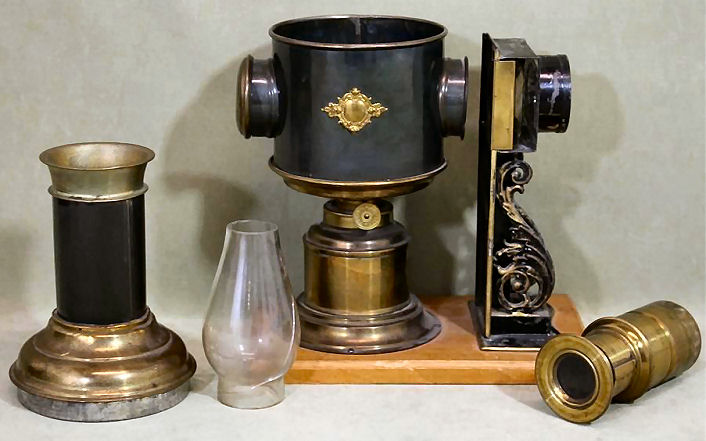
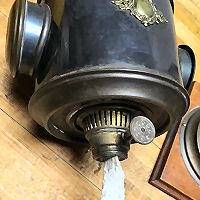
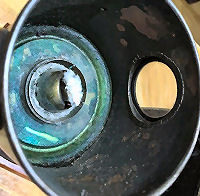
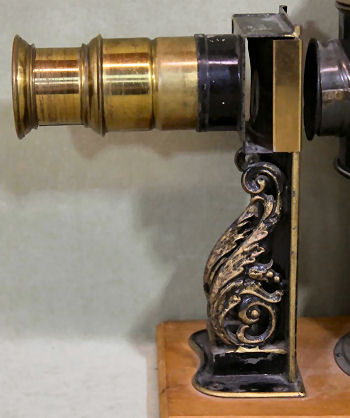
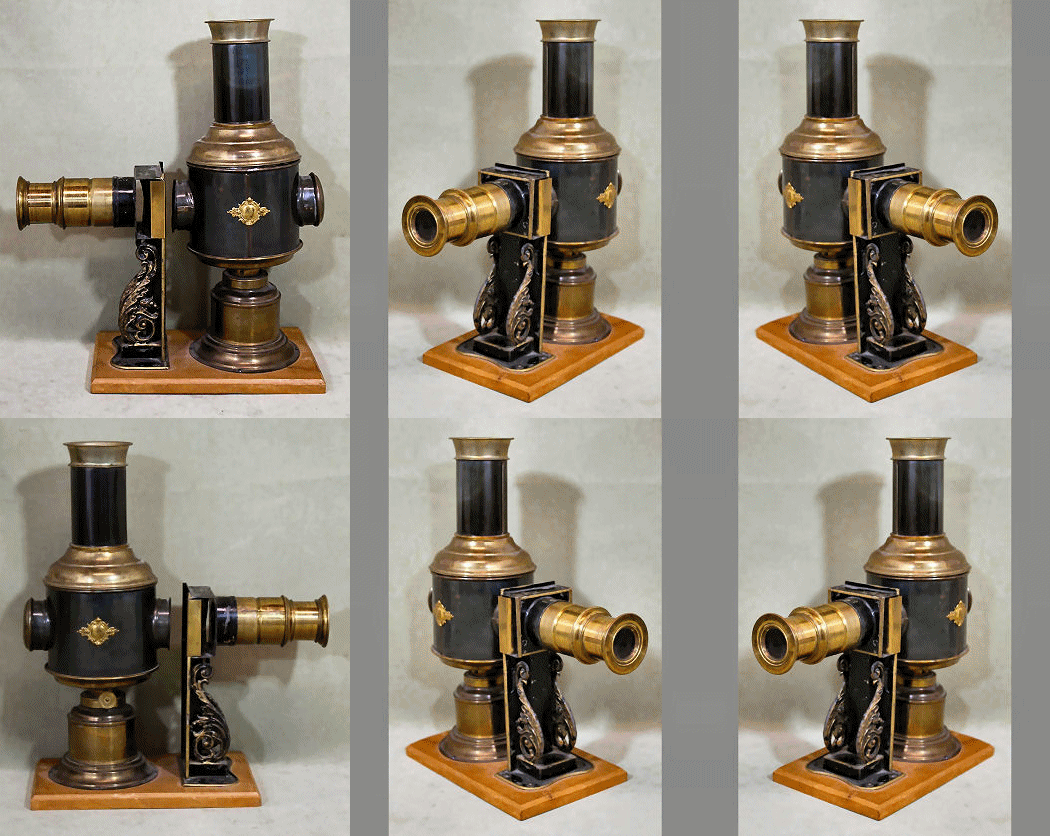
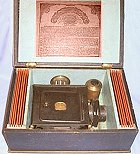
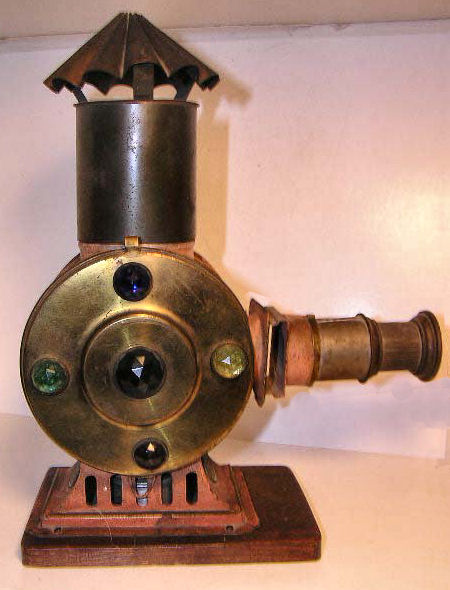
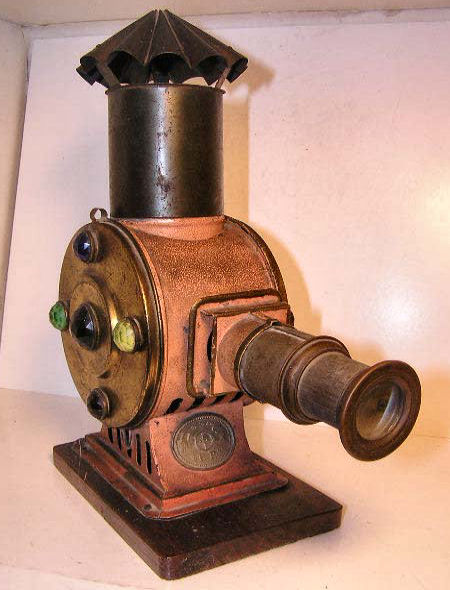
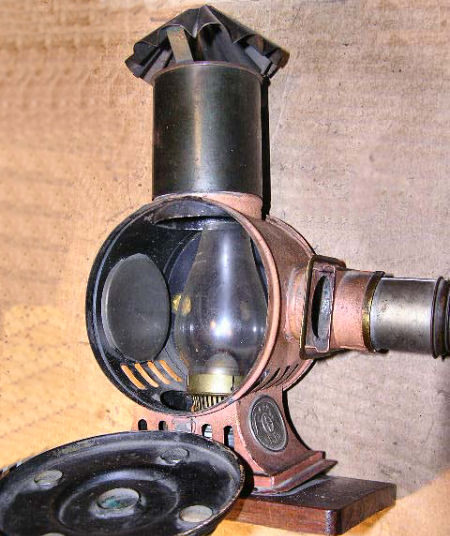
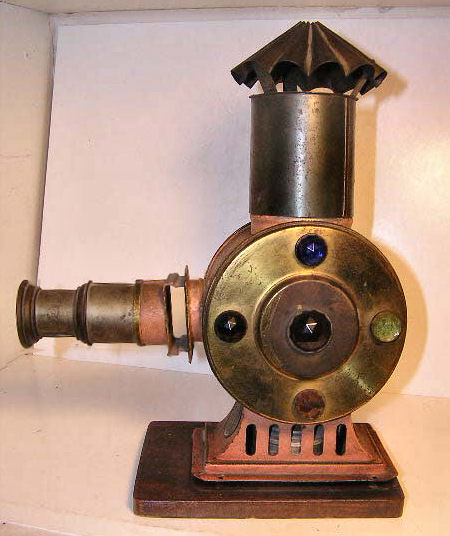
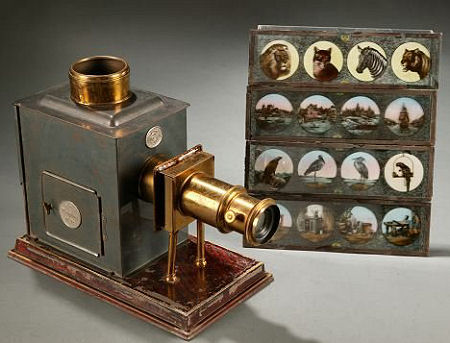
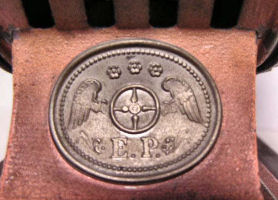 This brilliant magic lantern is decorated with beautiful different coloured glass 'gems' on each side. The lantern has a brass tag on the front and back with the E.P. trade mark in it. |
 |
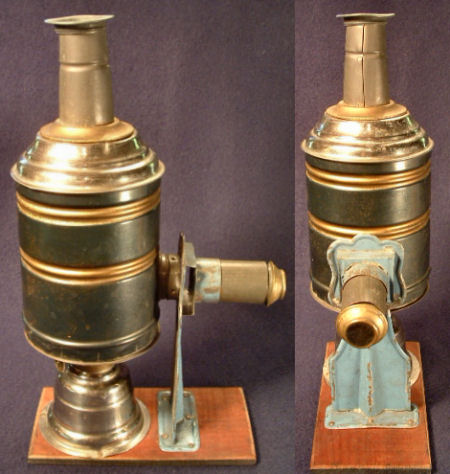 |
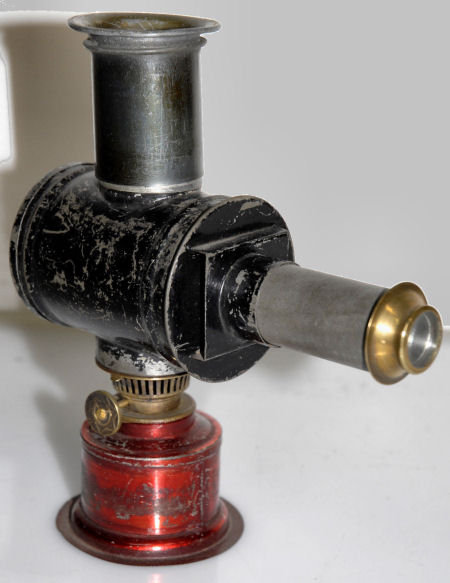
| No type designation known. Cylindrical lamp house of black lacquered tin on a red lacquered base that also serves as a holder for an oil lamp. The height is 17 cm, the length is 14 cm. Suitable for slides of 3 cm wide. | Another E.P. magic lantern without type designation. The cylindrical lamp housing stands upright here. Bell-shaped base containing the oil lamp. Height 23 cm, diameter lamp housing. Suitable for slides of 2.5 cm wide. |
 |
|
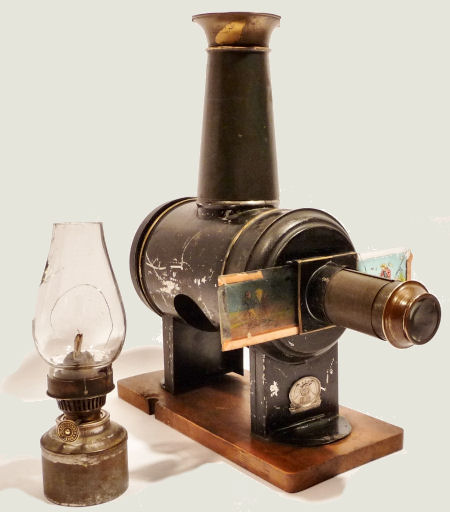
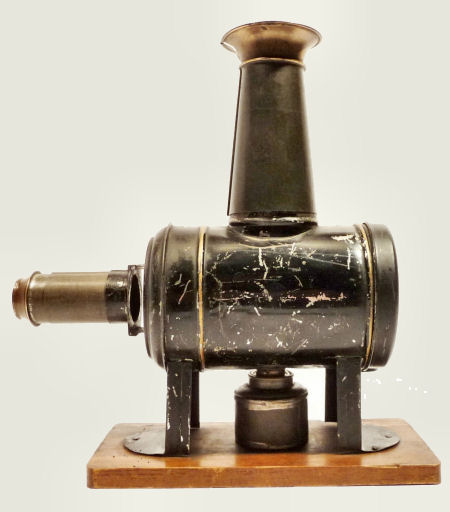
| E.P. with elegant lens support. | |
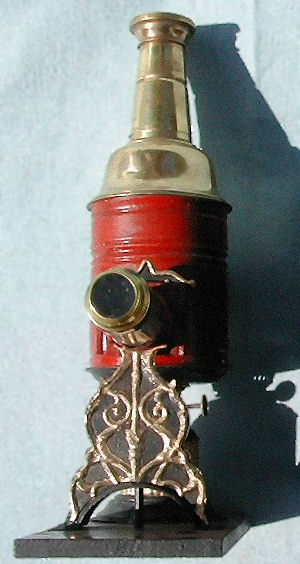 |
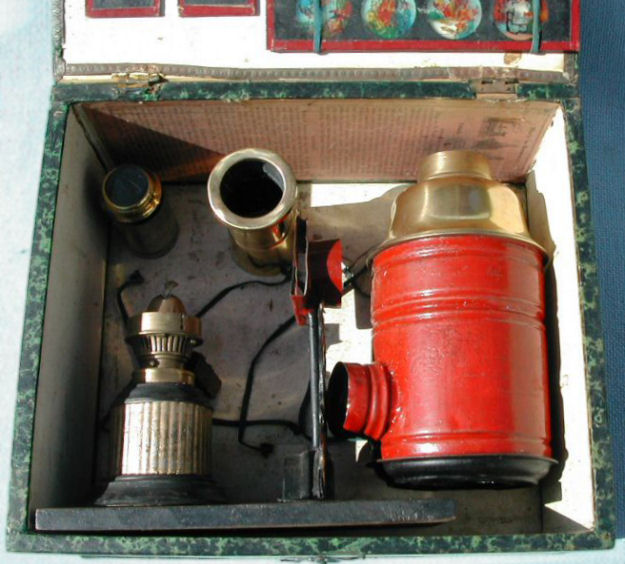 |
 |
 |
|
| Laterna Magica Solid. | |
 |
 |
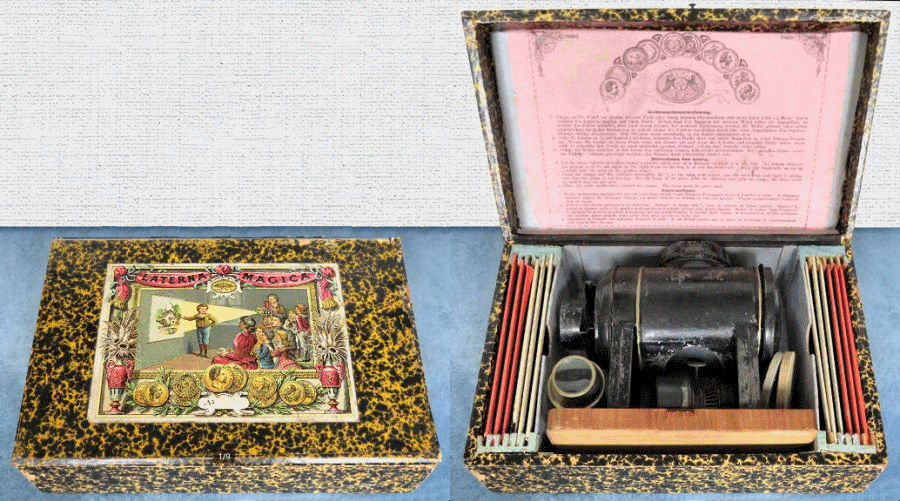 |
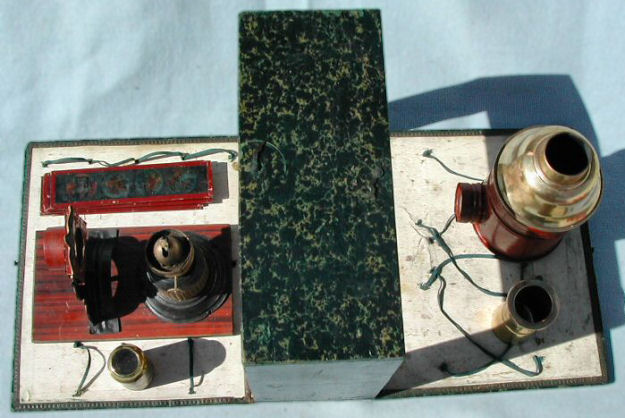
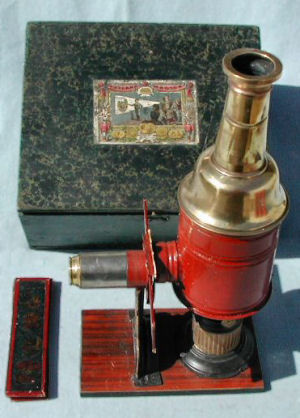
This simple magic lantern was sold in a large number of versions. The
smallest were suitable for the use of lantern slides 3 cm wide; the
larger ones could show plates of 8 cm wide. They were also supplied with
or without an associated oil lamp. A luxury set was delivered with 12
magic lantern slides, 1 chromotrope, a moving landscape and 1 comic
moving plate, both in a wooden frame. This magic lantern was packed in a wooden box lined with marbled paper, along with 12 magic lantern slides. Box dimensions: L 24.5 cm, H 7.5 cm and D 16 cm. Instructions for use were taped to the inside of the lid. |
|
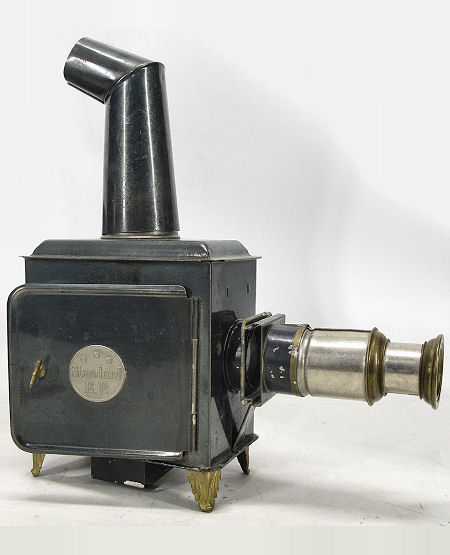
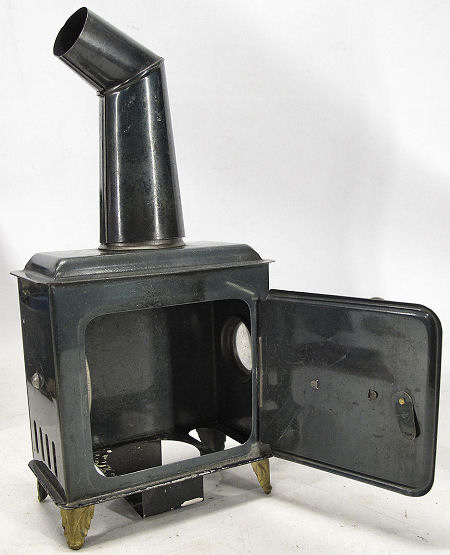
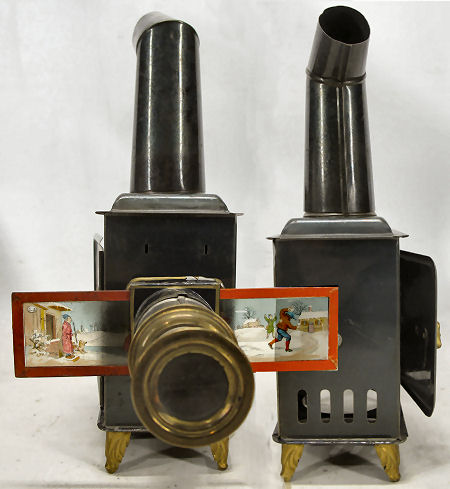
Standard,
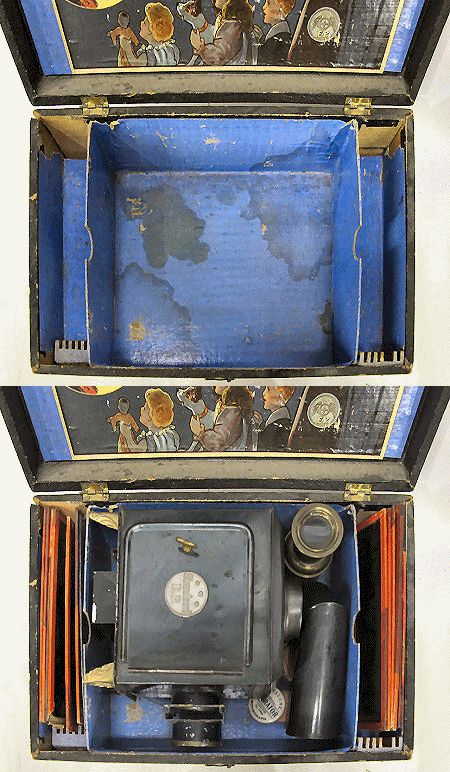
1900. One of the most frequently sold E.P. lanterns, the Standard (1900), in a wooden box with a colourful label on the lid. 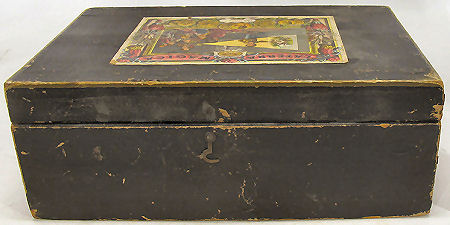 A label is stuck on the inside of the lid too. |
 |
 |
 |
 |
 |
| ACME. | |
 |
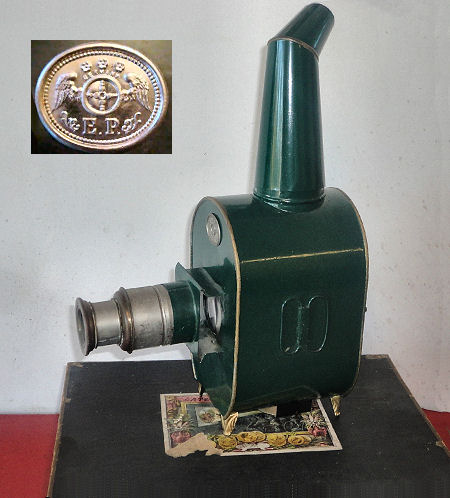 |
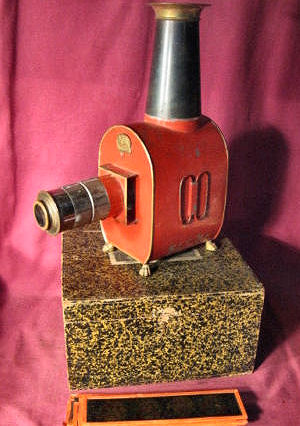 |
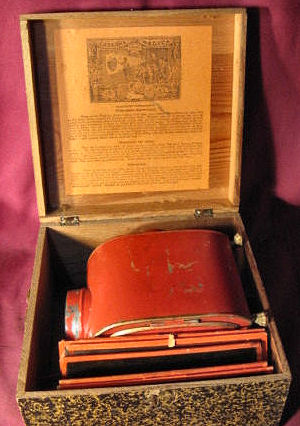 |
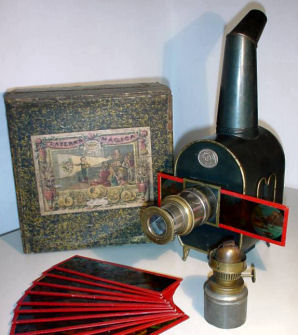
This magic lantern was supplied as standard in pump-green, but on request also with a red or black lacquer. There are two folding handles on one side. |
| Also this magic lantern appeared in different sizes and was suitable for displaying 4.5 cm - 9 cm wide slides. The lantern is supported by four golden lion legs, which is rather characteristic of Ernst Plank's lanterns. | ||
|
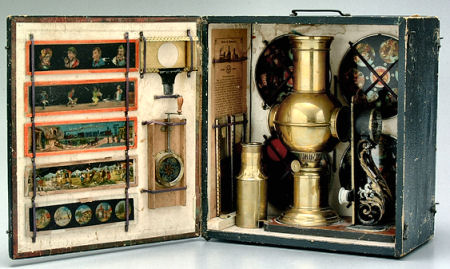
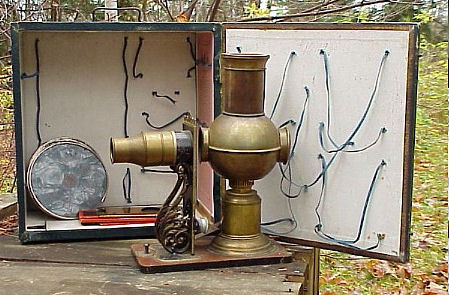
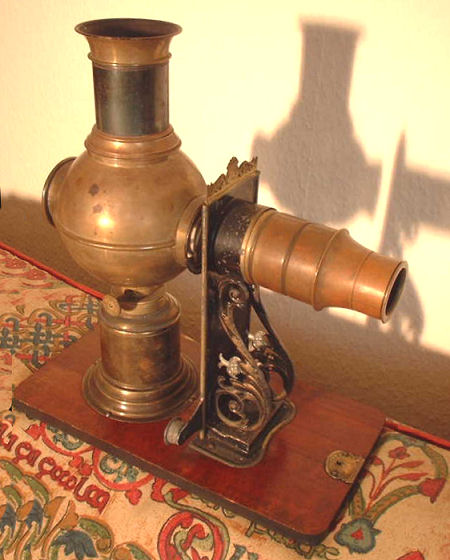
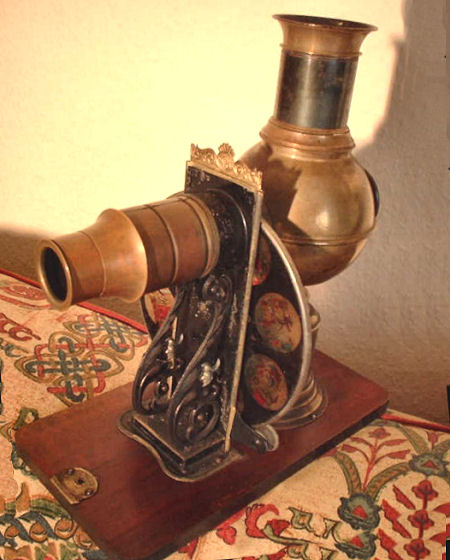
Globus. Complete in storage box, along with five round glass discs with series of pictures of Robinson Crusoe, Human races, Little Red Riding Hood, Portraits, and Geology, some elongated plates, a chromatrope and a mechanical slide. |
|
 |
 |
 |
 |
 |
 |
 |
 |
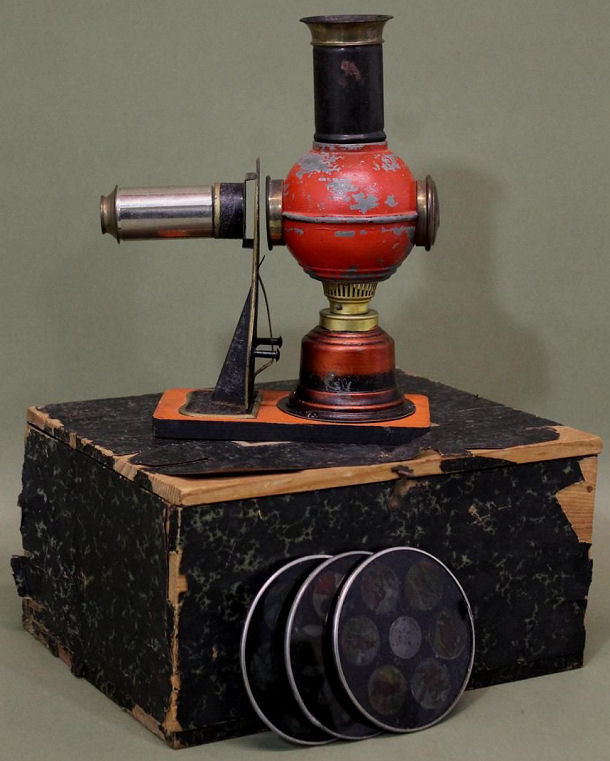
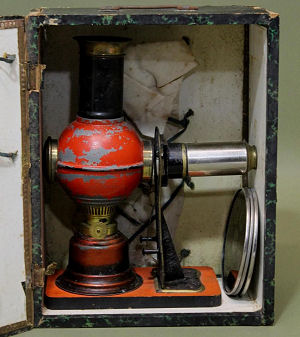
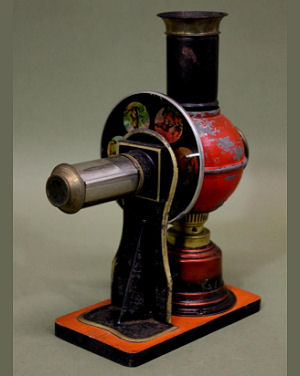
| Climax. | |
 |
 |
||
Climax 1898.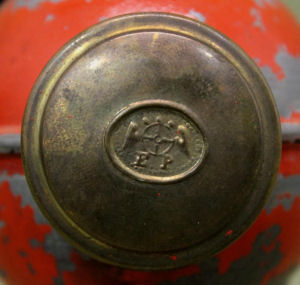 |
|||
 |
 |
 |
|
 |
 |
||
|
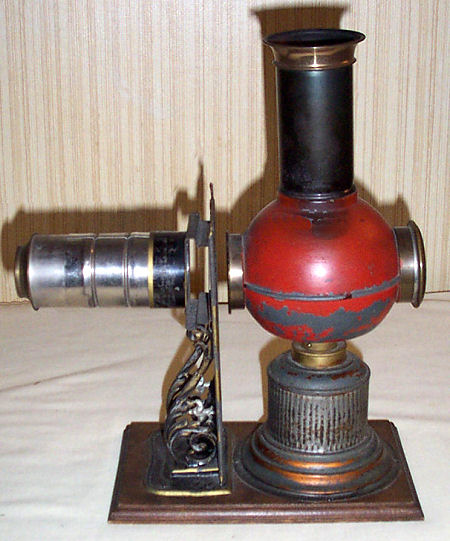
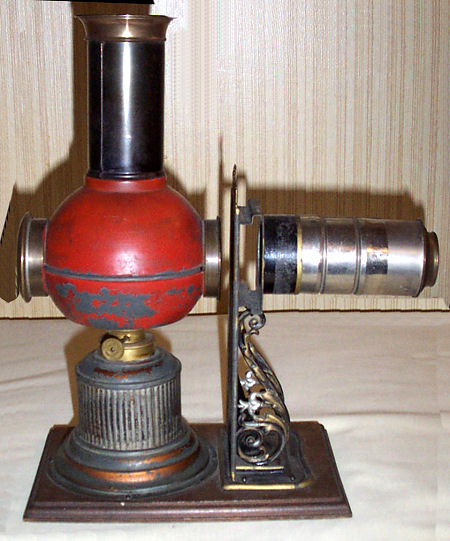
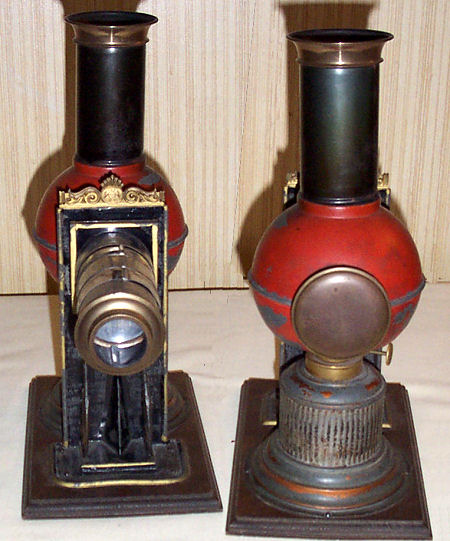
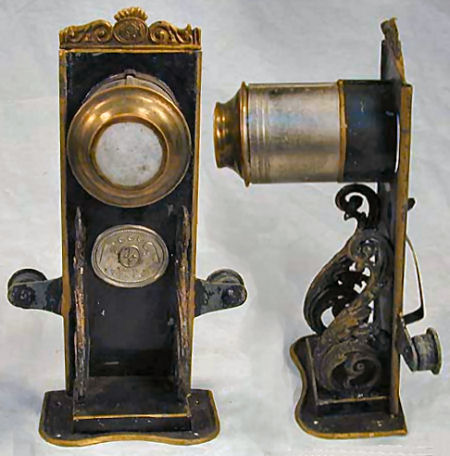
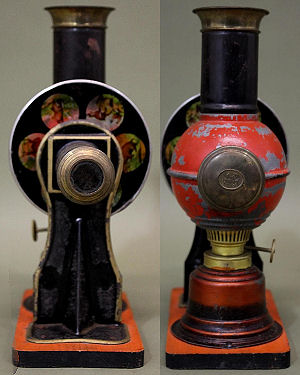
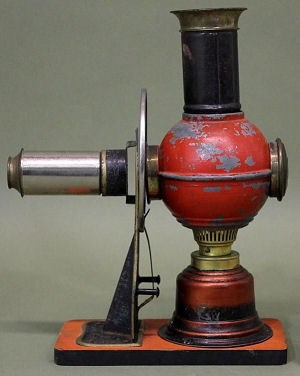
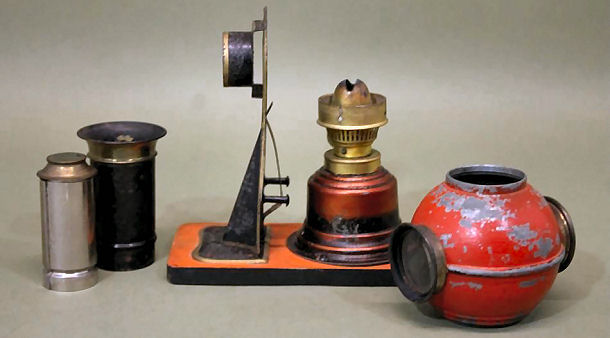
Red lacquered spherical tinplate body, suitable for the normal oblong glass slides
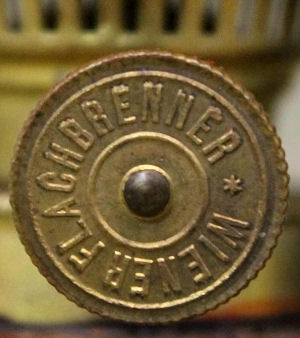
and disc shaped glass slides as well. This model was obtainable in five sizes. Many variations of this type exist: with a lacquered lamp house, with a brass lamp house, spherical or cylinder shaped, with a curly or simplified slide holder, and so on. 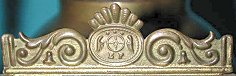 The EP-trade mark is pressed in the brass upper edge of the slide
holder. Suitable for round slide discs of 11 cm diameter. The EP-trade mark is pressed in the brass upper edge of the slide
holder. Suitable for round slide discs of 11 cm diameter.The Climax is also called 'Brilliant M.L.' in the USA and in the UK. |
|||
|
More magic lanterns made by E.P... |
|||


 |
©1997-2023
'de Luikerwaal' All rights reserved. Last update: 13-12-2023. |
 
|