
|
Discs and drums or how the images learned to walk. |
|
| part 2 | ||
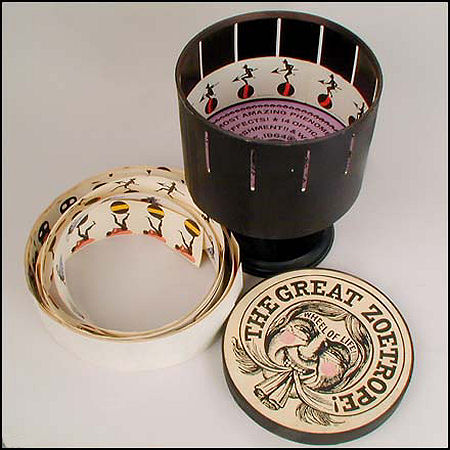 |
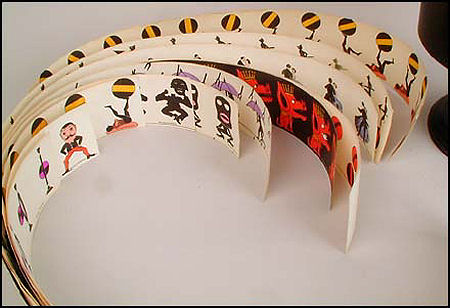 The Great Zoetrope is a 1964 reproduction by Boutique Fantastique of an early optical toy for showing short animation sequences. A label identifies it as "First Edition of 1,000, No. 0359." This item comes with a set of 11 different animation strips. |
|
| This Zoetrope
consists of a 10-inch diameter cardboard drum that looks like a
hat box with slits in its side. The drum attaches to a brass spindle which
balances it on a wooden stand. You then put an animation strip inside the
drum and spin it with your hand. As you peer through the slits, the figures
on the strip appear to move.
The wooden stand and all of the animation strips can be stored conveniently
inside the drum. A round lid covers it all. The animation effect of the Zoetrope depends on the persistence of vision phenomenon, which is also what makes movies possible. The inventor William Horner originally called it a Daedalum ("wheel of the Devil"). In fact, one of the included animation strips shows devil figures and balls. When you spin the drum, the devils appear to hop from ball to ball. Included strips show dancing men passing their heads from side to side, elegant couples dancing, running figures with umbrellas in a rain of falling pitchforks, a jack-in-the-box, plus other various fantastical figures and optical illusions. The strangest one is the animation of a dog swallowing an angel, which then flies out of his ear. |
||
 |
 |
 |
| In Reynaud's
Praxinoscope, a band of drawing placed around the circumference
of a shallow cylinder was viewed in motion by reflexion in a drum of mirrors
in the centre . |
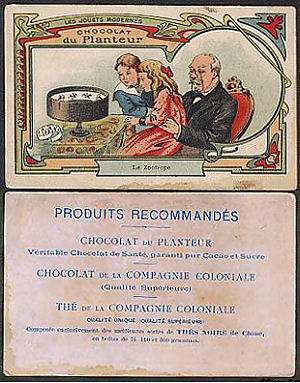
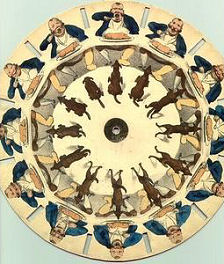
Old French trade card for 'Chocolat du Planteur', depicting in the series 'Les jouets modernes' (modern toys) 'Le Zoetrope'. | Beautiful disc for a Phenakistoscope, 9.75" (24.5 cm)diameter. |
|
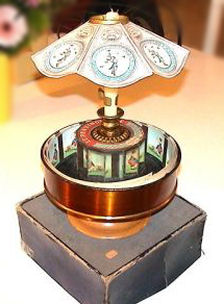
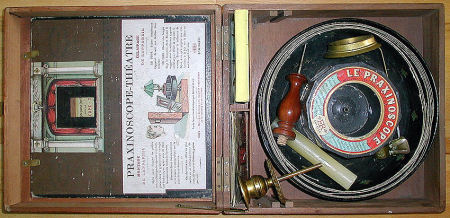
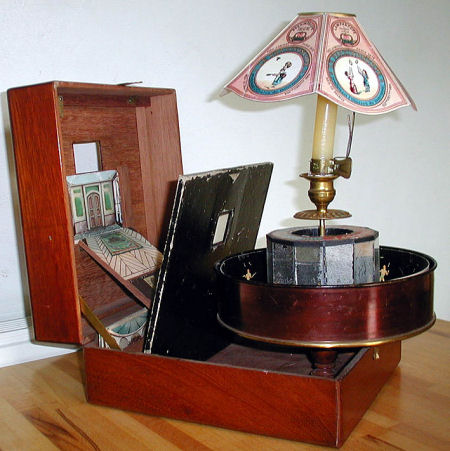
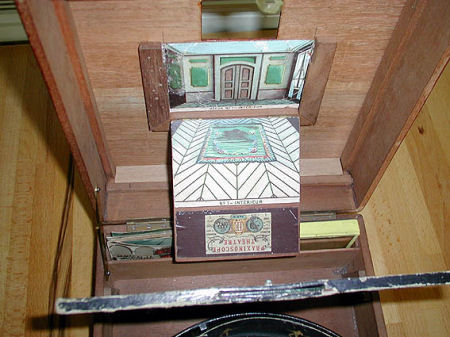
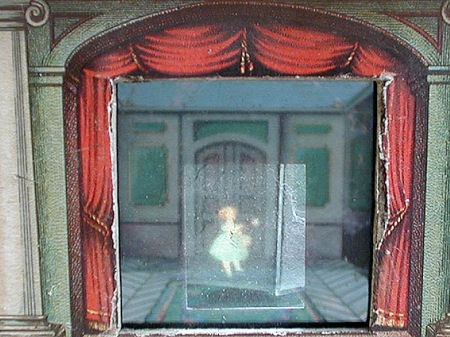
Deluxe version of a Praxinoscope Theatre in a mahogany chest. 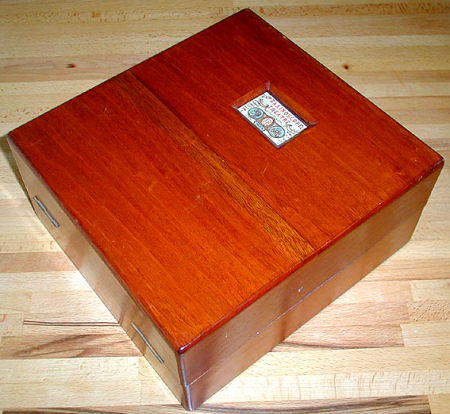 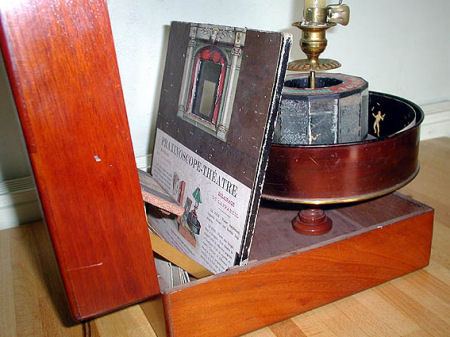 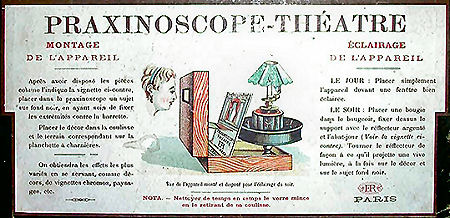 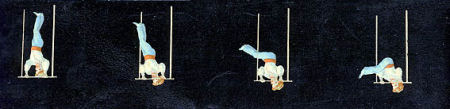 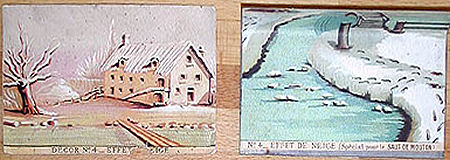 |
    |
|
The Zoetrope was a great toy showing the illusion of movement, but the loss
of light was high as one could only see through the narrow slots on the
drum. Emile Reynaud solved that problem with his Praxinoscope as the
movement is shown via mirrors at the centre of the apparatus, a great
improvement! This theatre version is a fantastic toy because you can see the animation within a static theatre. One of the ten different sets is placed on a holder in the lid of the device, one can then see the reflection on a wooden plate like a small theatre and through the hole in this plate one of the mirrors in the drum can also be seen . When the drum is turned, the character is animated. Magic! All pieces are original, except the lampshade. As always, the original was once burned by the flame of the candle. |
|
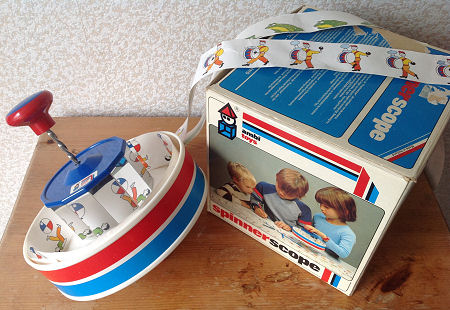 |
A relative modern praxinoscope in the shape of a humming top, the
Spinnerscope made by Ambi Toys, Holland. As with a
regular humming top, the knob needs to be moved up and down to rotate the
drum. The moving images can then be seen in the mirrors
on the inner drum. Using an enclosed manual, children can also make
the strips themselves. |
 |
 |
||
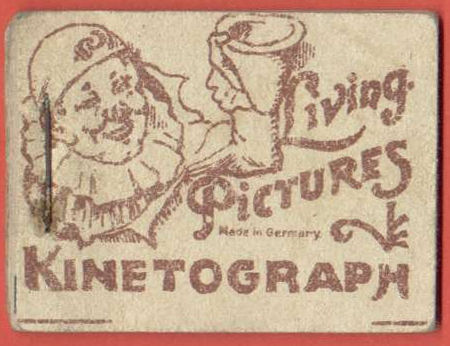
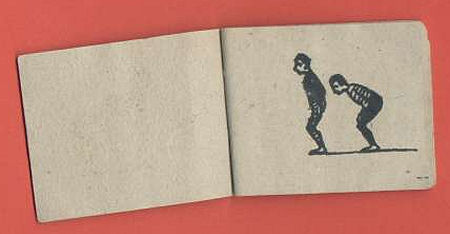
| German
optical toy called
'Kinetograph'. It is a flipbook,
producing 'Living Pictures' when it is flicked through quickly. It measures
2" x 1.5" (5.5 x 4 cm''. |
|||
 |
 |
 |
|
 |
 |
 |
 |
|
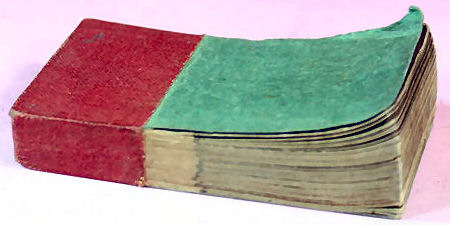
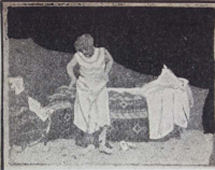
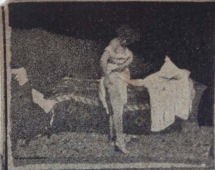
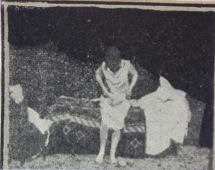
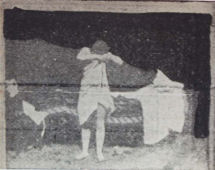
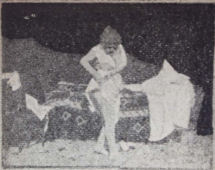
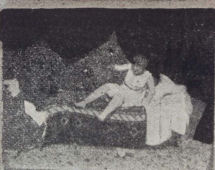
Funny small folioscope (flipbook) that shows a lady in her bed room preparing to
sleep. Such a scene was rather filthy at that time (around 1900). Sizes 7 x
4 cm. Probably French. |
|||
 |
 |
||
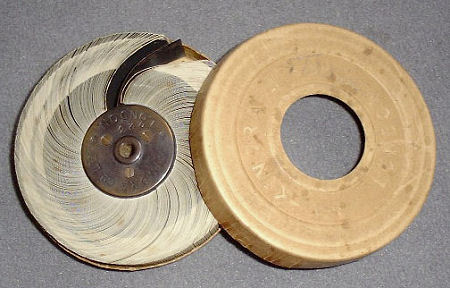 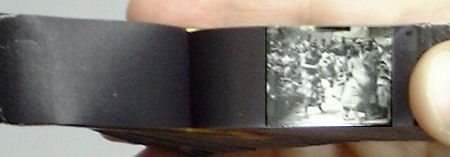 |
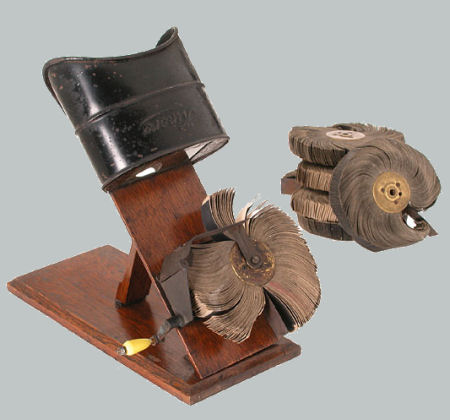
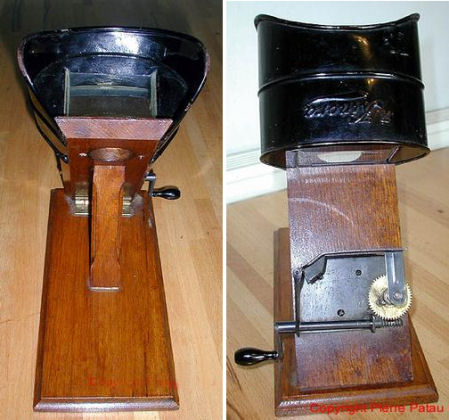
KINORA viewer manufactured in England around 1900. The Kinora system of "home movies" was an invention of the Lumiere Brothers in 1896, based on an idea by Herman Casler. Reels of 'flipbook' type contained thousands of leaves, each with a single photographic image. They were mounted in a simple, miniature Mutoscope viewing machine and were very popular until WW1. Reels could be bought or hired, and featured actuality scenes and many other subjects. It was also possible to have one's Kinora moving portrait taken in a studio; a home movie camera was marketed in England. The Kinora was popular from the turn of the century until around 1915. Size: 11" long, 10.5" high when open (28 x 27 cm). |
||
 |
 |
||
|
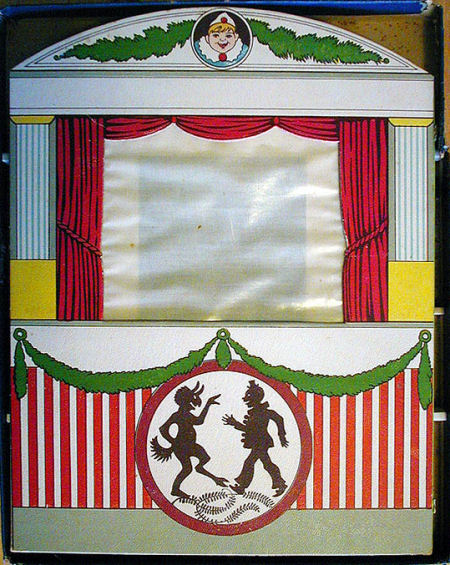
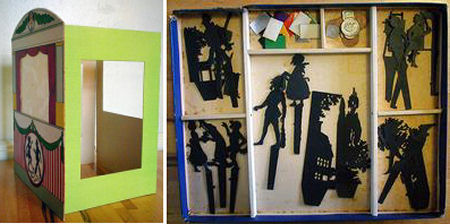
Spear shadow optical toy theatre. Boxed toy shadow theatre published circa 1910 by J.W.Spear & Sons Nuremberg. Folding theatre together with characters and set pieces. Also in the box are fake coins and tickets for the show. Size: 38 cm x 31 cm. |
|||
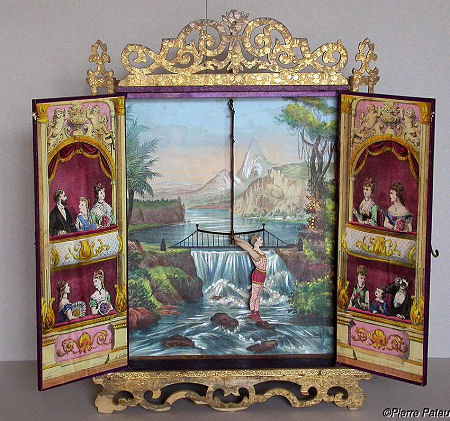 |
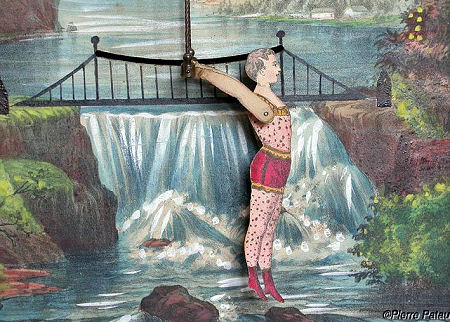
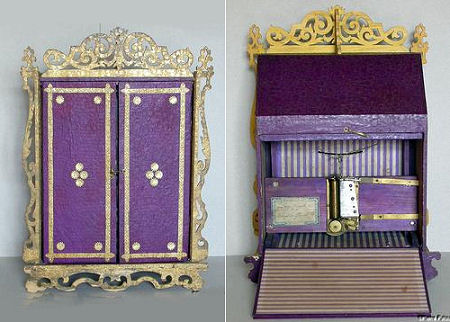
A beautiful wooden cabinet
covered in embossed paper that opens automatically to reveal a truly
exceptional toy automaton machine. Made in France around 1865 and signed
B.Couder. A slot along the top of the bridge allows the trapeze to swing from side to side as the acrobat performs. At the heart of this machine is an air-powered music box with stop/start and tune change levers; the winding mechanism is activated by pulling a copper ring on the side of the picture. 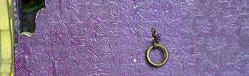 When opened, the automat theatre is 41 cm wide x 44 cm high x 18.5 cm deep. |
||
 |
 |
||
|
More about Pre-Cinema...... |
|||
 
 |
©1997-2022 'de Luikerwaal' All rights reserved. Last update: 24-11-2022. |
  
|