
Discs and drums Thanks to Pierre Patau who gave permission for the
the use of many of his photos in this item. |
Although the first magic lanterns were
already capable of producing moving pictures, it took a long time before the images really 'jumped to life'. From the 1830s onward, optical toys - such as the phenakistoscope, the zoëtrope and the praxinoscope - were designed to demonstrate or exploit the physical phenomenon of "persistence of vision." John Paris used his thaumatrope as early as 1824 to demonstrate this effect to the Royal College of Physicians. Such instruments used a technique comparable to the modern cartoon film. The principle is this: a series of pictures is made, each showing one stage of a movement. You are shown these pictures in such quick succession that your brain does not have time to register them as separate images, one following another; they run together and so create an impression of continual movement. The under mentioned inventions are usually disrespectfully referred to as 'optical toys'. They were however the instruments which introduced the invention of the film projector and modern cinematography. |
 |
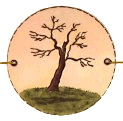 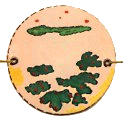 Replica of an antique thaumatrope, made by Henc R.A. de Roo. |
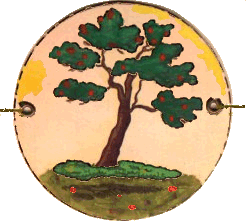 Thaumatrope Thaumatrope
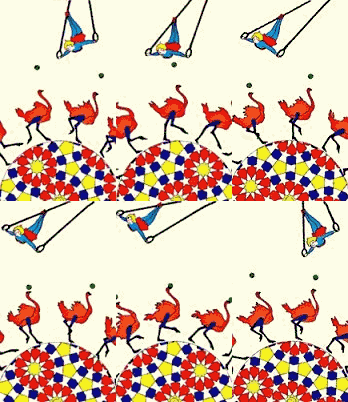
John Ayrton Paris invented the thaumatrope in England in 1824 to demonstrate the persistence of vision. It consists of one disc with two different images on both sides and a piece of string on either side of the disc. Both images are joined together by twisting the strings between the fingers, making the disc quickly revolve and change face. The bare tree gets back its leaves, a bird moves into its cage, etc., etc. |
 |
Stroboscope
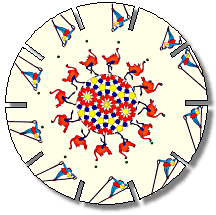
and Phenakisticope Two people, neither of whom knew anything about the other, invented the first wheels of this kind in 1832. Simon Ritter von Stamfer of Vienna in Austria, named his the stroboscope, while Joseph Antoine Ferdinand Plateau of Ghent in Belgium, called his the phenakisticope. These were the first instruments able to create the impression of a picture that actually moved. The movies and the modern cinema work on exactly the same principle. The wheels were usually mounted on a rod by a nail or 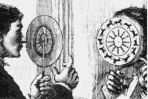 screw through the hole in the centre of the wheel.
One had to face the side with
the picture on it to an ordinary mirror, holding the rod in one hand. Then, by looking
at the reflection of the pictures through the slots round the edge of the
wheel and by spinning the wheel with the other hand, the pictures leaped into action. screw through the hole in the centre of the wheel.
One had to face the side with
the picture on it to an ordinary mirror, holding the rod in one hand. Then, by looking
at the reflection of the pictures through the slots round the edge of the
wheel and by spinning the wheel with the other hand, the pictures leaped into action.This wheel is one of twelve in THE BOOK OF MOVING PICTURES by Demi. 1979 Hutchinson of London. |
| Zoëtrope
|
|
 |
Praxinoscope
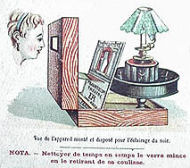
The problem with the zoëtrope
was
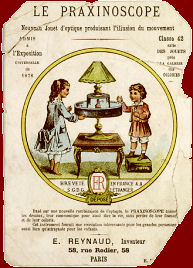
that the small slots did not let enough light through. In 1878 Emile Reynaud made an adaptation on the zoëtrope with mirrors instead of slots.
The mirrors were mounted on a polygonal drum at the centre of the shallow
cylinder, with a band of twelve coloured images set inside. The mirror
surfaces were equidistant between the axis and the picture strip so that
they reflected each picture for a brief moment as the toy revolved, giving a bright
and clear impression of movement without flicker. |
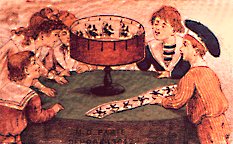 The
zoëtrope was invented by William Horner (1786 - 1837) and patented in 1834.
It was decades later before it was marketed in France (1860) and England and the
The
zoëtrope was invented by William Horner (1786 - 1837) and patented in 1834.
It was decades later before it was marketed in France (1860) and England and the
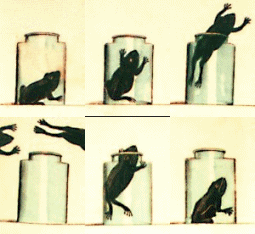 U.S. (1867).
  |
Praxinoscope
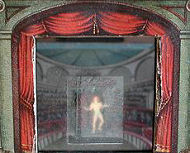
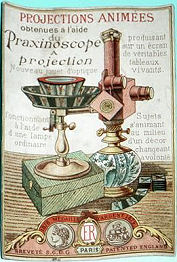
Theatre Reynaud continued to make refinements and improvements to his invention. His Praxinoscope Theater had surrounding background images to make the experience more complete. The mirror drum and shallow cylinder were set in a wooden box with a glazed aperture. The glass reflected a card with a background that was placed in a holder in the lid of the box. The moving figures, clowns, acrobats, playing children, were printed on black strips of paper and thus appeared superimposed on a suitable scene. The next development was the 'Praxinoscope à Projection', a projection praxinoscope for domestic use. In December 1888 Reynaud patented his 'Théatre Optique', a large scale Praxinoscope for public projection. |
 |
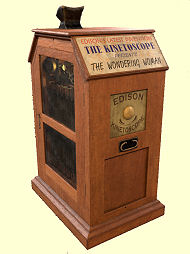 |
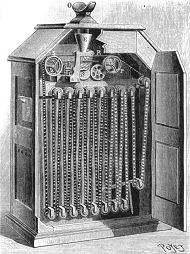
Kinetoscope The Kinetoscope is an early motion picture exhibition device, designed for films to be viewed by one person at a time through a peephole viewer window. It created the illusion of movement by conveying a strip of perforated film bearing sequential images over a light source with a high-speed shutter. First described in conceptual terms by U.S. inventor Thomas Edison in 1888, it was largely developed by his employee William Kennedy Laurie Dickson between 1889 and 1892. The Kinetoscope was not a movie projector, but it introduced the basic approach that would become the standard for all cinematic projection. |
 |
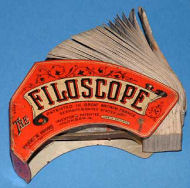 |
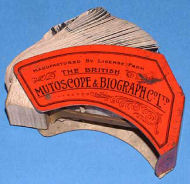
Flipbooks, Filoscope We all know the 'flipbooks', a picture series mounted as the leaves of a pad or book. Bending the book back and slipping the leaves from under one's thumb, brings the pictures into sight in such rapid succession that a very good motion picture is produced. |
 |
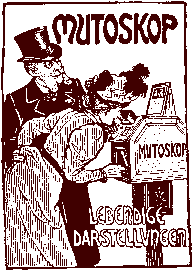 |
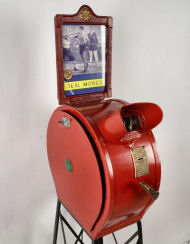
Mutoscope The principle of the flipbooks is used in a coin operated machine, the Mutoscope, invented by Herman Castler in 1895. The picture cards stood out from a drum to which they were attached by their bottom ends like rays of the sun, a thousand or more on a single drum, and these slipping from under a detent exhibited the pictures on them with smoothness and precision. The apparatus were placed in seaside resorts and pleasure parks, holding the public favour until the advent of the movie theatre. |
 |
|
More about
Pre-Cinema...... |
||
 
 |
©1997-2022 'de Luikerwaal' All rights reserved. Last update: 18-11-2022. |
 
|