 |
Dissolving views (part 1) |
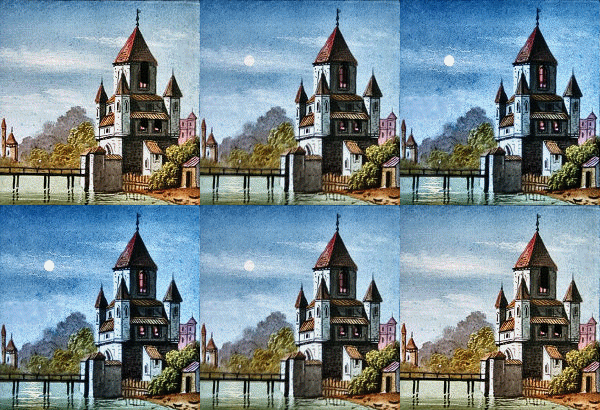 It was very special in the 17th and 18th centuries that large, colourful
images could suddenly appear on a wall in a dark room, but the fact that
these images could also be quickly changed made it even more mysterious,
especially when the scene on the wall changed into a similar scene,
making it seem as if it had come to life. For example, it became night
before the eyes of the viewer in the landscape that was previously
drenched in the sun, or a church was on fire while just moments earlier
people were walking peacefully across the church square. These
transitions could be achieved by quickly changing the lantern slides,
but it was of course much more real and magical if this took place
gradually. These gradual transitions from one scene to another became
known as dissolving views. It was very special in the 17th and 18th centuries that large, colourful
images could suddenly appear on a wall in a dark room, but the fact that
these images could also be quickly changed made it even more mysterious,
especially when the scene on the wall changed into a similar scene,
making it seem as if it had come to life. For example, it became night
before the eyes of the viewer in the landscape that was previously
drenched in the sun, or a church was on fire while just moments earlier
people were walking peacefully across the church square. These
transitions could be achieved by quickly changing the lantern slides,
but it was of course much more real and magical if this took place
gradually. These gradual transitions from one scene to another became
known as dissolving views.The special way in which interweaving magic lantern images are displayed required the presence of at least two lanterns that were placed either next to each other or on top of each other. They had to be positioned in such a way that their optical axes converge in one point, so that the circular planes of light they project onto the screen coincide exactly. Sometimes a mechanism on or in front of the lantern caused the projection of one image to disappear while the next appeared, sometimes the lanternist or his assistant manually covered a projection lens in turn. 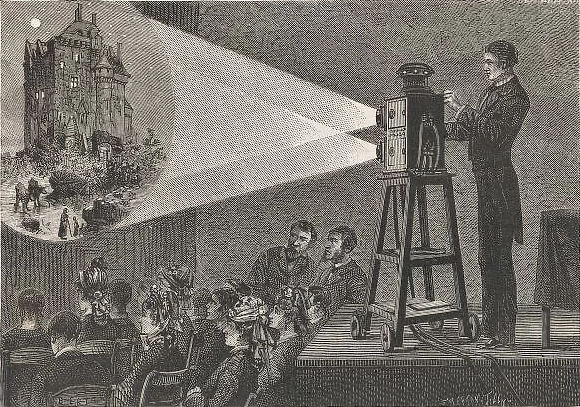 When using gas lighting with a gas regulator or electric lighting,
the alternating appearance and disappearance of the images could also be
achieved by controlling the light source in the lanterns. For best
results, biunials (two lanterns in one, placed one above the other) were
used, and later still triple lanterns or triunials, which allowed for
the addition of very sophisticated effects such as switching on the
lights in a building. Falling snow could be added to the images of the
changing of the seasons using an opaque strip with holes punched in it
(see below). When using gas lighting with a gas regulator or electric lighting,
the alternating appearance and disappearance of the images could also be
achieved by controlling the light source in the lanterns. For best
results, biunials (two lanterns in one, placed one above the other) were
used, and later still triple lanterns or triunials, which allowed for
the addition of very sophisticated effects such as switching on the
lights in a building. Falling snow could be added to the images of the
changing of the seasons using an opaque strip with holes punched in it
(see below).Until the early 1880s, almost exclusively hand-painted blends were made. Photographic plates were also used, but the blending usually consisted of transitioning from one scene to a completely different one, often without any relationship between the images. Photography was later used to color a few existing black and white negatives in different ways, which again made it possible to achieve a change from day to night, for example. This method was of course significantly cheaper than making two hand-painted plates. In the early 20th century, the popularity of blending faded as moving film began to develop even more impressive effects. The blends and blends that are still widely used in films, arise from the same visual effect. |
|
| What do we need? | |
 |
 |
||
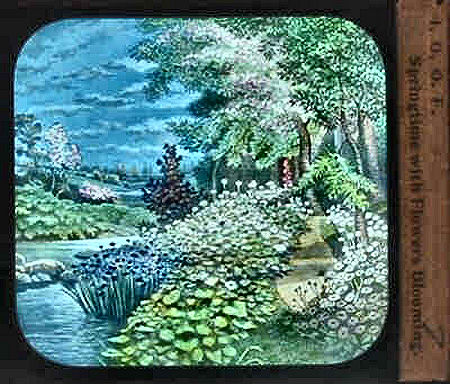
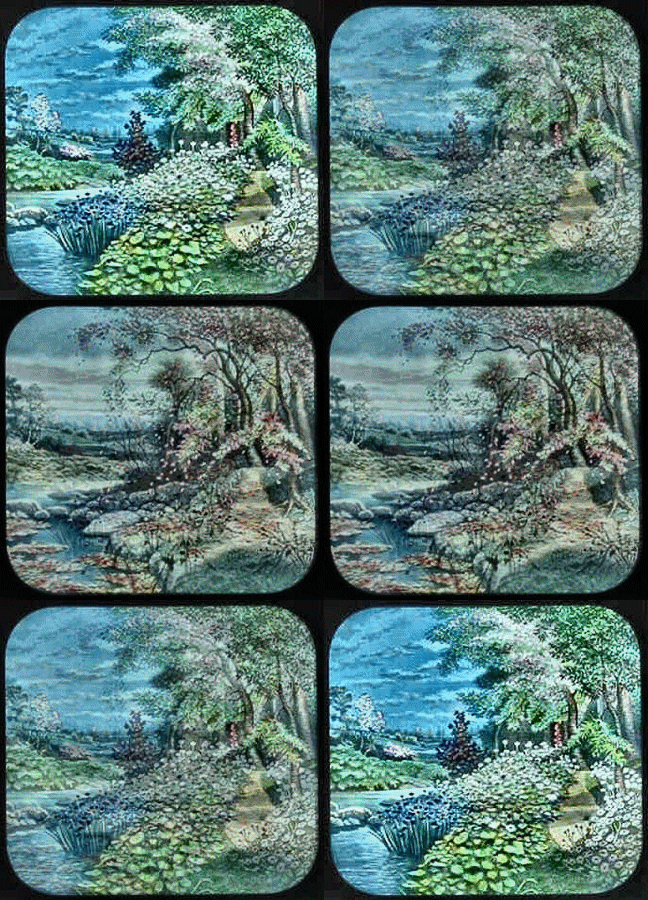
| Springtime with flowers blooming. |
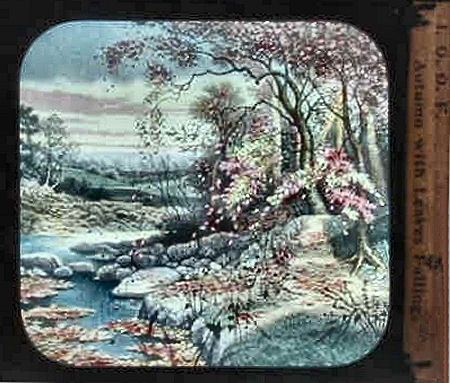
the slides | Autumn with leaves falling. |
|
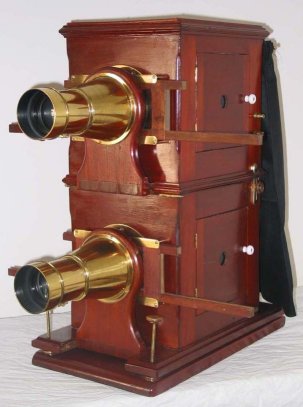
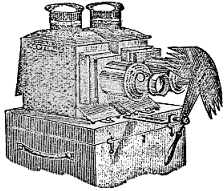
| the lantern This beautiful double lantern is possibly made by one John F. Hand (the name on the shield is difficult to read). Such a double lantern, also called a biunial lantern, is fitted for the highest class exhibition purposes. 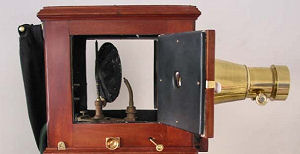 |
As the word bi-unial indicates
the lantern really consists of two in one. There are two
optical systems and two jets, one being placed above the other. This
position is for the convenience of the lanternist, so that he can manage
both lanterns without moving from the position in which he
stands. A triple or triunial lantern consists of, as you may guess,
three lanterns, placed above each other. Size 26 x 26 x 12 inches (65 x 65 x 30 cm). Optical lenses from Darlot (Paris). ca 1890. |
 |
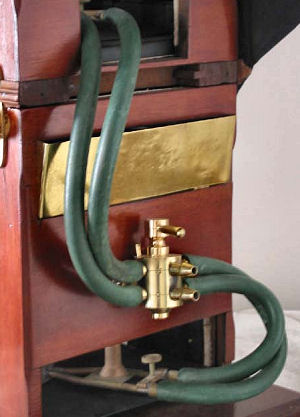 |
The arrangement of the
lanterns in which the two systems are placed one over the other in stead
of side by side, only became possible with the adoption of limelight illuminants. In those
days the control of the illuminant for biunial and triple lanterns was a
risky and difficult occupation. The light in one lantern had to be turned up to its full height before that in the other
began to diminish. To divide the gas to the burners, a dissolver, a system of dissolving taps, was
used. Lanternists of today have an easy time: they mostly use halogen lamps in their biunials, controlled by an electronic dimmer. |
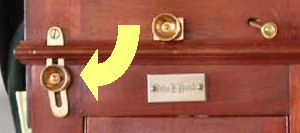
On the biunial was always a provision to adjust the two parts of the lantern to make sure that the projected images perfectly coincided. That way one picture could merge imperceptibly into another. In this case the adjustment is achieved by canting the upper lantern to the front. |
| the accessories | ||||||||||||||||||||||||||||||||||||||||||||||||||||||
|
|
|
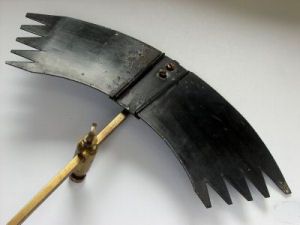
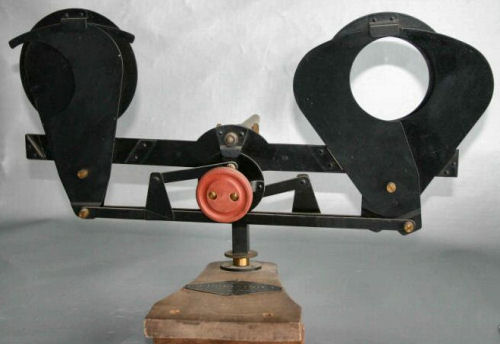
The
older lanterns were provided with a mechanical
dissolving arrangement consisting of a couple of metal screens, each
fitted with sharp notches on one edge. By a simple lever arrangement
these 'fans' were so moved that while one gradually covered the lens of
the right hand lantern, the other uncovered the lens of its neighbour.
Alternatively the brass discs on the front of the lens barrels could be
swivelled, one being manipulated by each hand. With the introduction of gas dissolvers for the gas supply, dissolving could be achieved by increasing the flame of one limelight burner as another was reduced. Photo left: This mechanical dissolve control has been manufactured by "Service des Projections Lumineuses de la BONNE PRESSE", 5 rue Bayard, Paris 8e, L'UNIVERSEL in the 1900's. This article is patented: S.G.D.G. |
 |
||
In
later years, particularly where a triunial was used, it became possible to add
further effects. The windows in a building could gradually 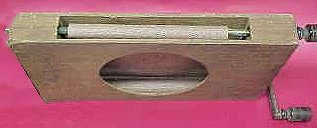 become
illuminated by using a slide that featured only the glowing windows and
was otherwise entirely black (see: Life
models, slide 3). During
many dissolving views suddenly some snow began to fall. This impressive
effect was contrived by means of a long strip of flexible opaque
material, pierced with tiny holes
and wound about two rollers in a light wooden framework. As the strip was passed upwards on to the
top roller by turning a little winch handle at the side of the frame, the snow
appeared to fall across the scene. become
illuminated by using a slide that featured only the glowing windows and
was otherwise entirely black (see: Life
models, slide 3). During
many dissolving views suddenly some snow began to fall. This impressive
effect was contrived by means of a long strip of flexible opaque
material, pierced with tiny holes
and wound about two rollers in a light wooden framework. As the strip was passed upwards on to the
top roller by turning a little winch handle at the side of the frame, the snow
appeared to fall across the scene.The operator had to take care that the handle was not turned in the wrong direction, which would cause the snow to fall upwards. |
 |
With the
increasing use of unframed glass slides in 3,25 x 3,25 en
3,25 x 4,25 inch formats, slide carriers became necessary. A
common, simple form is the duplex carrier for two slides, in which an
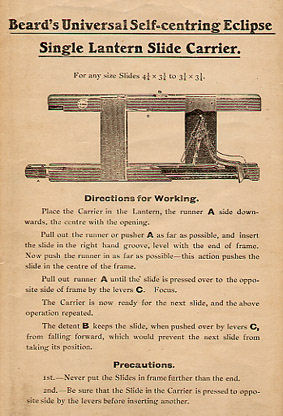
inner wooden frame slid from side to side. With the aid of aspecial slide holder, 'Beards Universal Self-centering Eclips Single Lantern Slide Carrier', the slide to be shown next was passed in front of the one being shown. When the latter was withdrawn, the former was pressed into focus by means of a spring. 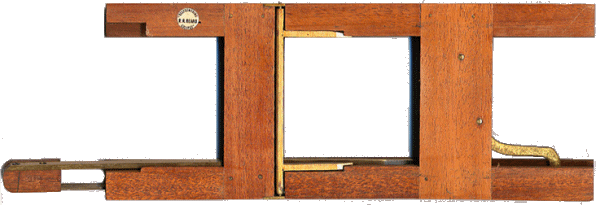 |
| The whole assembly is 28 cm (11”) long, 11,5 cm (4 1/2") high and 2 cm (7/10”) thick. The slide changer ‘runner’ on the bottom pulls out just over 15 cm (6”). According to the instruction leaflet it is suitable for any size slide from 3 1/4" x 3 1/4" to 4 1/4" x 3 1/4". Carrier has a small insert that says ‘R.R.Beard, Selfcentering Eclipse’ | |
|
the ambience |
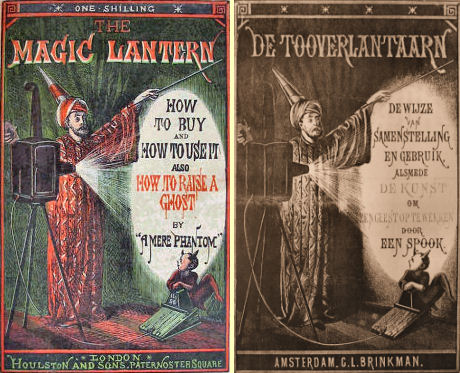
In his book 'The Magic Lantern. How to Buy and How to Use it' (Dutch version 'De Tooverlantaarn') A Mere Phantom describes a dissolving view as follows: |
- A noble palace, glowing in the golden beams of a setting sun, stands before us; its walls
glittering in their marble purity, filling the imagination like an
architectural dream, and forming the centre of a lovely landscape,
with a background of majestic mountains, at the foot of which a limpid
stream runs at its own sweet will, the cerulean heavens shedding a
charm over all that makes us think of "a better land;" when
lo ! a gradual indistinctness appears, the "insubstantial pageant
fades ;" the glow is gone ; a grey vapoury atmosphere succeeds ;
the river is ice ; the trees are bare and leafless ; the meadows and
gardens white and flowerless ; our spirits fall. But now the skaters
appear on the scene ; the snow falls, too, at
first slightly, then heavily, and the scene is half obscured, when
once more appears the enchanted palace, the everlasting hills, the
beauteous landscape, and the blue sky ; and when this scene
disappears, we go away filled with delight, and wondering HOW the charm was wrought.
- |
|
the result ! |
 |
 |
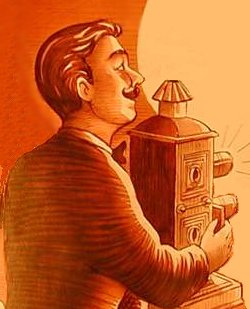
A computer animation of a dissolving view quickly produces large files. In reality, the lanternist will of course make the transition from one image to another much slower and smoother. |
|
| Some more nice examples of dissolving views | |
 |
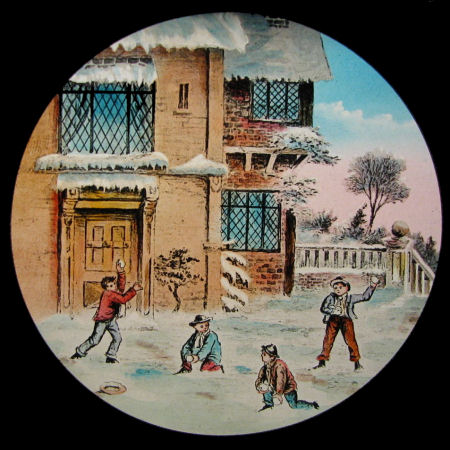 |
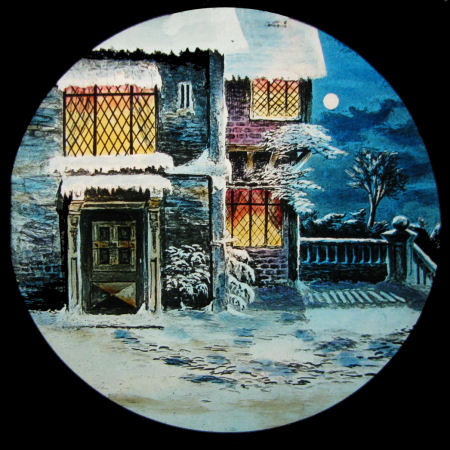
| It snowed
in the village last night. The next morning the youngsters are having a
good time. |
|
 |
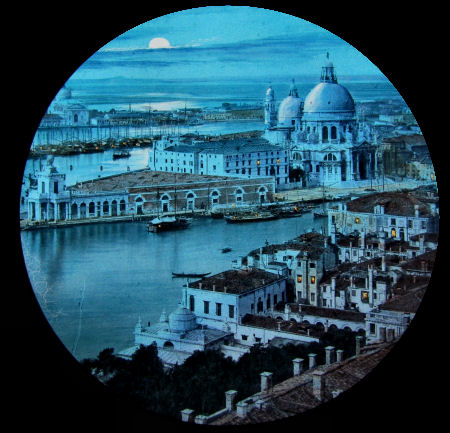 |
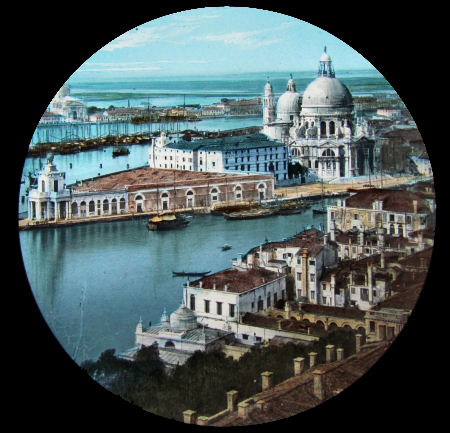
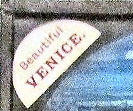 These two square magic lantern slides do not bear the name of the manufacturer, but do have a label with the name of the set 'Beautiful Venice'. |
|
 |
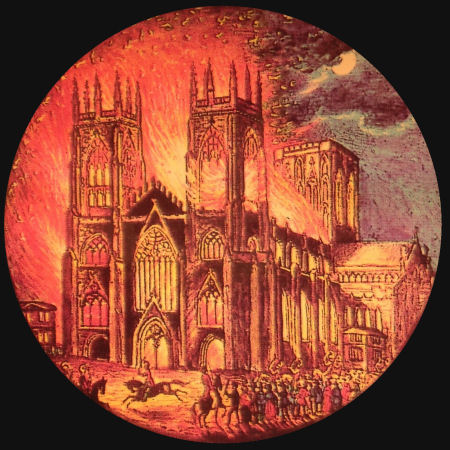 |
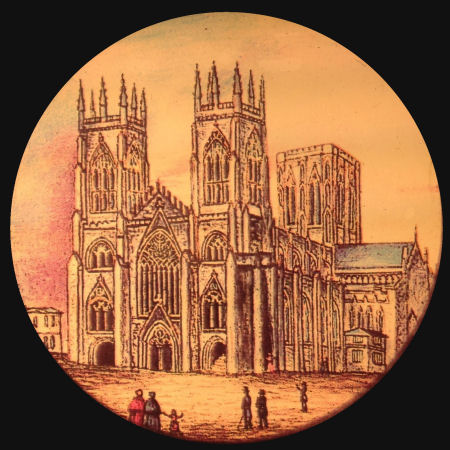
| It was
such a beautiful, peaceful day and no one could have imagined that a
terrible disaster would take place that evening. The fire in the
cathedral. |
|
 |
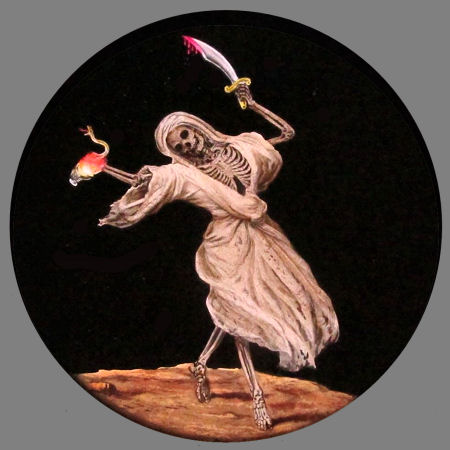 |
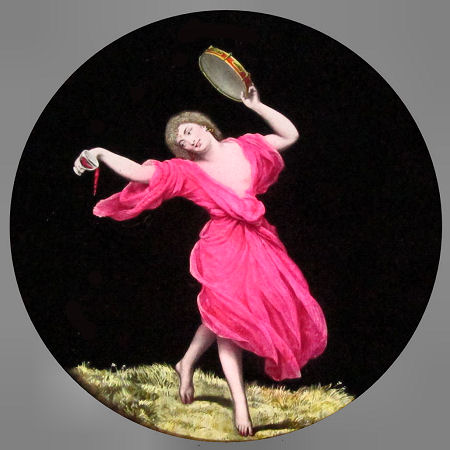
| Some
pretty macabre dissolving views. Look not upon the whine. A
beautiful woman with a cup of wine in het extended hand is transformed
into a ghastly skeleton, and a serpent appears in the cup. This
illustrates the words of Solomon: "Look not thou upon the wine when it
is red, when it giveth his colour in the cup, when it moveth itself
aright. At the last it biteth like a serpent, and stingeth like an
adder." (Prov. 23, 31/32). This slide was used by the
temperance campaign
to convert people to teetotalism. |
|
 |
|
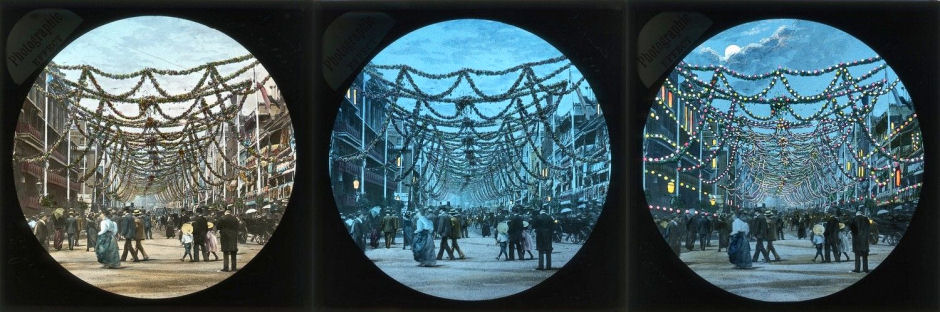
| This is a
set of three dissolving view slides size 3 1/4" x 3 1/4" (8.2 x 8.2 cm)
with images of St James Street in London by day, by night and with the
decorations illuminated for Queen Victoria's Diamond Jubilee. |
|
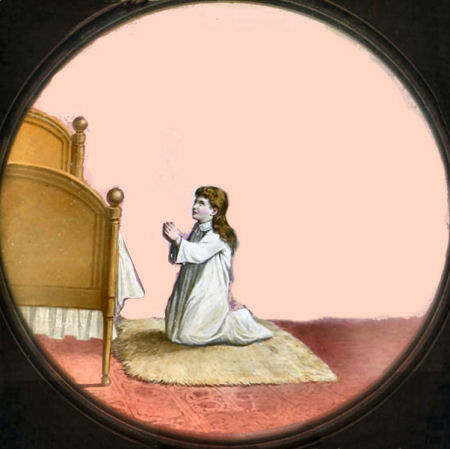
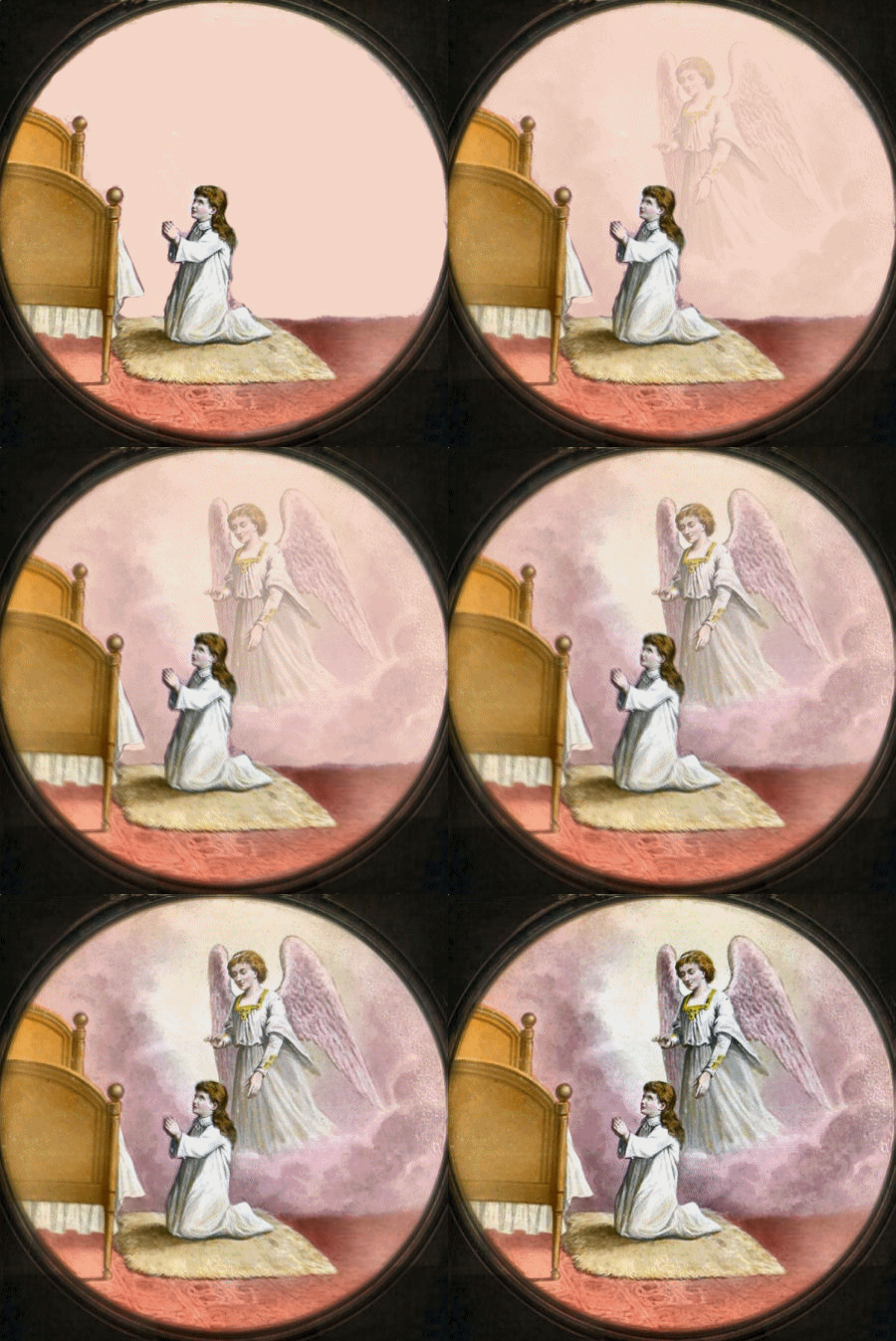
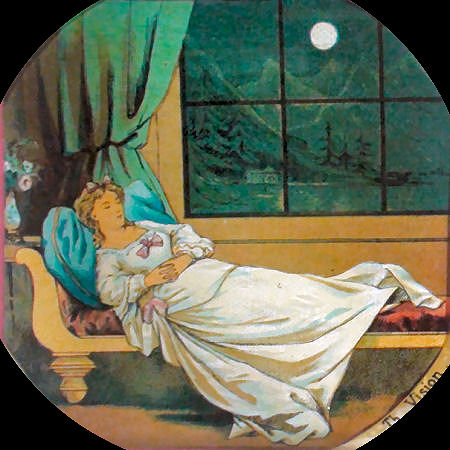
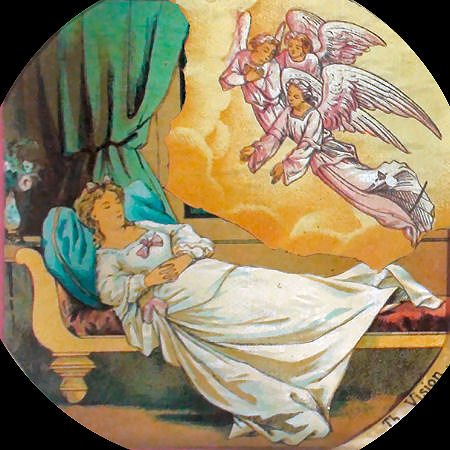
| It happened very often that angels came to visit by means of a dissoving view ..... | |
 |
 |
 |
 |
|
Much more
dissolving views ..........
|
 
 |
©1997-2023 'de Luikerwaal' All rights reserved. Last update: 06-11-2023. |
 
|