 |
|
| It's
not easy to classify the magic lanterns into groups. There is such a wide
variety of lanterns, that there will always be borderline cases and
exceptions. We can roughly divide the lanterns in toy lanterns, simple, at the time very cheap small lanterns for the children, the parlour lanterns which were somewhat larger and more expensive, and the large lanterns that were mainly used at lectures etc. Also the cinematographs, virtually simple filmprojectors, episcopes and biunials, can be considered as a separate group. Some extraordinary models remain, like the lampascopes and the street lanterns. The specimens shown on this page
mainly belong to
the collection of 'de Luikerwaal'. |
 |
Toy
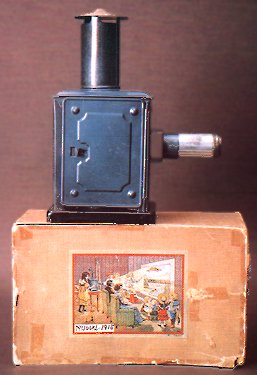
magic lanterns Example: c. 1900, Georg Carette & Co. type 244, complete with the original cardboard box. (see also: Magic Lanterns Georg Carette) Toy lanterns were intended to be used and operated by the children themselves. The light source was a candle or a simple oil lamp; the slides were only ca. 2 to 3 cm (about 1") width. |
| Parlour
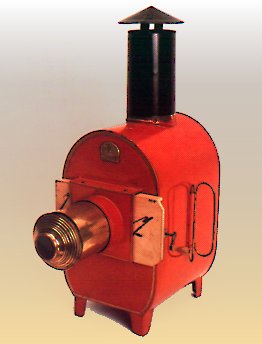
magic lanterns Example: 1890, Jean Schoenner, Nürnberg (see also: Magic Lanterns Jean Schoenner) Parlour lanterns were used for performances in the living room, at home. They were larger and more expensive than the toy lanterns and were mostly operated by father or an elder brother. The lamp and the lenses in the tube were more powerful and the slides were 5 cm (2") width or more. These lanterns were also able to present moving, mechanical slides in a wooden frame. |
|
|
|
Large
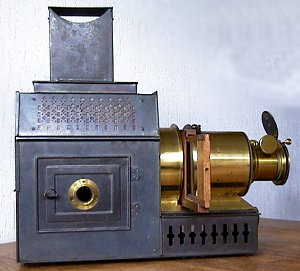
magic lanterns Example: ca. 1900, Made in France, Laterne Universelle C&G Paris. This lantern was used for more serious applications, like giving a public lecture or lessons to students. Powerful light sources like a three wicks refulgent lamp, burning mineral oil, carbon-point lamps and gas jets for limelight, made it possible to project from the back of the hall. The slides were 8,3 cm (3 1/4") square and were projected by means of a wooden double carrier. This sliding carrier made it easy to change the pictures rapidly. |
|
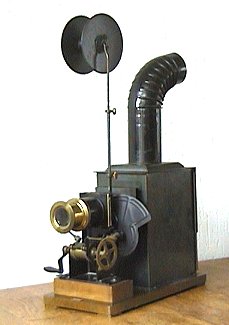
| Cinematographs (see also: Cinematographs) Example: ca. 1905, Gebrüder Bing Nürnberg. (See also Magic Lanterns Gebrüder Bing) To cope with the starting competition of the movie at the beginning of the twentieth century the magic lanterns were provided with an attachment that made it possible to show films (initially only loops, later on also films on small reels). The receiving reel is mostly lacking; the film simply lands on the floor. |
 |
|
 |
Episcopes and
epidiascopes (see also: Episcopes and epidiascopes) Example: Projectoscop, 1912, Germany, Bing Werke Nürnberg. Episcope for the projection of non-transparent pictures, like postcards. |
|
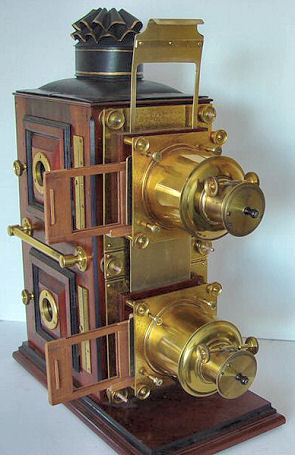 |
Biunials,
double lanterns (see also: Biunials) Example: Typical British style lantern (unsigned) from the penultimate turn of the century. Dimensions: height 25" (63.5 cm), length 20 1/2" (52 cm) (lenses pushed in) or 24" (61 cm) (fully extended). Base 19" x 10" (48 x 25,5 cm). |
|
| Special
lanterns:
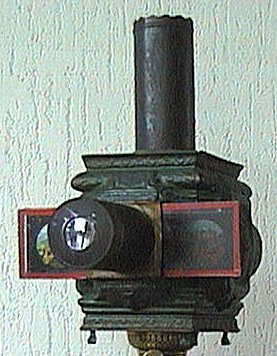
In addition to this there are some lanterns which are different from the lanterns above: Lampascoop Carré Example: 1880, France, Lapierre Frères. (See also: Magic Lanterns Lapierre) In the bottom of this lantern is a round hole that makes is possible to place the lantern on top of a large oil lamp. Such a lamp could be found in most families at that time. Therefore the purchase of a special lantern light source was not necessary. |
|
|

|
Street-
or pavement lanterns Example: 1918. Specially designed to project advertising pictures on the pavement in front of a shop, or on a wall across the street. Because of the chaos and damage this caused to traffic, the use of this lantern was soon officially forbidden. People suddenly stopped in their tracks and horses were scared to death and bolted. |
|
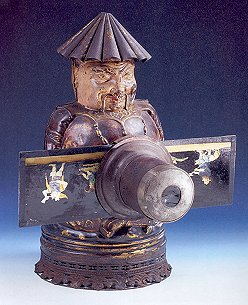
| Disguised
magic lanterns Lanterns that show at first sight as something else. (see also: Very special Magic Lanterns) Example: 'Buddha', 1870, France, Aubert. Very rare. House of lacquered tinplate. Photo: Sammlung Werner Nekes |
 |
|

|


 |
©1999-2015
'de Luikerwaal' All rights reserved. Last update: 25-09-2015. |

 
|